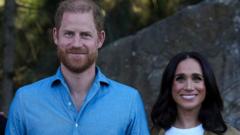
The coffee in the Sydney CBD tastes exactly as it did six years ago, but the air around the harbor feels heavier, or perhaps just emptier. In 2018, when Harry and Meghan first stepped onto Australian soil, the atmosphere was electric. It was a fever. People climbed poles and wept over a shared glance. Now, as the Duke and Duchess return for what the press calls a "pseudo-royal tour," the silence from the streets is louder than any cheering crowd could ever be.
Australia is a country that prides itself on being "no worries," but underneath that casual exterior lies a brutal pragmatism. We are a people who can spot a sales pitch from a kilometer away.
Consider a hypothetical bystander named Sarah. She works in a high-rise overlooking Circular Quay. In 2018, she might have snuck out of the office early, clutching a small plastic flag, hoping to catch a glimpse of the "Fairytale." Today, Sarah stays at her desk. She isn't angry. She isn't protesting. She just has a spreadsheet to finish, and the arrival of two wealthy expatriates from Montecito doesn't move the needle on her day.
This shift isn't just about a couple; it’s about the death of a specific kind of magic.
The Weight of the Invisible Crown
The problem with a royal tour that isn't a Royal Tour is that it lacks the one thing that makes the monarchy tolerable to a modern democracy: the burden of duty. When the Queen visited, there was a sense of a woman bound by a thousand-year-old contract. She was a symbol of service, whether you liked the institution or not.
Harry and Meghan arrive with a different energy. They are celebrities now. Influencers with a pedigree.
When they walk through a crowd, they are no longer representatives of a state; they are representatives of their own brand. Australians, by and large, are happy to buy into a brand if the product is good, but the "Sussex Product" feels increasingly like a solution in search of a problem. They speak of empathy and global impact, yet they do so from a height that feels inaccessible to a family in Western Sydney struggling with a thirty percent hike in their grocery bill.
The disconnect is visceral.
The couple’s itinerary looks familiar—meetings with youth groups, climate activists, and local dignitaries—but the scaffolding is gone. There is no official government mandate. No diplomatic objective. It is a performance of power without the responsibility of office.
A Nation Looking in the Mirror
Australia is currently wrestling with its own identity. The conversation around the Republic is never far from the surface, simmering like heat haze on a summer highway. For years, the argument for keeping the monarchy was built on "if it ain't broke, don't fix it."
But the Sussexes, through their very existence, have inadvertently broken the spell.
By stepping away from the "Firm" and then attempting to recreate the aesthetic of royal service on their own terms, they have highlighted the absurdity of the whole charade. If you can do the tour without the Queen’s permission, if you can wear the mantle of "Your Royal Highness" while living in a Californian mansion and signing Netflix deals, then what exactly is the point of the crown?
The indifference in the Australian streets is a symptom of a deeper realization. We are realizing that the "magic" was actually just a very expensive set of costumes.
Imagine a theater where the lead actors quit the production but kept showing up at the stage door to sign programs. At first, the fans are thrilled. Then, they start to wonder why they’re still hanging around the lobby when the play is happening inside without them. Eventually, the fans just stop coming to the lobby.
The Currency of Attention
We live in an attention economy. Harry and Meghan are masters of it, or they were. But attention is a volatile resource. It requires constant escalation.
In 2018, the hook was the wedding, the pregnancy, the newness of it all. In 2024, the hook is... what, exactly? A podcast? A documentary about the documentary?
The Australian public has moved on to more pressing dramas. We are worried about the Great Barrier Reef. We are worried about the housing crisis. We are worried about whether we can afford to retire. Against that backdrop, the sight of a motorcade whisking a prince to a private lunch feels less like a historical event and more like a traffic jam.
The stakes for the Sussexes are incredibly high. This trip was meant to prove their global relevance, to show that they still possess the "Diana Spark" that can ignite a continent. Instead, it has served as a quiet confirmation of their isolation.
They are stuck in a liminal space. Too royal to be normal, too normal to be royal.
The Human Cost of the Limelight
It is easy to be cynical, but there is a genuine tragedy at the heart of this narrative. Harry, a man who clearly loves the idea of service, seems to be searching for a way to be useful in a world that only wants to consume his trauma. Meghan, a woman of undeniable talent and drive, is trapped in a loop of self-justification.
They are trying to build a new world on the ruins of the old one, but they brought the old bricks with them.
Every time they lean into the royal aesthetic—the staged photos, the choreographed walks, the heavy security—they remind the public of the very thing they claimed they wanted to escape. It is a paradox that they cannot seem to resolve.
The "many Aussies" who weren't interested aren't necessarily "haters." Most of them don't spend their time writing angry comments on tabloid websites. They are simply the silent majority who have looked at the spectacle and decided it has nothing to offer them.
The silence isn't a protest. It's a shrug.
In the sun-drenched plazas of Melbourne and the windy corners of Hobart, life goes on. People buy their lattes, they catch their trains, and they talk about the footy. The Duke and Duchess pass through like ghosts of a monarchy we haven't quite decided to bury yet, haunted by the memory of a time when their presence felt like it actually meant something.
As the sun sets over the Opera House, the light hits the white sails just right, a reminder of things that endure. The building stays. The harbor stays. The people stay. The visitors, no matter how many titles they carry or how many cameras follow them, are just passing through, leaving no footprints on the sand.