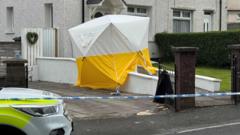
The flashing lights never look natural against the dark green of pine trees. They turn the needles a strange, neon purple, pulsing every two seconds. On a Tuesday evening, that light rhythmically cut through the mist rising off the still water of the local reservoir. A mile away, in a small brick semi-detached house with a manicured front lawn, a different set of lights cast the same jarring glow against a bedroom window.
Two scenes. Connected by an invisible thread.
Most people read about these moments in twelve-line blurbs on a news app. A woman dies in her home following a suspected assault. A man’s body is recovered from a body of water hours later. The words are clinical, scrubbed clean of blood, history, and the devastating weight of what actually happened. The police report offers a skeleton. It tells us the what, the where, and the when.
It completely ignores the who and the why.
To understand how a quiet street ends up taped off by investigators, you have to look past the yellow plastic barriers. You have to look at the ordinary days that came before the flashing lights. Tragedy does not materialize out of thin air. It builds. It breathes. It occupies the spaces we choose not to look at too closely.
The Weight of the Unspoken
Consider the neighbors. On any ordinary afternoon, they watched the couple carry groceries from the trunk of their car. They exchanged polite nods over the garden fence. There were no loud screaming matches in the driveway. No broken windows. No obvious distress signals that would justify dialing emergency services.
Isolation is a quiet room.
It grows slowly, a fraction of an inch at a time, until a person is entirely cut off from the people who live just twenty feet away. In communities everywhere, this silence is treated as privacy. We congratulate ourselves on minding our own business. We tell ourselves that what happens behind a neighbor’s curtains is their own affair, a sacred boundary of modern life.
But privacy becomes a dangerous commodity when it transforms into a fortress.
The human mind is built to seek patterns. When we look at a tragedy after the fact, we desperately search for the inflection point. We want to find the exact moment everything went wrong, because if we can pinpoint it, we can convince ourselves that our own lives are safe. We want a monster with a visible snarl. We want an obvious villain.
The reality is far more terrifying.
The reality is that the descent is often polite. It is a slow withdrawal from Friday night gatherings. It is a phone call that goes unanswered, followed by a text message saying, "Just tired tonight, catch up next week." It is the gradual fading of a person from the social fabric of their own life until their absence is no longer noticed.
The Echoes in the Water
The reservoir was built fifty years ago to supply clean water to three surrounding towns. It is a place where families teach their children to fish on Saturday mornings. It is where runners track their miles along the gravel perimeter path. It is a public utility, a symbol of civic planning and community health.
Suddenly, it is a crime scene.
When a life ends in a body of water that thousands of people drive past every single day, the geography of a town shifts permanently. The water is no longer just water. The gravel path is no longer just a place to jog. The collective memory of a community absorbs the trauma, rewriting the meaning of familiar landmarks.
Divers went into that cold water because a vehicle was found abandoned on the causeway. Think about that walk from the driver’s side door to the water's edge. It is a walk taken in absolute certainty or absolute despair, two states of being that look remarkably similar from the outside.
The police will compile their timeline. They will match the tire tracks on the gravel to the vehicle. They will estimate the time of death based on water temperature and lung capacity. They will file the paperwork in a steel cabinet, and a clerk will stamp it closed.
The case is resolved. The problem is not.
The Architecture of Control
We often talk about domestic harm as if it is an explosion. We use words that suggest a sudden, uncontrollable burst of anger. This framing is a comforting lie. It suggests that violence is anomalous, an unpredictable weather event that no one could have foreseen.
It is almost never a weather event. It is an architecture.
Every pillar of that architecture is designed to reduce the size of a victim's world. Consider the subtle ways choices are stripped away. It begins with small critiques of friends, a gentle suggestion that a sibling is being manipulative, or a sudden financial complication that requires shared account access. These are not explosive acts. They are administrative.
By the time the physical assault occurs, the victim is frequently standing on a tiny island of their own existence, with no bridges left to the mainland.
Look at the statistics compiled by advocacy groups over decades. The patterns are uniform across geographic lines, income brackets, and cultural backgrounds. The escalation follows a predictable script, yet we continue to act surprised when the final act plays out on the evening news.
The real problem lies elsewhere. It lies in our collective inability to read the script while it is being performed.
We are trained to look for black eyes and broken bones. We are not trained to look for the chilling compliance of someone who checks their phone every three minutes to ensure they haven't missed a call. We do not notice the subtle panic when a casual conversation runs five minutes later than scheduled.
The Cost of Looking Away
A woman is gone. A man is gone. Left behind is a house filled with half-finished cups of coffee, unwashed laundry, and a calendar on the refrigerator door with appointments marked for next Thursday.
The suddenness of a violent end leaves the physical world intact. The contrast is jarring. The mail carrier still drops letters through the slot. The automated lawn sprinkler still whirs to life at dawn, casting a fine mist over the grass where investigators stood just hours before.
The neighborhood feels a collective shudder. People stand on their porches, looking toward the house with the drawn blinds. They speak in hushed tones, offering the standard refrains.
"They seemed so quiet."
"He was always very polite when he mowed the lawn."
"You just never really know what goes on behind closed doors."
That last phrase is the most dangerous one we use. It is an admission of defeat disguised as a philosophical truth. It shrugs off responsibility, treating the home as an impenetrable black box that no amount of human empathy or intervention could possibly penetrate.
But doors have handles. They have hinges. They can be knocked on.
The hesitation to interfere is rooted in a fear of awkwardness. We worry about being intrusive. We fear making an assumption that turns out to be wrong, creating an uncomfortable social interaction at the next block party. We weigh that potential awkwardness against a nagging feeling that something is wrong, and most of the time, the fear of social embarrassment wins.
We have to look at that equation honestly. We have to weigh the discomfort of an awkward conversation against the absolute finality of a reservoir at midnight.
Rebuilding the Social Fabric
This is not a call for vigilantism or constant surveillance of our peers. It is a plea for the restoration of genuine connection. In an era where we are more connected through digital networks than at any point in human history, we are paradoxically more isolated from the people who live across the hallway.
We know what our favorite influencers ate for breakfast, but we do not know the name of the woman who lives at number forty-two.
The solution does not involve sophisticated technology or complex policy frameworks. It involves the difficult, unglamorous work of being present in our physical communities. It means noticing when the patterns change. It means having the courage to ask a direct question and the patience to listen to an uncomfortable answer.
Imagine the difference a single, persistent conversation might make. Not a confrontation. Just an authentic inquiry. A quiet acknowledgment that someone seems stressed, or tired, or distant.
It might be rejected. The person might pull away further. But it creates a crack in the wall of isolation. It lets a single ray of outside reality into that tiny, shrinking island. It reminds the person that they are seen, that their existence matters to someone outside the walls of their home.
The police have cleared the yellow tape from the reservoir path. The runners are back, their sneakers crunching against the gravel in the morning light. The water is still, reflecting a clear blue sky as if nothing ever happened beneath its surface.
The house on the quiet street stands empty. The neon lights are gone, replaced by the dull grey of an overcast afternoon. The lawn will grow tall over the coming weeks, a visible sign of an interrupted life, waiting for someone to notice that the rhythm of the house has stopped entirely.