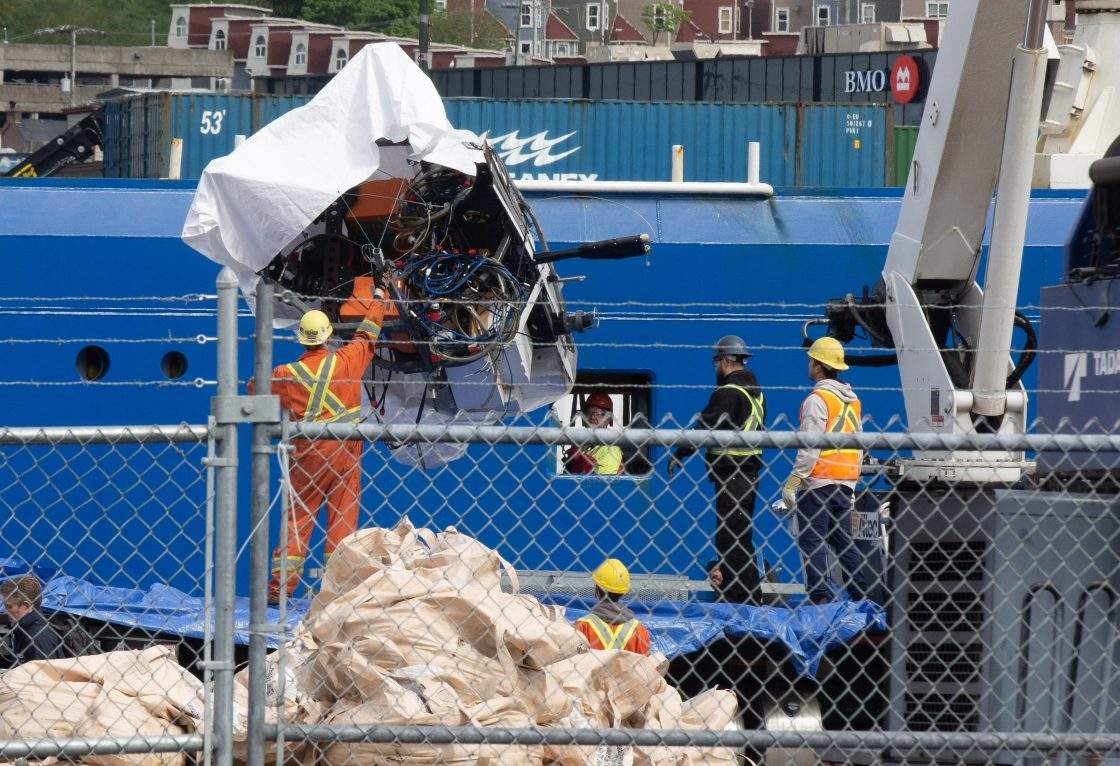
The Transportation Safety Board of Canada released its report on the Titan submersible disaster, and the predictable chorus of bureaucratic finger-pointing has begun. The consensus screaming from the headlines is lazy: Canada failed because it didn't regulate a rogue operator. Critics are demanding more oversight, tighter borders, and a thicker blanket of red tape to ensure an experimental carbon-fiber tube never slips through a Canadian port again.
They are asking the wrong question. They want to know who failed to stop Stockton Rush, when they should be asking why anyone believes a government inspector with a clipboard can assess the structural fatigue of an unclassified, experimental vessel operating in international waters. You might also find this connected story interesting: The Capital Structure of DeepSeek and the Wealth Engine of Liang Wenfeng.
The belief that more domestic regulation would have saved the Titan is a dangerous myth. It misunderstands maritime jurisdiction, misdiagnoses the nature of extreme engineering, and provides a false sense of security that will actively jeopardize future innovation.
The Jurisdictional Shell Game
The TSB report laments that the Titan operated inside a regulatory gray zone. That is not an oversight; it is a feature of international maritime law. As extensively documented in recent articles by Mashable, the effects are widespread.
The Titan was a Bahamas-registered vessel owned by a US company, deployed from a Canadian-flagged ship (the Polar Prince), into international waters. To pretend that a Canadian port authority could—or should—have stepped in and halted the operation displays a fundamental ignorance of how global shipping works.
Let’s dismantle the premise of the "regulatory gap."
- Flag State Sovereignty: A country's jurisdiction ends where international waters begin. The Polar Prince was a surface vessel operating legally. The Titan was a cargo payload until it hit the water.
- The Port State Control Illusion: Port states inspect ships for basic safety compliance (lifeboats, fuel leaks, crew certification). They do not, and cannot, reverse-engineer proprietary experimental deep-sea submersibles sitting on the deck of a transport ship.
- The Chilling Effect of Bureaucratic Overreach: If Canada had seized the Titan, OceanGate would have simply loaded the sub onto a vessel departing from an island nation with zero maritime infrastructure.
I have watched tech companies spend millions dodging localized regulations by simply moving their physical deployment hubs fifty miles down the coast. Pushing extreme exploration into back-alley jurisdictions does not make it safer. It makes it invisible.
Classification is Not an Insurance Policy
The loudest critique leveled against OceanGate was its refusal to "class" the Titan through organizations like Lloyd’s Register or the American Bureau of Shipping (ABS). The lazy narrative says: Classing equals safety, non-classing equals negligence.
This is a failure to understand what classification societies actually do.
Classification societies are backward-looking institutions. They write rules based on historical data and proven engineering archetypes. They are exceptional at ensuring a steel-hulled container ship or a standard titanium deep-submergence vehicle (DSV) doesn't sink.
Standard DSV: Steel/Titanium Hull -> Predictable Fatigue -> Easy to Class
Titan DSV: Carbon Fiber Hull -> Acoustic Monitoring Only -> Impossible to Class
When dealing with a novel carbon-fiber-and-titanium hybrid hull subjected to cyclic loading at 4,000 meters, there was no existing standard to test against. A classification society wouldn't have made the Titan safer; they simply would have refused to review it, or worse, applied outdated steel-fatigue metrics to an anisotropic composite material.
The downside of my contrarian stance is uncomfortable: without classification, you rely entirely on the integrity of the operator's internal testing. OceanGate’s internal testing was criminally flawed. They relied on real-time acoustic monitoring to detect hull degradation instead of rigorous non-destructive testing (NDT) between dives.
But mandating traditional classification for radical engineering concepts is a death sentence for innovation. If we applied the TSB’s logic retroactively, the Wright brothers would have been grounded for lacking an airworthiness certificate from a railroad commission.
The Flawed Questions People Keep Asking
The public post-mortem has generated a series of flawed assumptions that need to be dismantled brutally.
Why didn't Canada stop a vessel using a commercial gaming controller?
This is a favorite talking point for late-night hosts and low-effort journalists. It is irrelevant. The aerospace and defense industries use off-the-shelf gaming controllers constantly. The US Navy uses Xbox controllers to operate periscopes on Virginia-class submarines. Why? Because they are ergonomically superior, highly reliable, and easily replaceable. Focusing on the controller is a distraction from the real point of failure: acoustic monitoring as a primary safety metric for a brittle composite hull.
Shouldn't we ban extreme tourism altogether?
Ban it where? In international waters? Good luck enforcing that without a global maritime police state. Furthermore, the line between "extreme tourism" and "scientific exploration" is entirely semantic. Deep-sea exploration has always been funded by wealthy patrons, eccentric billionaires, or governments with geopolitical axes to grind. Cutting off private capital doesn't stop the risks; it just ensures only militaries get to see the ocean floor.
Actionable Realism for Deep-Sea Tech
Stop looking to governments to draft laws for environments they cannot reach. If the maritime industry wants to prevent another catastrophic implosion, the solution must be technical and operational, not bureaucratic.
- Mandate Open-Source Telemetry: Any experimental craft operating in international waters should be required by its insurance underwriters (the only entity with actual leverage) to broadcast real-time hull integrity and telemetry data to an open, shoreside repository. Transparency, not regulation, is the ultimate disinfectant.
- Enforce Strict Liability for Operators: Eliminate the liability waivers signed by passengers if the operator skips independent peer-review testing. If an executive knows their personal wealth and freedom are tied directly to the structural calculus of a hull, the appetite for shortcuts vanishes.
The TSB report is a monument to hindsight bias. It assumes that because an event ended in tragedy, a bureaucratic mechanism must have failed. The uncomfortable truth is that human exploration has always advanced through high-stakes failure. Pretending Canada could have saved the Titan with a few more signatures is a fairy tale told to comfort a public that has forgotten the cost of reaching the frontier.