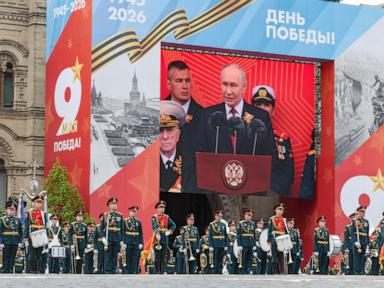
Moscow’s Red Square has long served as the ultimate stage for Kremlin power, a place where the roar of heavy engines and the glint of nuclear-capable missiles signal national invulnerability. But the most recent Victory Day celebrations told a different story, one written in the conspicuous absence of modern hardware. What was once a gargantuan display of industrial-military might has devolved into a tightly scripted, scaled-back ceremony that reveals more about the state of the Russian military than any official briefing ever could. The primary reason for this diminished parade is simple: the armor intended for the cobblestones of Moscow is currently burning or bogged down in the mud of Ukraine.
While the Kremlin attempts to frame the minimalist approach as a security necessity or a somber nod to ongoing efforts, the reality is a logistical and political crisis. The parade featured a single, lonely T-34 tank—a relic of World War II—leading the column. There were no modern T-90s, no T-14 Armatas, and no infantry fighting vehicles of the caliber seen in previous decades. This isn't just about optics. It is a loud, ringing admission of resource exhaustion.
The Logistics of a Hollowed Out Arsenal
To understand why the Red Square parade has shrunk, you have to look at the attrition rates on the front lines. Military analysts tracking equipment losses have documented thousands of destroyed Russian tanks and armored vehicles. In a functional war economy, a nation might keep a few dozen modern units back for the sake of domestic morale. Russia no longer has that luxury.
The decision to omit modern main battle tanks from the parade suggests that every operational unit is either deployed, being repaired, or held in reserve for immediate shipment to the front. When a superpower cannot spare ten modern tanks for its most important national holiday, the narrative of "unlimited resources" collapses. The T-34, while a symbol of the Great Patriotic War, served as a painful reminder that the current military is cannibalizing its heritage to mask a lack of contemporary hardware.
The Security Paranoia Behind the Scenes
It wasn't just the hardware that was missing. The atmosphere in Moscow has shifted from celebratory to deeply anxious. For the first time in years, the "Immortal Regiment" marches—where citizens carry photos of ancestors who fought in WWII—were canceled across the country. Officially, this was due to "security concerns." Unofficially, the state feared that people might bring photos of sons and husbands killed in the current conflict, turning a state-sanctioned celebration into a mass demonstration of grief and dissent.
The Kremlin’s biggest fear is the merging of historical pride with present-day frustration. By canceling the public marches and thinning out the parade, the government effectively sanitized the event, ensuring that the only voices heard were those of the high-ranking officials on the dais. The square was a fortress, shielded by layers of electronic jamming and elite security details, reflecting a leadership that is increasingly isolated from the population it claims to lead.
The Failure of the Armata Dream
For years, the T-14 Armata was touted as the future of armored warfare, a "game-changing" (to use the jargon of the defense industry) platform that would make Western tanks obsolete. Its recurring absence from recent Victory Day parades is the definitive proof of its failure. A tank that cannot be produced in meaningful numbers is not a weapon; it is a prop.
The Armata’s absence highlights a broader systemic collapse within the Russian defense-industrial complex. Sanctions have choked the supply of high-end Western components, specifically the thermal imaging and fire-control systems that modern tanks require. Russia’s attempt to pivot to domestic or Chinese-sourced chips has met with significant technical hurdles. The result is a military that is moving backward in time, refurbishing 1960s-era T-62s from deep storage because it cannot manufacture enough T-90Ms to replace its losses.
A Masterclass in Managed Perception
Despite the glaring gaps in the lineup, Russian state media worked overtime to present the parade as a show of "restraint" and "focus." This is a classic Soviet-style pivot. When you lack the strength to intimidate, you pretend that your weakness is actually a calculated choice. The speeches delivered atop the Lenin Mausoleum focused on Western "aggression" and the existential nature of the current struggle, attempting to wrap the lack of equipment in a blanket of national sacrifice.
But perception management only works when the audience is willing to believe. For the families of soldiers and the veterans of past conflicts, the sight of a single vintage tank was a jarring disconnect. The Russian public is highly attuned to the language of military strength; they know what a "real" parade looks like. The 2024 display looked less like a superpower and more like a regional power struggling to maintain appearances.
Air Power and the Threat of the Sky
The total cancellation of the aerial flyover in recent years is perhaps the most telling indicator of the Kremlin’s vulnerability. In previous years, dozens of fighter jets and bombers would roar over Moscow in complex formations. Now, the skies remain empty. The official line often cites weather conditions, even when the sun is shining.
The true reason involves a combination of two factors: air defense saturation and maintenance fatigue. Every airframe is being pushed to its limit in the southern theater. Furthermore, the threat of small, long-range drones has become a persistent nightmare for Russian security services. Bringing a massive fleet of aircraft over the capital requires lowering certain air defense protocols to avoid friendly fire, creating a window of opportunity that the Kremlin is no longer willing to risk. They are effectively being held hostage by the possibility of a single, cheap drone ruining a billion-dollar optics campaign.
The Global Audience is Not Impressed
While the parade is largely a domestic tool for reinforcing nationalism, it also serves as an annual sales brochure for the global arms market. India, Vietnam, and various African nations have historically looked to the Red Square parade to see what they should buy next. That sales pitch is now in shambles.
When potential buyers see that the Russian military cannot even field a battalion’s worth of modern gear for its own celebration, they look elsewhere. The "brand" of Russian military hardware is currently suffering from a catastrophic loss of prestige. Why invest in Russian armor when the manufacturer itself is forced to field museum pieces? The economic fallout of this reduced display will be felt for decades as Russia loses market share to competitors who can actually deliver on their technological promises.
The Human Cost of the Display
Behind the polished boots of the marching soldiers lies a grim reality of recruitment and retention. Many of the units that traditionally march in the parade have suffered staggering casualty rates. To fill the ranks on the cobblestones, the military has had to pull instructors from academies and cadets who haven't finished their training.
The "veterans" sitting in the stands are increasingly those who fought in the 1940s, while the soldiers of the current era are noticeably absent or sequestered. There is a profound irony in celebrating a victory over fascism while the current generation of Russian youth is being fed into a meat-grinder of a war that lacks a clear exit strategy. The parade is no longer about honoring the dead; it is about distracting the living.
The End of the Red Square Era
The scaled-down parade is not a one-off event. It is the new normal. Russia has entered a period of long-term military and economic degradation. The grand spectacles of the early 2010s, which signaled a resurgent Russia, are now a historical anomaly.
What we are witnessing is the dismantling of a myth. The myth that Russia can maintain a world-class military while its economy is smaller than that of Italy. The myth that its defense industry is immune to Western pressure. The myth that the Kremlin can hide the costs of its geopolitical ambitions behind a few hours of televised pageantry.
The lone T-34 is the most honest thing to come out of Moscow in years. It is a confession. It tells us that the empire is tired, the warehouses are thinning, and the glory that the state so desperately tries to project is now a dwindling resource. The cobblestones of Red Square haven't changed, but the weight of the boots walking over them has never felt heavier.
The era of the "Great Russian Parade" ended when the first tanks crossed the border into Ukraine, and no amount of television editing or patriotic rhetoric can bring it back.



