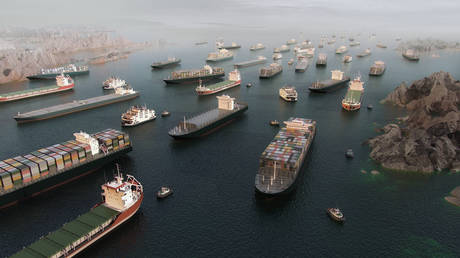
The steel hull of a container ship vibrates with a low, bone-deep hum that never stops. For a twenty-four-year-old third mate standing watch in the Strait of Hormuz, that vibration is the only comforting reality. Everything else is tension. To his left, the jagged, sun-bleached cliffs of Oman rise out of the haze. To his right, the low coastline of Iran stretches into the distance. Beneath him lies a shipping lane so narrow that giant vessels must navigate a passage only two miles wide to enter or leave the Persian Gulf.
This is the choke point. One-fifth of the world’s petroleum passes through this suffocatingly tight corridor of water every single day. If you are watching a radar screen here, you are not just monitoring traffic. You are watching the volatile friction point of global geopolitics. Meanwhile, you can explore similar developments here: The Cold Strategy Behind Chinas Support for Indias BRICS Leadership.
Imagine the radar screen blips. A fleet of fast-attack craft, low to the water and moving at forty knots, emerges from the shadow of an island. They bear no clear markings. They do not respond to standard radio hails on the international maritime distress frequencies. On the bridge of a commercial tanker, or worse, a United States Navy destroyer, the seconds begin to bleed away.
Is this a routine patrol? An aggressive posture meant for domestic television cameras? Or is it the opening salvo of a conflict that could freeze global energy markets, spike gas prices by forty percent overnight, and drag nuclear-armed superpowers into an unwanted war? To understand the full picture, we recommend the detailed article by USA Today.
For decades, the answer to that question depended on guesswork, instinct, and luck. If an American commander needed to talk to an Iranian counterpart to say, “We are turning port to avoid a collision, do not fire,” the message had to travel an absurd, agonizingly slow path. It went from the ship to a naval headquarters in Bahrain, up to the Pentagon in Washington, over to the Swiss Embassy in Tehran—which acts as the diplomatic intermediary because the US and Iran have no formal relations—then to the Iranian Foreign Ministry, and finally down to the local Islamic Revolutionary Guard Corps Navy commander.
By the time the message arrived, the ships would have already collided. Or the missiles would have already flown.
Now, a quiet, technical shift is fundamentally altering that calculus.
The Anatomy of an Accidental War
Miscalculation is the great, uncredited author of human history. Wars rarely start because everyone at the table explicitly decided Tuesday was a splendid day for a massacre. They start because someone misread a signal, panicked, and pushed a button they could not unpush.
In the Strait of Hormuz, the margin for error is essentially zero. The physical geography forces warships into uncomfortably close quarters. When a US carrier strike group transits the strait, Iranian speedboats routinely buzz within hundreds of yards of the massive vessels. It is a high-stakes game of chicken played with live ammunition.
Consider the sheer sensory overload inside a modern combat information center. The air conditioning is freezing, humming loudly to keep the massive server racks from overheating. Blue light bathes the faces of operators staring at automated tracking systems. Alarms chirp. Synthetic voices announce incoming data. In this environment, adrenaline is a liability. Human beings under extreme stress suffer from tunnel vision. They interpret ambiguity as hostility.
If an Iranian drone flies too close to an American helicopter, the American pilot has seconds to decide whether to deploy flares, execute evasive maneuvers, or engage. If they shoot, the chain reaction begins.
This is not a hypothetical anxiety. In 1988, amidst the chaos of the Iran-Iraq War, the USS Vincennes mistakenly shot down an Iranian civilian airliner, Iran Air Flight 655, killing all 290 people on board. The crew of the American cruiser, operating under intense psychological stress after skirmishing with Iranian gunboats, convinced themselves the descending Airbus A300 was a diving F-14 Tomcat fighter jet. It was a tragedy born entirely of a breakdown in communication and situational awareness.
The terrifying truth of the modern era is that technology has compressed decision-making windows from hours to milliseconds. Automated defense systems can track and destroy threats faster than a human being can blink. But those systems lack context. They do not know if an aggressive maneuver is a deliberate act of war or a junior officer making a steering mistake.
To prevent the machine from taking over, humans need a way to talk. Directly. Instantly.
The Wire That Spans the Chasm
The establishment of a direct communications hotline between the naval forces of Iran and the United States is an exercise in profound pragmatism. It is an acknowledgment that while two nations may disagree on almost everything—from regional hegemony to nuclear proliferation—they share a mutual interest in not blowing each other up by accident.
Establishing this link is less about high-tech engineering and more about bureaucratic courage. It requires creating a secure, dedicated channel that bypasses the theatrical posturing of public diplomacy.
Think of it as a digital version of the famous Cold War "Red Telephone" that connected the White House to the Kremlin after the Cuban Missile Crisis. That phone wasn't actually red, and it wasn't a telephone; it was a teletype machine. The color was a metaphor for urgency. The medium was text because text reduces the chance of vocal inflection being misconstrued as anger or weakness.
The Hormuz hotline operates on a similar philosophy. It provides a localized, reliable mechanism for real-time deconfliction.
When a routine exercise is scheduled, one side can notify the other. When a mechanical failure causes a patrol boat to drift across a maritime boundary, a quick transmission clarifies the situation before defense conditions are upgraded. It strips away the fog of war before the war even has a chance to start.
But the existence of a wire does not automatically guarantee safety. A hotline is only as reliable as the people on either end of it.
The Currency of Trust Between Enemies
To understand why this technical link is so fragile, one must look at the fractured nature of power within Iran itself. The Iranian state is not a monolith. The regular Iranian Navy (Artesh) operates with a traditional, professional doctrine. The Islamic Revolutionary Guard Corps Navy (IRGCN), however, is an ideological force that answers directly to the Supreme Leader. It is the IRGCN that controls the fast-attack craft and the coastal missile batteries along the strait.
For a hotline to work, the American commanders in Bahrain must know exactly who is picking up the phone on the other side. Is it a professional diplomat, a regular naval officer, or an ideological commander looking to make a political statement?
Trust, in international relations, is a highly misunderstood concept. It is rarely built on affection or shared values. True strategic trust is built on predictability. It is the confidence that your adversary will act in their own self-interest in a rational manner.
When the US and the Soviet Union established their hotlines, it did not end the Cold War. It did not stop proxy conflicts in Africa or Asia. What it did was give both sides an off-ramp during moments of acute crisis. It allowed John F. Kennedy and Nikita Khrushchev to communicate without relying on public radio broadcasts or slow-moving diplomatic pouches.
The Hormuz hotline offers that same off-ramp. It is an insurance policy against catastrophe.
Yet, critics of the arrangement argue that even talking to an adversary provides them with legitimacy. They worry that a hotline could be used for deception—that one side could use the channel to reassure the other right before launching a surprise attack. This view, while understandable in its caution, misjudges how military intelligence functions. A hotline does not replace radar, satellite surveillance, or electronic signals intelligence. It supplements them. If the voice on the phone says one thing while the troop movements on the screen show another, the contradiction itself becomes a vital piece of data.
Silence is the most dangerous sound in a crisis. When the lines go dead, human imagination invariably fills the void with the worst possible scenarios.
The Unseen Beneficiaries
When we read news of geopolitical agreements, our minds tend to drift to grand conference rooms in Geneva or Vienna. We see politicians in tailored suits shaking hands in front of velvet drapes.
But the real impact of the Hormuz hotline is felt far away from those rooms, down where the water meets the steel.
It is felt by the crew of an aging oil tanker registered in Panama, manned by Filipino sailors who have no stake in the ideological struggles of the Middle East, but whose lives are on the line every time they pass through the Oman Sea. It is felt by the twenty-year-old sonar technician on an American destroyer, hyper-focused on a strange acoustic signature, praying she doesn’t have to make a call that changes the course of global history.
The world depends on the quiet efficiency of these maritime highways. If the Strait of Hormuz closes for even a week, the economic shockwaves travel instantly to gas stations in Ohio, manufacturing plants in Germany, and electronics factories in Japan. The global economy is a delicate, interconnected organism, and its jugular vein runs right through those two miles of deep water.
The hotline is a monument to a simple, unglamorous truth: survival requires communication. It is a recognition that even in an age of autonomous drones, artificial intelligence, and hypersonic missiles, the ultimate check against disaster remains the human voice.
The radar screen will continue to blip. The fast boats will still ride the swells. The tension in the Strait of Hormuz will not disappear tomorrow, nor the next day. But somewhere in a command center, a terminal sits quiet, ready to flash to life. It is an ugly piece of hardware, unglamorous and hidden from public view. It is merely a line of text on a monitor, a direct link across a geopolitical abyss.
It is the thin difference between a tense afternoon on the water and the smoke of an exploded world.


