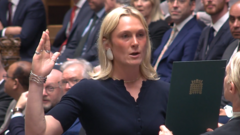
When Lara Bird walked up to the dispatch box in the House of Commons, she was participating in a ritual that has remained virtually unchanged since the mid-nineteenth century. The newly elected SNP representative for Arbroath and Broughty Ferry was required by law to swear allegiance to King Charles, his heirs, and successors. Instead, she chose to use the moment to stage a quiet but deeply deliberate act of political defiance. She crossed her fingers. Before uttering the mandatory words prescribed by the Promissory Oaths Act 1868, Bird stated clearly that she was only taking the oath so she could serve her constituents, declaring that her first allegiance would always belong to the sovereign people of Scotland.
The incident sparked immediate outrage across the benches and went viral on social media. Critics labeled it a disrespectful stunt that degraded the solemnity of Parliament. Supporters praised it as a necessary rejection of an outdated feudal relic. What both sides missed was the deeper systemic friction that this moment exposed. The dispute over the parliamentary oath is not merely an isolated piece of political theater. It is a fundamental clash between two entirely irreconcilable concepts of governance that lies at the very heart of the modern British state.
An Outdated Law Facing Modern Reality
The text that British parliamentarians must read is uncompromising. Under current legislation, an MP cannot sit, vote, or receive a salary until they have sworn or affirmed their loyalty to the Crown. There is no alternative option that allows an individual to swear allegiance to the public, the constitution, or the country.
This creates an immediate barrier for republicans, nationalists, and those who believe that political authority should stem directly from the electorate. The law demands a personal pledge to a hereditary monarch.
For decades, this requirement has forced politicians with republican convictions into a difficult corner. They must choose between compromising their personal principles or abandoning the voters who elected them to office. Most choose to compromise. They perform the ritual with a public caveat, signaling to their supporters that the words they are saying do not represent their true beliefs.
This compromise undermines the very concept of a solemn pledge. When a state force-feeds a specific declaration of loyalty to elected officials who openly oppose the institution in question, the ceremony ceases to be an authentic expression of commitment. It becomes an act of institutional coercion. The ritual loses its moral weight because everyone in the room understands that for a significant portion of the chamber, the words are entirely hollow.
The Historic Friction of Scottish Sovereignty
The tension is particularly acute for representatives from Scotland. Scottish constitutional history contains a distinct tradition regarding the nature of power. The principle of popular sovereignty has a long history north of the border, rooted in documents like the Declaration of Arbroath, which suggested that a monarch's authority was conditional upon the consent of the people.
When nationalist MPs arrive at Westminster, they find themselves operating within an English constitutional framework. This framework is built entirely on the concept of parliamentary sovereignty and the ultimate authority of the Crown in Parliament.
+--------------------------------------------------------+
|             TWO CONFLICTING VIEWPOINTS                 |
+--------------------------------------------------------+
| Westminster System      | Scottish Radical Tradition   |
| -------------------     | --------------------------   |
| Crown in Parliament     | Popular Sovereignty          |
| Hereditary Authority    | Conditional Consent          |
| Institutional Oath      | Accountability to Electorate |
+--------------------------------------------------------+
This structural mismatch ensures that the oath ceremony remains a flashpoint. It happens every time a new parliament assembles or a significant by-election occurs. For an SNP politician, swearing unconditional loyalty to a distant monarch feels like an explicit betrayal of the core ideology that their voters endorsed at the ballot box. Bird was simply following a well-established tradition of republican dissent at the Westminster table.
Previous generations of politicians have found their own ways to navigate this institutional hurdle. Tony Banks once admitted he signed the register with his fingers crossed. Dennis Skinner frequently delivered the oath with visible contempt, muttering sarcastic additions under his breath. Members of Sinn Féin take the most radical approach by refusing to take the oath at all, choosing to forfeit their seats and salaries entirely rather than recognize the British monarch.
Political Upheaval and Institutional Disconnect
The timing of this latest dispute has intensified the scrutiny on parliamentary procedures. Westminster is currently experiencing severe political instability following the sudden resignation of Keir Starmer and the rapid swearing-in of Andy Burnham as the new member for Makerfield. The political focus shifted overnight.
With the government scrambling to manage a high-profile leadership transition and the public demanding stability, the spectacle of politicians arguing over hand gestures and mid-Victorian phrasing looks increasingly out of touch. The contrast is stark. While ordinary citizens worry about public services and economic pressures, the legislative chamber is consumed by a debate over whether an MP crossed her fingers during a mandatory ceremony.
This disconnect highlights the rigidity of the British unwritten constitution. The system relies heavily on convention and ancient precedent to maintain its authority. When those conventions are challenged, the state lacks a flexible mechanism to adapt.
The standard response from traditionalists is to demand strict adherence to the rules. They argue that the oath provides a vital thread of continuity that binds parliament together across partisan divides. Yet, forcing a uniform pledge onto a diverse body of lawmakers achieves the exact opposite effect. It emphasizes the deep divisions within the union rather than healing them.
The Case for Alternative Affirmations
A straightforward solution exists, but the political will to implement it is entirely absent. Many modern democracies offer their elected officials a choice when it comes to official declarations. In countries with republican structures or modernized parliaments, representatives can choose to swear allegiance directly to the constitution or to the people who elected them.
Implementing an alternative option in the UK would require an amendment to the Promissory Oaths Act. An MP could be given the option to choose a democratic affirmation.
"I do solemnly declare that I will be faithful and bear true allegiance to the people of my constituency, and that I will uphold the democratic laws of this land."
💡 You might also like: The Vatican Realignment and the Vatican Pressure on the Trump Doctrine
Such a change would immediately resolve the ethical dilemma faced by republican and nationalist MPs. It would allow them to enter the legislature with their integrity intact. It would also restore genuine meaning to the oath process itself. If those who swear allegiance to the King do so because they genuinely wish to, the act becomes a meaningful statement of personal belief rather than a bureaucratic necessity required to unlock a paycheck.
The resistance to this reform is driven by a fear of what it represents. For traditionalists, allowing an alternative oath is a dangerous concession that acknowledges the fragility of the monarchical system. They worry that if MPs are given permission to bypass the King, it will accelerate the normalization of republican ideas within the British establishment. The survival of the ritual depends entirely on its compulsory nature.
The Cost of Maintaining the Status Quo
By refusing to modernize the oath, Parliament ensures that these public confrontations will continue to occur. Every new intake of MPs will produce individuals who refuse to participate quietly in a ceremony they find morally objectionable. The status quo does nothing to protect the dignity of the Crown. Instead, it turns the monarch into a political shield used to enforce conformity on elected representatives.
The public reaction to the incident involving the member for Arbroath and Broughty Ferry shows how polarizing this issue remains. For one segment of the population, the gesture was an unacceptable insult to a national institution. For another, it was a accurate reflection of their own alienation from a remote and archaic political system centered in London.
The current arrangement cannot completely suppress dissent. It merely alters its delivery. When an institution prioritizes the precise repetition of words over the genuine intent of the person speaking them, it chooses form over substance. The House of Commons prides itself on being a modern, representative legislature that reflects the diverse beliefs of the entire population. As long as it forces its members to participate in an mandatory pledge of feudal loyalty, that claim will remain fundamentally hollow.