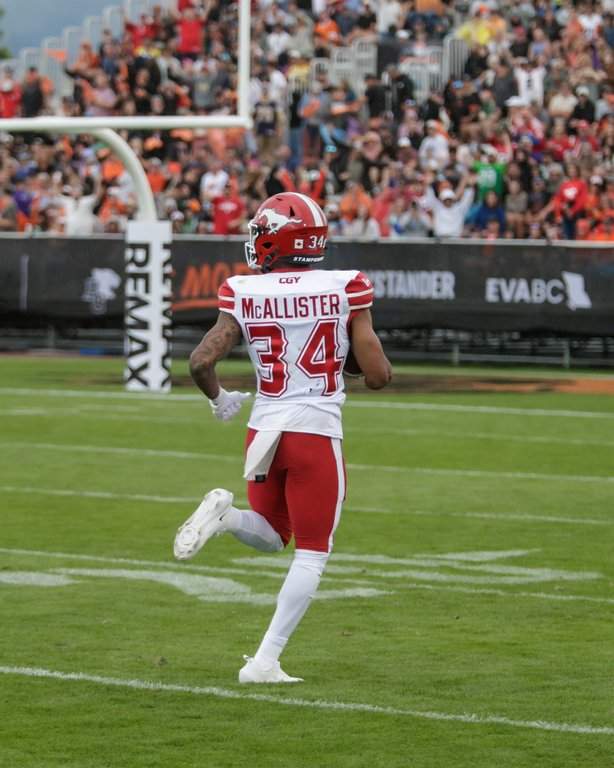
Tyreik McAllister is single-handedly exposing the strategic vulnerabilities of Canadian Football League coverage units. By scoring return touchdowns in back-to-back games—a 120-yard missed field goal return against Saskatchewan and a 90-yard punt return against British Columbia—the Calgary Stampeders returner has electrified early-season football. But this isn't just a story about a fast player finding open space. It is a symptom of a deeper, systemic failure in modern special teams schemes across the league. Cover teams are failing to maintain lane integrity against directional changes, and Calgary is exploiting it.
The Calgary Stampeders signed McAllister in March 2026 to solve a specific crisis. Last year, Calgary ranked dead last in total return yards, a deficiency that consistently buried their offence in poor field position. McAllister, who led the CFL in all-purpose yards with Hamilton in 2023 before a brief stint with the Las Vegas Raiders and the UFL's Columbus Aviators, was brought in as a pure specialist. For a deeper dive into this area, we recommend: this related article.
His sudden resurgence highlights a growing tactical gap in the league. While media narratives focus on McAllister getting his "legs back" or adjusting to the heavy winds at McMahon Stadium, the actual mechanics on film reveal that opponents are beating themselves before they even get near the ball carrier.
The Broken Mechanics of Lane Integrity
Special teams coordination relies entirely on mathematical spacing. When a ball is punted or a field goal is missed, the coverage unit must spread across the width of the field in strict lanes, forming a net that constricts around the returner. To get more context on this development, in-depth analysis can be read on NBC Sports.
The moment a single player over-pursues or bites on a feint, the net tears.
Against the Saskatchewan Roughriders in Week 3, the breakdown occurred during a missed field goal attempt. A field goal return is the most chaotic play in Canadian football because the defensive linemen and linebackers trying to block the kick suddenly have to transition into open-field tacklers. They do not have the speed or the training for it. McAllister fielded the missed kick 20 yards deep in his own end zone. Instead of running straight, he paused, allowing the Saskatchewan heavy linemen to commit to an inside pursuit route.
Then he bounced it outside. By the time the coverage unit realized they had lost the edge, McAllister was past the numbers, outrunning players carrying 60 extra pounds of mass.
The Kelowna Breakdown
The 90-yard punt return against the B.C. Lions in Kelowna was an even clearer example of structural failure. Punt coverage units are supposed to feature two "gunners" whose sole job is to fly down the sidelines and force the returner inside toward the heavy traffic.
On that specific fourth-quarter play, the B.C. gunners were blocked completely out of bounds. This forced the interior coverage line to flow toward the sideline to compensate. McAllister utilized a sharp cutback technique.
- The Illusion: He pressed hard toward the left hash mark, dragging the entire B.C. cover unit with him.
- The Cut: He planted his right foot and exploded back to the right side of the field.
- The Void: Because B.C. lacked discipline in their backside pursuit lanes, there was nobody there to greet him. He hit a crease that was ten yards wide.
The NFL and UFL Experience Vacuum
To understand why McAllister is cutting through these units so easily, one has to examine where he has been for the last two years. He spent 2024 with the Las Vegas Raiders and early 2026 with the Columbus Aviators. In the NFL, the game is played on a significantly narrower field (53.3 yards wide compared to the CFL’s 65 yards). Spaces close instantly. A returner in the NFL does not have the luxury of dancing horizontally; they must verticalize the return immediately or get pulverized.
When a player with NFL-level acceleration is given an extra 12 yards of horizontal width to play with, it changes the entire geometry of the field.
Calgary head coach Dave Dickenson noted that McAllister hadn't played a lot of traditional football over the last 24 months, mostly working on practice rosters or handling limited pre-season reps. That lack of mileage has left his legs incredibly fresh compared to veteran CFL players who have taken weekly beatings on hard turf.
He is entering his prime at 28 years old, possesses elite short-area quickness, and is playing against coverage units that are fundamentally unprepared for that combination of speed and field width.
The Imminent Battle with Toronto
The test of whether Calgary's return game is a sustainable weapon or a temporary aberration comes immediately. The Stampeders host the Toronto Argonauts at McMahon Stadium. Toronto features Janarion Grant, a historic return threat who just logged a 68-yard punt return touchdown against Saskatchewan, marking the 14th return touchdown of his career.
This creates a high-stakes chess match between two teams utilizing contrasting special teams philosophies.
| Team | Return Philosophy | Main Threat | 2026 Return TDs |
|---|---|---|---|
| Calgary Stampeders | Horizontal manipulation and cutbacks | Tyreik McAllister | 2 |
| Toronto Argonauts | North-south power and broken tackles | Janarion Grant | 1 |
Toronto's coverage teams are notoriously physical. They do not rely on finesse; they use a heavy press scheme designed to jam blockers at the line of scrimmage, disrupting the timing of the return blocks before they can form a wall. If Toronto successfully jams Calgary’s blocking scheme, McAllister will be forced to field balls with defenders already in his face, eliminating the horizontal runways he used against B.C. and Saskatchewan.
How Defences Must Adjust to Stop McAllister
Fixing the special teams crisis against dynamic returners requires coordinated tactical adjustments. Special teams coordinators must stop telling their cover men to "go make a play." That individualistic mindset is exactly what a patient returner wants.
First, the interior pursuit must use a "contain-first" technique. Instead of sprinting directly at the spot where the returner catches the ball, the middle lane players must aim two yards outside the returner’s shoulder. This sacrifices immediate tackle depth but ensures the returner stays boxed inside the hash marks.
Second, teams must alter their punting strategy. Punting the ball down the middle of the field against Calgary is coaching malpractice. Teams must utilize situational directional punting, placing the ball within two yards of the sideline. This effectively cuts the 65-yard wide field in half, using the boundary as an extra defender and taking away McAllister's signature cutback avenues.
If opposing teams continue to gamble on their coverage units winning individual footraces against a player with modern pro-football acceleration, Calgary will continue to flip the field effortlessly. The burden of proof is no longer on McAllister to show he is back in a CFL groove. The burden is entirely on the rest of the league to prove they can design a scheme disciplined enough to stop him.