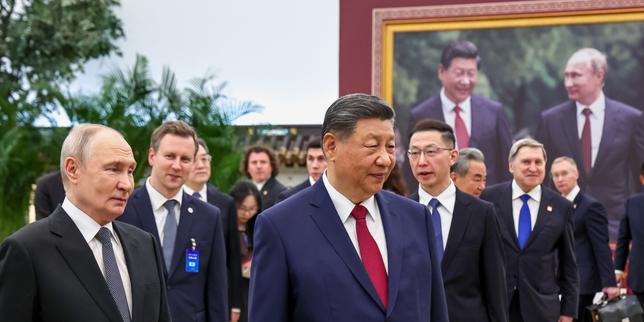
Russian President Vladimir Putin arrived in Beijing expecting a lifeline. Instead, he received a lesson in asymmetric economic warfare. Despite a massive 39-person delegation featuring five deputy prime ministers, eight cabinet ministers, and the heads of Gazprom and Rosneft, the May 2026 state visit concluded without a signed contract for the Power of Siberia 2 gas pipeline. China is intentionally stalling the mega-project because it holds all the leverage. Beijing is demanding natural gas at heavily subsidized Russian domestic rates—roughly $50 to $130 per 1,000 cubic meters—while Gazprom desperately needs to replace its lost European market at sustainable commercial prices.
Moscow is learning the hard way that an "unprecedentedly high" diplomatic friendship does not translate to charity in energy economics. In other news, take a look at: The Erasure of a Name.
The Brutal Math of a One Buyer Market
The proposed 2,600-kilometer pipeline is designed to pump 50 billion cubic meters of natural gas annually from the Arctic Yamal peninsula to northern China via Mongolia. For the Kremlin, it represents the holy grail of its post-Ukraine economic pivot. When European sanctions cut off Gazprom from its historical customer base, the state-owned energy giant saw its long-haul exports plummet to lows not seen since the late 1980s.
Russia needs China. China does not strictly need Russia. The Guardian has also covered this important subject in extensive detail.
This fundamental asymmetry dictates the brutal math of the negotiations. Beijing currently pays roughly $258 per 1,000 cubic meters for gas via the existing Power of Siberia 1 pipeline. For Power of Siberia 2, however, Chinese negotiators are squeezing Moscow. They are demanding prices that mimic Russia's heavily subsidized domestic market, which hovers as low as $50 per 1,000 cubic meters. To put that in perspective, Gazprom previously charged European clients upwards of $400 for the same volume.
Accepting Beijing’s terms would turn the pipeline into a multi-billion-dollar infrastructure project that operates at a financial loss for years. Rejecting them leaves Russia’s vast northern gas reserves trapped in the ground with nowhere to go.
Domestic Peak Gas and the Shifting Global Context
While the Kremlin hoped that recent geopolitical chaos—specifically the US-Israeli conflict with Iran and the resulting disruption of shipments through the Strait of Hormuz—would force China to scramble for secure overland energy, Beijing has remained cold.
Chinese economic policymakers are looking at long-term domestic structural shifts rather than short-term global panics. Internal consensus among economic planners in Beijing suggests that China’s domestic gas demand may have already peaked, or is rapidly approaching its plateau, due to an aggressive domestic build-out of renewable energy and nuclear power. Committing to a decades-long supply contract for an additional 50 billion cubic meters of gas is a financial risk Beijing is unwilling to take unless the price is virtually negligible.
Strategic Interaction vs Economic Reality
The optics of the Beijing summit were meticulously choreographed to project unity. Xi Jinping and Vladimir Putin signed a sweeping joint declaration on a "multipolar world order" and oversaw the signing of 20 separate cooperation agreements covering trade, technology, and a visa-free travel extension through 2027. Yet, the total absence of oil and gas milestones among those 40 total bilateral documents speaks louder than any joint press conference.
Kremlin spokesman Dmitry Peskov downplayed the setback, claiming that the "basic parameters of understanding" regarding the route and construction methods are finalized, leaving only "commercial nuances" to be ironed out. In the language of international energy diplomacy, "commercial nuances" is a euphemism for a total deadlock.
Russia has already conceded to expanding the capacity of the original Power of Siberia 1 pipeline to hit 38 billion cubic meters annually, and has agreed to a minor Far Eastern route to push total exports toward 56 billion cubic meters by 2030. But these increments are a drop in the bucket compared to the 150 billion cubic meters of annual capacity Russia lost in Europe.
The Colonization of the Russian Energy Sector
By dragging out the negotiations, China achieves two strategic objectives simultaneously. First, it secures an incredibly cheap insurance policy against maritime blockades without spending a dime on construction costs before it absolutely has to. Second, it deepens Russia's economic subordination.
The economic relationship is transforming into something resembling a colonial dynamic. While Chinese imports of Russian oil jumped 35 percent in the early months of this year, total bilateral trade swelled past $85 billion primarily because Russia has no other source for industrial components, microchips, and machinery required to sustain its domestic economy and wartime manufacturing.
China is selling high-value manufactured goods and buying deeply discounted raw commodities. Xi Jinping knows that time is on his side; the longer the conflict in Europe drags into its fifth year, the more desperate the Kremlin will become, and the lower Gazprom's pricing floor will drop.
The ultimate failure to secure the Power of Siberia 2 contract this week proves that Beijing distinguishes sharply between diplomatic rhetoric and core national economic interests. Xi Jinping will happily stand shoulder-to-shoulder with Vladimir Putin to challenge the Western-led global order. But he will not overpay for Russian gas to do it.