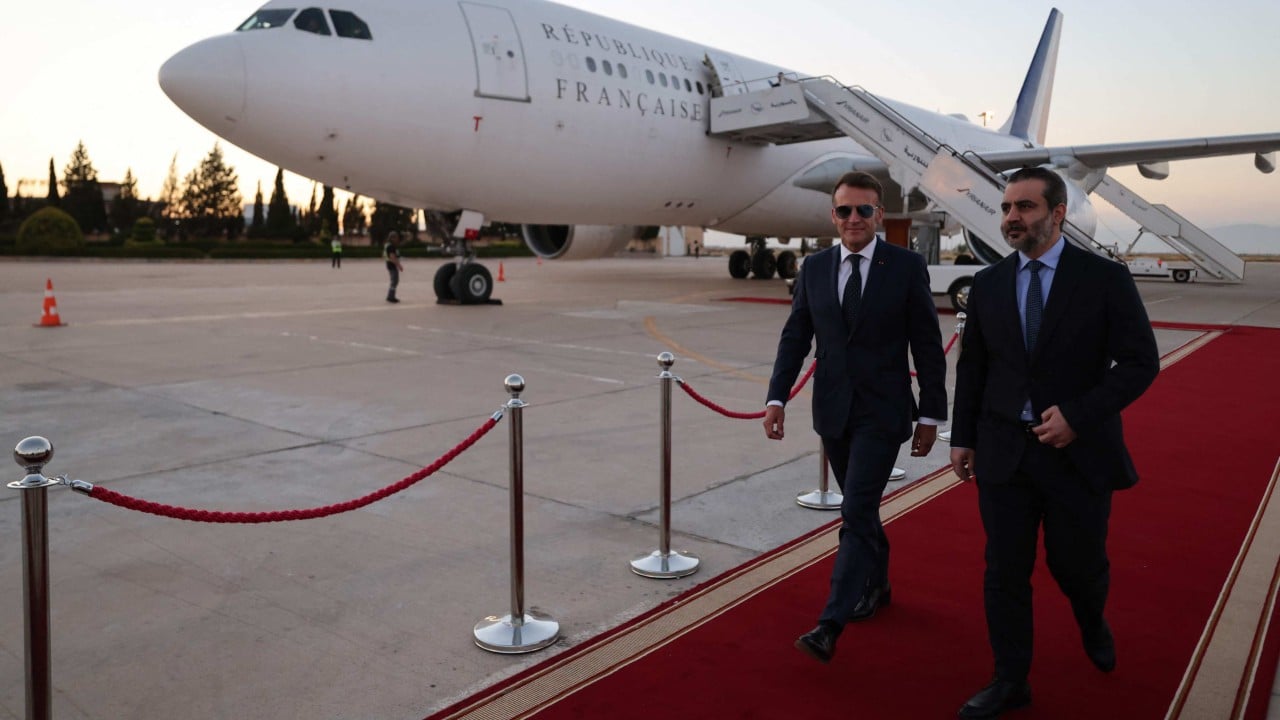
French President Emmanuel Macron landed at Damascus International Airport on Monday, marking the first time a Western head of state has set foot in Syria since the fall of the Assad dynasty in December 2024. On the surface, the state visit is being sold as a diplomatic triumph for pluralism, human rights, and regional stability. The reality is far colder, driven by a desperate scramble for billions of dollars in reconstruction contracts and an attempt by Paris to lock down Mediterranean influence before Washington or Beijing can shut them out. Macron is accompanied by a heavy delegation of French corporate titans, including the chief executives of energy giant TotalEnergies and shipping conglomerate CMA CGM, signaling that France views the post-Assad era less as a human rights project and more as an economic frontier.
The diplomatic pivot represents an extraordinary gamble on Syria's new ruler, President Ahmed al-Sharaa. Less than two years ago, Western intelligence agencies knew Sharaa as Abu Mohammad al-Julani, the blacklisted former commander of an al-Qaeda affiliate. Today, he is receiving Western heads of state, preparing for meetings with American leaders at the upcoming NATO summit in Turkey, and positioning his administration as the sole guarantor of order in a fractured nation. For France, embracing this transformed insurgent leader is a calculated risk, born out of a fear of being left behind in the post-war gold rush.
The Corporate Calculus Behind the Damascus Diplomacy
While the French government fills social media with declarations about a sovereign, united Syria, the real work is happening in closed-door sessions between corporate executives and Syrian technocrats. The inclusion of TotalEnergies and CMA CGM in the presidential entourage is not an afterthought. It is the core motivation. Syria requires hundreds of billions of dollars to rebuild its shattered electricity grid, shattered ports, and decimated oil infrastructure after thirteen years of civil war. Paris wants French firms at the front of the line.
TotalEnergies has its eyes on the hydrocarbon fields of eastern Syria, assets that were frozen out of European hands for over a decade by heavy international sanctions. The French energy giant possesses the capital and engineering capability that Damascus desperately needs to restart its domestic energy production, which is vital for a population still suffering from chronic electricity shortages.
Similarly, CMA CGM is looking to secure long-term concessions at the strategic ports of Latakia and Tartous. These Mediterranean gateways were previously under Russian control, but the collapse of the Assad regime has left a vacuum that the new Syrian authorities are eager to fill with Western commercial partnerships. By embedding these corporate leaders into an official state visit, Macron is attempting to use the weight of the state to secure commercial monopolies before rival European or Asian firms can establish a foothold.
France took the lead in lobbying for the removal of the sweeping Western sanctions that had throttled the Syrian economy for over a decade. Most of those sanctions were dismantled last year following intense pressure from Paris. That legislative clearance was not granted out of altruism. It was designed to clear a legal path for French multinational corporations to sign binding agreements without facing compliance penalties from the United States Treasury.
Washing the Al Qaeda Legacy
The willingness of Paris to embrace Ahmed al-Sharaa highlights a dramatic shift in how European intelligence and diplomatic networks operate in the Middle East. Sharaa’s transition from a designated global terrorist to a suited statesman is one of the most remarkable rebrandings in modern geopolitical history. His security forces have cracked down on more radical factions, protected some religious minorities, and adopted the language of international law.
Yet, beneath the polished exterior lies a highly volatile political structure. The new authorities are struggling to maintain absolute control over the country. Just last week, a deadly bombing at a Damascus cafe shattered the illusion of a secure capital, proving that insurgent remnants and rival factions still possess the capability to strike deep within government-held territory. France is betting that Sharaa can suppress these elements, but many veteran intelligence analysts view the current stability as a fragile truce rather than a permanent peace.
Human rights organizations remain deeply skeptical of the new government's internal policies. Reports continue to emerge regarding the systemic marginalization of political dissidents, questionable detentions, and the enforcement of conservative religious codes in provincial areas. Macron’s public statements during his visit emphasized the necessity of a pluralistic Syria that respects women and minorities, but these words carry little structural leverage. Paris has made it clear that economic engagement is not conditional on flawless democratic reforms; the financial commitments are moving forward regardless of the domestic political climate.
The Geopolitical Race Against Washington and Beijing
Macron's rapid arrival in Damascus is also a preemptive move ahead of the NATO summit in Turkey, where Sharaa is scheduled to hold high-profile talks with United States President Donald Trump. The French presidency is acutely aware that the current American administration views international relations through a transactional lens. If Washington decides to back the Sharaa government with massive financial or military aid packages, American firms will likely secure the lion's share of infrastructure contracts. By executing this visit now, Macron is attempting to establish a French sphere of influence before the United States can dictate the terms of Syria's reintegration into the global economy.
There is also the looming presence of regional actors who moved faster than Europe. Qatari Emir Sheikh Tamim bin Hamad Al-Thani was the first foreign head of state to visit Damascus in January 2025, pouring immediate liquidity into the new government's coffers. European Commission President Ursula von der Leyen followed shortly after, attempting to set a broader European Union framework for engagement. France, however, is rejecting a slow, consensus-based European approach in favor of unilateral commercial diplomacy. Paris refuses to allow Brussels to mediate its access to the Levant.
This aggressive approach carries immense reputational risks. If Sharaa’s government defaults to authoritarian methods or if the country descends back into fractional warfare, Macron will face severe political backlash at home for validating a former militant leader. French opposition figures are already questioning the ethics of using presidential prestige to shield a regime with such a complicated history.
The strategy also exposes a deep hypocrisy in European foreign policy, where democratic ideals are loudly championed in some regions while economic opportunism dictates terms in others. Syria is not a developing democracy; it is a war-weary nation run by a highly organized security apparatus that has successfully adapted to Western expectations. Macron’s visit confirms that for the modern French state, securing a seat at the reconstruction table is worth the moral compromise.
The French business delegation will spend Tuesday finalizing preliminary agreements at the presidential palace, focusing on transport infrastructure and renewable energy projects. These agreements will form the basis of Syria’s economic architecture for the next decade, locking Damascus into an economic relationship with Paris that will be difficult for future governments to unwind.
The era of isolating Damascus is officially over, replaced by a ruthless competition for contracts among the world's commercial powers. France has made its move, wagering its diplomatic capital on a former insurgent leader in exchange for a dominant stake in the reconstruction of the Levant. The success of this strategy will not be measured by the emergence of a free and open Syrian society, but by the volume of French cargo moving through the port of Latakia and the barrels of oil extracted by French engineers in the eastern deserts.