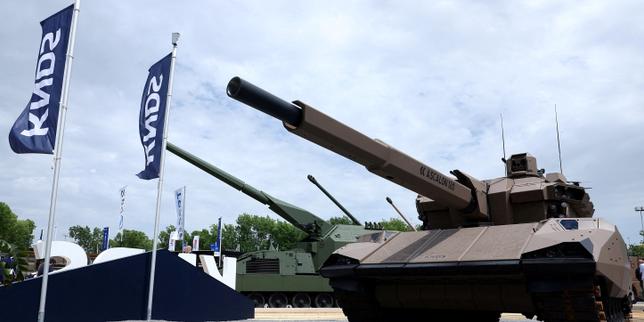
Franco-German tank manufacturer KNDS abruptly frozen its highly anticipated initial public offering on July 1, 2026, just one week after confidently announcing plans to list on Euronext Paris and the Frankfurt Stock Exchange. While corporate executives blamed generalized market uncertainty and sector volatility, the real collapse stemmed from a hardline valuation standoff between institutional investors, the French government, and the ultra-private Wegmann family. Early investor books indicated the enterprise would struggle to cross a twelve billion euro valuation, far below the fifteen billion euro target envisioned by its directors.
For an industry riding the tailwinds of massive European rearmament, the sudden retreat exposes deep structural flaws in how continental defense conglomerates are financed, governed, and valued.
The Warship Contract Shockwave that Shook the Market
The timing of the initial listing announcement could not have been more unfortunate. On the exact day KNDS publicized its intent to float up to twenty percent of its existing share capital, a major regulatory tremor struck its primary domestic rival, Rheinmetall. The German government unexpectedly canceled a massive, multi-billion-euro contract for new naval warships, sending a shockwave through European defense equities. Rheinmetall shares plummeted nineteen percent in a single afternoon.
That sudden correction fundamentally altered the math for KNDS. Institutional money managers who had spent months modeling record-breaking defense budgets suddenly reassessed their risk premiums. The defense equity boom, which had seemed virtually unstoppable since early 2022, showed its first major signs of vulnerability.
When underwriters began informal book-building conversations with major fund managers in London, Frankfurt, and Paris, the feedback was brutal. Investors were no longer willing to pay a premium for political promises of future procurement. They demanded steep discounts, pricing KNDS closer to eleven or eleven and a half billion euros. For the company's internal architects, who viewed their portfolio of Leopard 2 tanks and Caesar self-propelled howitzers as the crown jewels of continental land defense, this markdown was an insult.
Inside the Fifty Fifty Power Struggle
To understand why the transaction disintegrated so quickly, one must look past the official press releases and examine the delicate, fifty-fifty corporate governance model that underpins KNDS. The company was born out of a marriage of convenience between Nexter, owned entirely by the French state, and Krauss-Maffei Wegmann, controlled by the secretive German billionaire Wegmann family.
This equal division of power has always been a source of operational friction. In a traditional corporate entity, a minor valuation gap can be resolved through board negotiation or by adjusting the volume of shares on offer. In KNDS, any deviation from the agreed-upon baseline alters the fragile equilibrium between Paris and Munich.
The Wegmann family holds a definitive veto over the pricing structure. Sources familiar with the internal deliberations confirm that the family office flatly refused to proceed with any public listing that valued the combined entity below twelve and a half billion euros. For the German shareholders, selling down a portion of their family legacy at a discount to satisfy temporary market anxieties was an unacceptable proposition. The French state, while traditionally more eager to monetize state-backed industrial assets to fill treasury deficits, found itself cornered. It could not force the listing without blowing up the cross-border partnership entirely.
When Sovereign Interests Clash with Corporate Capitalism
Public capital markets demand transparency, agility, and a single-minded focus on shareholder returns. Sovereign defense companies, by contrast, serve national security interests, geopolitical alliances, and domestic employment agendas. This fundamental incompatibility lies at the heart of the postponed initial public offering.
Consider the operational reality of manufacturing heavy armor in Europe. A prospective investor looking at KNDS sees an incredibly full order book stretching into the next decade. However, they also see a manufacturing network hamstrung by national political red tape. France wants to protect production facilities in Roanne; Germany insists on maintaining industrial capacity in Munich and Kassel. Every major contract negotiation involves an intricate dance of industrial offsets, ensuring that neither side of the Rhine feels shortchanged.
The Problem of Export Controls
A secondary, yet equally potent factor weighing down investor appetite is the persistent divergence in export regulations between Paris and Berlin. France takes a pragmatic, commerce-first approach to arms sales, regularly supplying regimes in the Middle East and Asia. Germany operates under strict, morally driven export limitations that can freeze multi-billion-euro defense deals for years.
An investor buying shares in Frankfurt cannot be certain that a future German coalition government won't unilaterally block a massive tank order destined for a non-NATO ally. This regulatory friction acts as a permanent discount on the company's market capitalization. Until France and Germany fully align their defense export doctrines, KNDS will struggle to achieve the premium valuation commanded by its American peers, who operate under a unified, highly predictable foreign military sales framework.
The Deep Structural Friction of Franco German Defense Cooperation
The postponement of the market debut is not an isolated financial event. It reflects a broader, ongoing malaise within the joint industrial projects designed to form the backbone of European strategic autonomy. The most prominent of these is the Main Ground Combat System, the multi-decade project intended to replace both the German Leopard 2 and the French Leclerc tanks.
For years, this project has been bogged down by fierce industrial infighting. French engineers want to prioritize lighter, highly mobile platforms compatible with rapid deployment doctrines. German designers lean toward heavily armored, technologically complex platforms optimized for conventional continental warfare. KNDS was supposed to act as the unified corporate umbrella to smooth over these differences. Instead, it has become the primary arena where these national rivalries play out.
By attempting a public listing, the management hoped to use the discipline of the stock market to force a more unified corporate culture. The logic was simple. If the company answered to public shareholders, national political interference would naturally recede. That view proved naive. The public market looked at the internal political baggage of the organization and decided it wanted a significant discount for taking on the risk.
The Reality Check for European Armaments Valuations
The broader defense sector must now grapple with the realization that the post-2022 valuation bubble has its limits. Recent European listings, such as the Czech group CSG hitting a twenty-five billion euro valuation in January or the German warship builder TKMS successfully raising funds at over five billion euros in late 2025, gave the impression that any defense asset could command an astronomical premium.
KNDS proved that theory wrong. The investment community is becoming increasingly sophisticated in distinguishing between pure defense play assets and complex, state-tied industrial bureaucracies. Investors are beginning to look closely at profit margins, supply chain bottlenecks, and the sheer capital expenditure required to scale up heavy munitions production.
The company's order backlog is historic, but turning that backlog into cash flow requires immense investments in factories, machine tools, and skilled labor. When inflation, rising wages, and component shortages are factored into the equation, the projected margins look far tighter than they did two years ago.
The decision to freeze the listing prevents a high-profile market failure, but it solves none of the underlying dilemmas. The company still requires capital to expand its production lines to meet the frantic demand for artillery and armor across Europe. Without the influx of public cash, the financial burden falls back squarely on the French taxpayer and the private reserves of the Wegmann family.
The underwriters will undoubtedly spend the coming months attempting to restructure the offering, waiting for defense equities to stabilize and hoping for a more favorable macroeconomic climate. Yet, the core tension remains unresolved. You cannot easily sell a company to the public when its primary objective is not to generate profit, but to satisfy the competing national security ambitions of two separate sovereign states. KNDS will remain trapped in this geopolitical tug-of-war long after the current market volatility subsides.