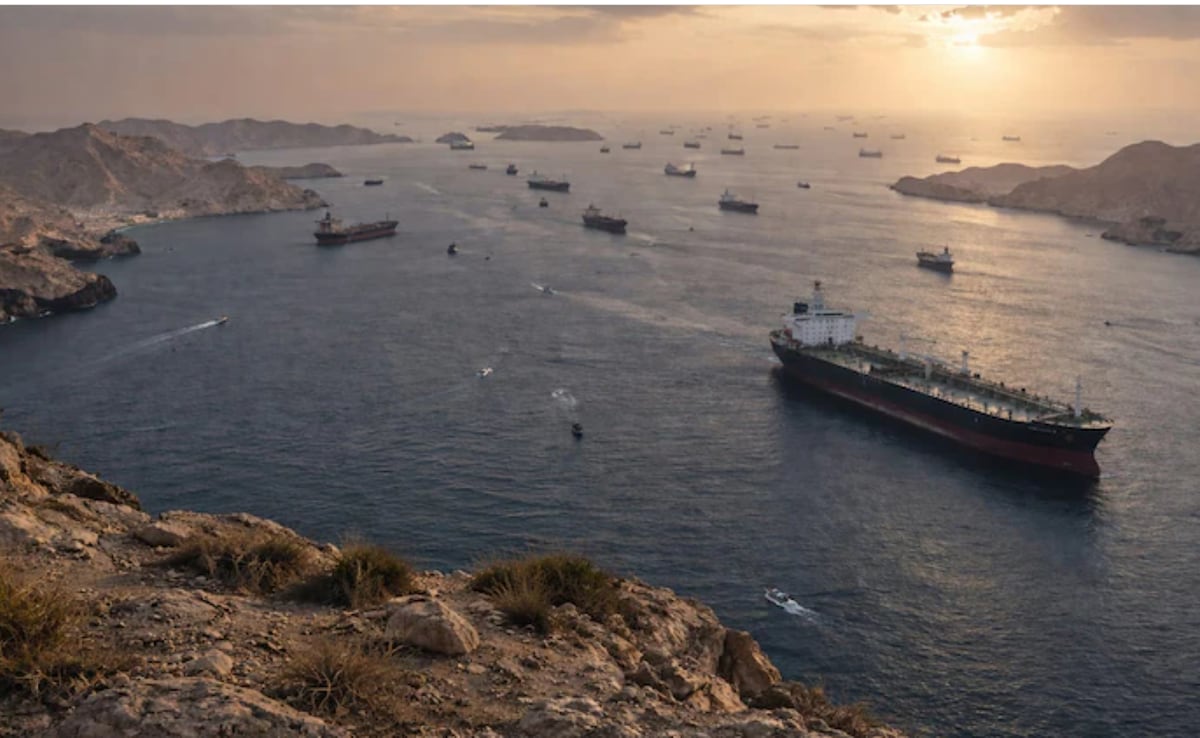
Commercial tracking data shows a ghost town where one-fifth of the world’s energy supply used to flow. For eleven weeks, the Strait of Hormuz has been locked down under a dense fog of military blockades, drone skirmishes, and failed diplomacy. While financial headlines attribute the sudden spikes in Brent crude and West Texas Intermediate to the immediate, theatrical friction between Washington and Tehran, the underlying reality is far more dangerous. The global energy market is not just reacting to a temporary diplomatic standoff. It is fundamentally repricing for a permanent structural collapse of the decades-old Persian Gulf supply architecture.
When President Donald Trump stood in the Oval Office and dismissed Tehran’s latest peace proposal as garbage, Brent crude surged past $104 a barrel, and WTI climbed to $98.03. This is not the speculative volatility of a typical geopolitical flare-up. This is the structural baseline of a world where the primary energy artery has been cut open. The market had briefly flirted with optimism, dropping crude prices by 6% when early rumors of a ceasefire circulated. But that optimism was built on a superficial reading of the crisis. The core dispute is no longer just about regional posturing. It is about a deep-seated war over economic survival and maritime control that a simple signature on a peace treaty cannot fix.
The Mirage of the Ceasefire
The primary misconception driving superficial analysis is that a ceasefire means a return to normal shipping operations. It does not. Although a fragile halt to direct military strikes was announced in April, maritime traffic through the Strait of Hormuz remains severely depressed compared to pre-war baselines.
The mechanics of international shipping are governed by insurance, not declarations of peace. On March 5, major protection and indemnity clubs stripped war risk coverage for the strait. Without this insurance, commercial vessel owners face catastrophic financial liabilities if a ship is hit by a rogue sea drone or an unexploded mine. It takes a single incident, like the attack on the tanker Skylight or the drone boat strike on the MKD VYOM, to terrify the maritime industry. The strait remains technically open by international law, but it is effectively closed by the cold logic of corporate risk management.
Furthermore, Iran’s demands for opening the waterway go far beyond a halt to active hostilities. Tehran is demanding a complete, unconditional lifting of the U.S. naval blockade on its own oil exports and an easing of all energy-sector sanctions. More critically, Iran insists on retaining absolute operational veto power over all commercial traffic passing through its territorial waters in the strait. Washington cannot grant that control without abandoning its strategic commitments to regional allies, creating an institutional gridlock that guarantees prolonged supply shortages.
The Collapse of the Gulf Economic Model
The damage done to the global energy supply chain is already irreversible in the short term. The International Energy Agency has characterized the ongoing shutdown as the largest supply disruption in the history of the global oil market, eclipsing the oil shocks of the 1970s.
The crisis has shattered the economic foundations of the Gulf Cooperation Council states. While countries like Saudi Arabia and the United Arab Emirates possess overland pipelines to bypass the strait, these routes are drastically limited in capacity. By mid-March, collective oil production from Kuwait, Iraq, Saudi Arabia, and the UAE plummeted by an estimated 10 million barrels per day. The infrastructure simply cannot absorb the volume of stranded oil.
| Region / Asset | Operational Impact | Market Consequence |
|---|---|---|
| Strait of Hormuz | Commercial traffic down over 70% | Spot shortages of specific crude grades |
| GCC Oil Production | 10 million barrels per day sidelined | Rapid drawdown of global commercial inventories |
| Ras Laffan (Qatar) | 17% reduction in LNG capacity | Asian LNG spot prices up 140% |
The destruction extends beyond crude oil. When Iranian forces targeted Qatar’s Ras Laffan Industrial City LNG complex, they knocked out nearly a fifth of Qatar’s liquefied natural gas production capacity. Infrastructure specialists estimate that repairing the highly specialized cooling trains and export terminals will take three to five years. The immediate result was a 140% explosion in Asian LNG spot prices. This forces industrialized Asian economies, particularly Japan and South Korea, to aggressively outbid European buyers for any available Atlantic basin cargo, creating a secondary, structural shockwave throughout global energy markets.
The Inflation Transmission Lag
On the retail front, the U.S. domestic economy is bracing for an impact that has been buffered only temporarily by domestic shale production and strategic reserves. The national average for a gallon of regular gasoline has shot up from just under $3 before the conflict to $4.52. In highly regulated or logistically isolated markets like California, pump prices have comfortably breached $6.00 per gallon.
To stem the political bleeding, President Trump floated a proposal to suspend the federal gas tax of 18.4 cents per gallon. This is a cosmetic bandage for a systemic disease. A tax holiday offers a meager 4% relief at the pump, while the underlying cost of crude has doubled since late February.
The real danger lies in the economic transmission lag. Crude oil price shocks take roughly six to twelve weeks to ripple through the broader consumer supply chain. Petroleum is not just a fuel. It is the baseline feedstock for the global manufacturing sector. Synthetic textiles, consumer electronics packaging, chemical fertilizers, and plastics are all manufactured using petroleum derivatives. Estimates suggest that if Brent crude remains structurally anchored above $90 through the remainder of the year, retail costs for basic consumer goods and footwear will rise by up to 15% by late autumn. This threatens to trigger a brutal cycle of stagflation that major central banks cannot easily combat with interest rate adjustments.
The Shifting Flow to Asia
The crisis has also accelerated a profound geopolitical realignment of energy distribution. Prior to the blockade, roughly 75% of the crude oil moving through the Strait of Hormuz was destined for Asian markets, with China serving as the primary destination.
With the strait blocked, the traditional maritime highway to the East is broken. This leaves emerging economies like Pakistan facing existential fiscal crises, with oil import costs soaring by 167% due to the necessity of sourcing spot cargoes from distant, non-traditional suppliers.
China, however, is adapting through alternative mechanisms. It has aggressively increased its intake of overland Russian crude via the ESPO pipeline and boosted bilateral imports from Central Asian producers. This shift leaves a massive volume of stranded Middle Eastern production looking for a home, but with no viable maritime route to move it out of the Persian Gulf. The global market is bifurcating into localized zones of extreme deficit and localized zones of stranded surplus, rendering traditional global price benchmarks highly volatile and increasingly disconnected from physical reality on the ground.
The persistent high price of oil is not a product of speculative panic that will dissipate with the next diplomatic press release. The conflict has caused an unprecedented physical loss of production, severely damaged critical LNG infrastructure, and broken the commercial insurance framework required to operate global shipping lanes. The traditional energy map has been fundamentally altered, and the global economy will be paying the premium for this transformation long after the current political actors leave the stage.