Inside the grand convention hall in Southeast Asia, air conditioners hummed with cold, artificial precision. Outside, the tropical heat sat heavy over the city streets, but inside, diplomats in crisp suit jackets moved with cautious, deliberate steps across polished marble floors.
They gathered under the banner of the Association of Southeast Asian Nations. Ten nations, hundreds of millions of citizens, and a shared geographical identity. Yet the air in the room was not thick with optimism or shared ambition. It was thick with anxiety.
Diplomacy is often depicted through photo opportunities—smiling ministers clasping hands in a show of unity. But strip away the flag pins and the polished mahogany tables, and you find human beings carrying the immense burden of two distant, colliding fires.
To the east lay the South China Sea, a body of water where fishermen navigate waters choked by naval patrols and disputed shoals. To the west, thousands of miles away, the Middle East burned with escalating warfare.
The diplomats sat between these two massive crises, trying to draft communiqués that could somehow bridge deep, ideological divides.
The Fisherman and the Frigate
Consider a hypothetical fisherman named Minh.
Minh wakes at three in the morning off the coast of Luzon. His wooden boat has been in his family for three generations. It smells of dried salt, diesel, and motor oil. For thirty years, he has followed the migration of tuna and mackerel through shallow, clear waters that his grandfather taught him to navigate by the stars.
Today, Minh hesitates before turning the key in his ignition.
Over the past three years, the waters he has fished his entire life have changed. Gray hulls of foreign coast guard vessels now cut through the morning fog. Water cannons have been deployed against boats like his. Radio warnings crackle across emergency frequencies in foreign languages, declaring that ancient fishing grounds are now restricted zones.
When ASEAN foreign ministers sit down in a air-conditioned conference room, they discuss maritime law, sovereign rights, and the long-delayed Code of Conduct for the South China Sea.
Minh does not care about the phrasing of sub-clause four in a draft agreement. He cares about whether his net comes back full or torn to shreds. He cares about whether he returns home to his family at dusk.
The South China Sea is not an abstract chessboard. It is a highway of global trade carrying over three trillion dollars in ship-borne commerce each year. More than that, it is the sole source of livelihood for millions of families who have nowhere else to turn.
When foreign ministers argue over word choice in a joint statement, the real debate is about whether small nations can exist safely alongside giants. China claims vast swaths of these waters under historical assertions, while neighboring states point to international treaties established under the United Nations Convention on the Law of the Sea.
The tension is constant. A single misplaced steering maneuver by a patrol vessel could spark a military chain reaction that no diplomat in the room can easily undo.
Echoes From a Distant Fire
While the immediate threat rests on local waters, a darker shadow stretched across the meeting table from thousands of miles away.
The conflict in the Middle East—the catastrophic violence in Gaza, the expanding regional strikes, the humanitarian devastation—hung heavy over every conversation.
Why does a war thousands of miles across the Indian Ocean disrupt a meeting of Southeast Asian ministers?
Because Southeast Asia is not a monolith.
The region is home to vast diversity. Indonesia stands as the world’s most populous Muslim-majority nation. Malaysia’s public identity is deeply intertwined with solidarity for the Palestinian people. Meanwhile, other neighboring states maintain close security, economic, and technological ties with Israel or prioritize strategic neutrality to protect trade.
When news of civilian casualties, strikes, and starving populations fills social media feeds in Jakarta and Kuala Lumpur, public outrage is instant and intense. Citizens demand that their leaders take a firm, uncompromising stand.
Yet within the walls of the summit, consensus is required for every single official word. ASEAN operates on unanimity. If one nation dissents, the statement dies.
This requirement creates an agonizing friction.
Diplomats worked late into the night, staring at draft documents illuminated by laptop screens. They debated adjective choices while thousands of miles away, families searched through rubble for survivors, and regional war threatened to shut down global shipping lanes in the Red Sea.
Consider the reality of that friction. On one side, ministers face intense domestic political pressure to speak out forcefully against human rights atrocities. On the other side, fellow member states caution against taking positions that could alienate key global allies or draw the region into a distant geopolitical storm.
The delay in issuing joint declarations was not caused by laziness. It was caused by the sheer difficulty of trying to speak with a single voice when ten different throats are conditioned to sing entirely different songs.
The Cost of Silence
There is a temptation to view these diplomatic gatherings with cynicism.
Critics call them talk shops. They point out that a carefully worded paper does not stop a missile in the Middle East, nor does it move an armored coast guard vessel away from a disputed reef in Asia.
That criticism contains truth. Paper cannot stop steel.
But consider the alternative: complete silence.
When dialogue breaks down, force becomes the only remaining language. When sovereign nations stop sitting down to argue over vocabulary, they start moving troops toward borders.
In the corridors between formal sessions, away from the microphones, small-nation diplomats pull representatives from major world powers aside. They issue quiet warnings. They explain that a confrontation in the Pacific or a supply chain collapse in the Middle East will drag global energy prices through the roof, starving vulnerable communities of basic necessities.
The stakes are invisible until they fail.
If energy routes close in the Middle East, electricity costs spike in Manila and Bangkok. If trade routes stall in the South China Sea, factories in Vietnam and Malaysia run out of raw materials, leaving assembly line workers without paychecks.
Global geopolitics is an interconnected web. A tear in one thread pulls directly on the rest.
A Fragile Balance
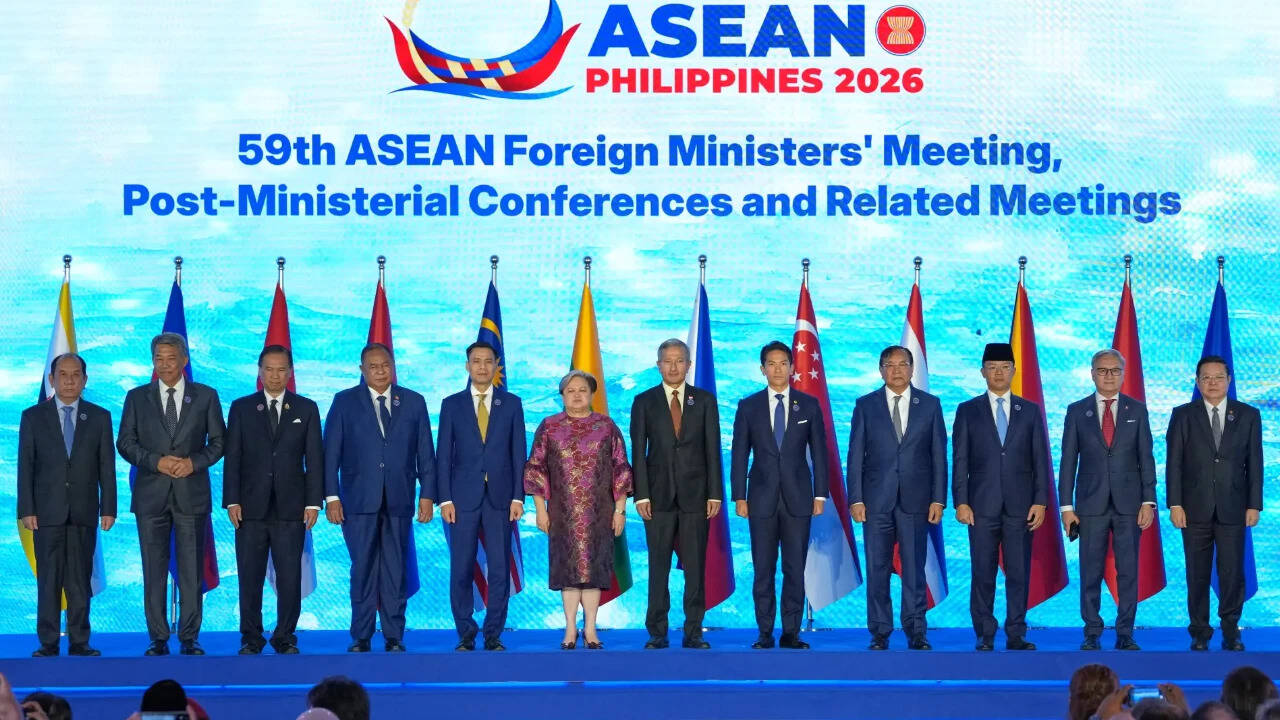
As the meeting drew toward its end, ministers gathered once more on stage for the traditional joint photograph. They linked arms, crossed hands, and smiled for the cameras.
The resulting official statements contained the expected language: calls for restraint, urges for peaceful dialogue, adherence to international law, and deep concern for humanitarian crises.
To an outsider reading a brief news summary, it looks like standard bureaucratic rhetoric.
Underneath those carefully scrubbed paragraphs lies a tense, continuous struggle to keep the peace among nearly 700 million people caught in the crossfire of rival superpowers and global instability.
The diplomats packed their leather briefcases, stepped out into the tropical heat, and headed for the airport.
Back on his wooden boat off the coast of Luzon, Minh guided his vessel through the dark morning water. He watched the horizon for the searchlights of approaching patrol ships, knowing that whatever happened in those carpeted rooms across the ocean, his life—and the lives of millions like him—hung in the balance.