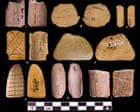
The discovery of modified artiodactyl astragali (knucklebone dice) in the Great Basin of North America, dating back approximately 6,000 to 7,000 years, shifts the chronology of human risk-modeling and leisure-based social hierarchies. While initial reporting focuses on the chronological novelty—placing these artifacts millennia before similar evidence in the Near East—the true value lies in the structural complexity of the gaming systems. These were not merely randomized pastimes; they were standardized probabilistic tools integrated into the economic and migratory frameworks of archaic hunter-gatherers.
The Mechanics of the Bone Die
To understand the sophistication of Great Basin gaming, one must analyze the physical geometry of the astragalus. Taken from the ankle of sheep or deer, the bone is naturally asymmetrical, providing four distinct landing faces with varying surface areas.
The Great Basin finds demonstrate intentional modifications—flattening, incising, or staining specific sides—to alter the center of gravity or surface friction. This represents a primitive form of weighting or "loading" dice, suggesting a deep-seated understanding of:
- Probability Distribution: Each face of an unmodified astragalus has a specific likelihood of landing. The "broad" sides (dorsal and plantar) have higher probabilities, while the "narrow" sides (lateral and medial) are lower-probability, higher-reward outcomes.
- Strategic Standardization: By incising specific patterns into these bones, players established a universal scoring system across disparate nomadic groups. This allowed for inter-tribal exchange and competition without a centralized regulatory body.
- Durability Requirements: The selection of dense, cortical bone ensured that the tools maintained their geometric integrity over thousands of rolls, essential for maintaining "fair" odds in high-stakes social interactions.
The Socio-Economic Utility of Gambling Systems
Gambling in the Great Basin served as a mechanism for resource redistribution and social signaling. In a high-volatility environment where food security was dictated by seasonal migration and fluctuating prey populations, gaming functioned as a risk-management protocol.
The Three Pillars of Archaic Gambling Utility
- Wealth Circulation: High-stakes games facilitated the movement of tools, hides, and obsidian between individuals without the friction of barter or the social debt of gifting. It acted as a fluid market clearinghouse.
- Conflict Mitigation: Competition through gaming provided a non-violent outlet for inter-group tensions. By simulating the "combat" of risk in a controlled environment, groups could resolve status disputes through proxy variables (the dice) rather than physical attrition.
- Social Cohesion: The ritualization of gaming created a shared cognitive framework. The ability to understand and adhere to the rules of a complex probabilistic game signaled intellectual and social competence to potential mates or allies.
Structural Analysis of the 6,000-Year Gap
The discrepancy between the North American timeline and the European or Near Eastern timelines (where such dice appear roughly 2,000 to 3,000 years ago) is often attributed to preservation bias. However, the Great Basin’s arid caves provided a unique archaeological "clean room." This suggests that the capacity for abstract mathematical play is a baseline human cognitive trait rather than a byproduct of sedentary agricultural civilization.
The existence of these tools in pre-agricultural societies disrupts the standard sociological model that leisure-class activities—like gambling—require a food surplus generated by farming. Instead, it appears that hunter-gatherers optimized their time-energy budgets to include significant periods of high-intensity social gaming.
The Bottleneck of Material Evidence
A significant limitation in analyzing these ancient gaming systems is the organic nature of the equipment. While bone persists, the associated tools—betting mats, tally sticks, or the baskets used to shake the dice—have largely decayed. This creates a data bottleneck where we can see the "engine" (the dice) but not the "interface" (the game board or scoring rules).
Archaeologists rely on ethnographic parallels from later Numic-speaking peoples to reconstruct these rules. In these later systems, games were often gendered or tied to specific cosmological events. The 6,000-year-old dice likely shared this symbolic load, serving as tools for divination as well as recreation. The act of "throwing" was a physical inquiry into the state of the universe, where the outcome of the die represented the intent of the unseen environment.
Quantifying Risk in Archaic Environments
The transition from recognizing random patterns to manufacturing tools that generate them is a critical leap in human development. By creating dice, Great Basin inhabitants were quantifying "luck."
The mathematical complexity is found in the "Four-Sided" system:
- Flat Face (Value 1): High surface area, low risk.
- Concave Face (Value 2): Moderate stability, moderate risk.
- Convex Face (Value 3): Unstable, high risk.
- Sinuous Face (Value 4): Extremely unstable, maximum reward.
In an environment where a bad winter could mean starvation, the ability to calculate and accept risk at the gaming mat was a training exercise for the hunt. The hunter who understands the odds of a die landing on its narrowest edge is better equipped to judge the probability of a successful long-range projectile strike on a moving target.
Strategic Implications of Early Abstract Play
The presence of these artifacts confirms that the Great Basin was not a cultural vacuum, but a laboratory for social and mathematical experimentation. The use of standardized gaming equipment 6,000 years ago indicates that human cognitive architecture was already fully primed for the complexities of modern economics, including the concepts of capital, odds, and standardized currency.
For the modern strategist, the Great Basin gaming kit is a reminder that complex systems do not require complex technology. They require a shared agreement on rules, a durable medium for interaction, and a clear understanding of the relationship between risk and reward. The "players" of the Great Basin were not merely passing time; they were honing the very skills of observation and probabilistic thinking that allowed their lineages to survive the extreme climatic shifts of the mid-Holocene.
The focus must now shift toward identifying the geographical "hubs" where these dice are most prevalent. High concentrations of modified astragali likely indicate trade crossroads or seasonal gathering spots where the social utility of gambling was most needed to bridge the gap between different familial bands. Mapping these sites provides a blueprint of the first true economic networks in the Western Hemisphere.
Observe the wear patterns on the medial faces of these bones. The polish is not from geological friction, but from the sweat and oils of thousands of human hands. This is the hardware of human decision-making, unchanged in its fundamental logic for six millennia.