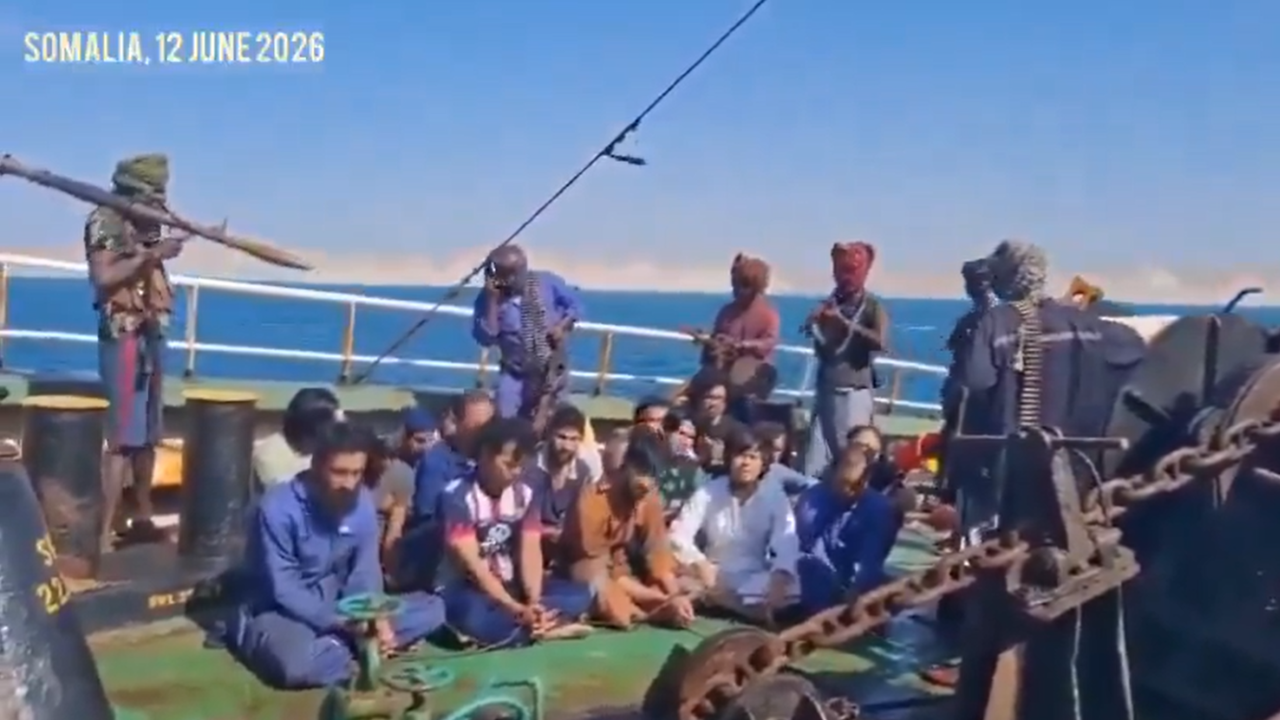
The camera shakes. It is a cheap smartphone video, grainy and poorly lit, but the terror it captures is brutally sharp. A young man, his skin hollowed by months of starvation, stares directly into the lens. Behind him, the endless, mocking blue of the Indian Ocean stretches to the horizon. Beside him stands a masked figure holding a rusted AK-47.
"We have no water. We have no food," the young man whispers, his voice cracking under the weight of a slow, agonizing despair. "Please. If you don't save us, they will kill us."
This is not a scene from a Hollywood thriller. It is a real, desperate plea for survival broadcast from the deck of a hijacked vessel. The man speaking is a Pakistani merchant sailor. He, along with his crewmates, has become a ghost in the global supply chain, captured by Somali pirates who view human beings as nothing more than leverage in a high-stakes financial game.
For years, the world congratulated itself on solving the piracy crisis. Naval patrols increased, private security guards were hired, and the shipping lanes off the Horn of Africa grew quiet. The world moved on. But the ocean is vast, memories are short, and the desperation that fuels piracy never truly disappeared. Now, the nightmares of the past have returned, and a group of forgotten sailors is paying the price for our collective complacency.
The Illusion of a Safe Ocean
To understand how we got here, we have to look at how global shipping actually works. It is an industry built on invisibility. Every day, massive cargo ships carry everything from smartphones to grain across oceans, entirely unnoticed by the average consumer. We only notice the shipping industry when it breaks.
Consider a hypothetical sailor named Ali. He is twenty-four, from a small village outside Karachi. He took a job on a commercial vessel because it was his only ticket to a middle-class life, a way to send money home to his aging parents. When Ali boards a ship, he trusts that international maritime laws, naval coalitions, and his employers will protect him.
But international waters are a legal no-man's-land.
When a ship is hijacked, a bureaucratic nightmare begins. The vessel might be owned by a company in one country, registered under a "flag of convenience" in a second country, managed by an agency in a third, and crewed by men from a fourth. When Somali pirates seize a ship, they exploit this fragmented system. Everyone points fingers at everyone else. Months turn into years. Meanwhile, men like Ali sit in a floating prison, waiting for a ransom that may never come.
The recent resurgence of Somali piracy caught the global community off guard. Security forces had shifted their attention to geopolitical conflicts in the Red Sea, pulling naval assets away from the Somali coast. Pirates saw the opening. They tracked the blind spots. Then, they struck.
Inside the Floating Prison
What happens to a human being when they are held captive at sea for months on end?
The physical toll is obvious. Pirates rarely provide adequate sustenance. Rice and contaminated water become the daily ration. Scurvy, dehydration, and skin infections run rampant. The heat on deck is suffocating during the day; the cold is biting at night.
But the psychological warfare is far worse.
Pirates use tactical cruelty to speed up ransom negotiations. They force hostages to call their families, letting mothers and wives hear the sound of their loved ones being beaten. They stage mock executions. The video plea issued by the Pakistani hostages is a calculated product of this psychological pressure. The pirates want the world to see the suffering. They want the panic to reach a boiling point because panic forces insurance companies and governments to open their wallets.
The families back home live in a parallel hell. They are not wealthy people. They cannot afford the multi-million-dollar ransoms demanded by criminal syndicates. They hold press conferences, they weep on local television, and they beg their governments to intervene.
"Every time the phone rings, my heart stops," the mother of one captive sailor recently shared with a local community advocate. "I don't know if I am going to hear my son's voice, or the voice of a man telling me my son is dead."
The Cold Math of Modern Piracy
There is a dark irony in how the international community measures shipping risks. Everything is calculated in dollars, cents, and insurance premiums.
When a region is deemed a "High Risk Area," insurance rates for shipping companies skyrocket. When piracy dipped a few years ago, the shipping industry successfully lobbied to have the High Risk Area designation removed or shrunk in parts of the Indian Ocean. It was a financial win. It saved companies millions in insurance costs and private security fees.
But the risk didn't vanish. It was simply transferred from the balance sheets of corporations to the lives of the crew members.
Without private security on board, smaller vessels become incredibly vulnerable. Pirates operate using "mother ships"—captured fishing trawlers that allow them to sail hundreds of miles away from the Somali coast into deep waters. When they spot a target, they launch small, fast skiffs. They use ladders to scale the sides of the massive, slow-moving cargo ships. Within minutes, a handful of armed men can take control of a multi-million-dollar vessel and dozens of lives.
The international response to these hijackings is often painfully slow. While powerful navies patrol the region, their rules of engagement are deeply complex. Intervening during an active hijacking carries massive risks to the hostages. Once the ship enters Somali territorial waters and anchors near the shore, a military rescue becomes almost impossible without causing a bloodbath.
The Faces in the Grainy Video
We live in an age of information overload. We swipe past tragedies every single day. A crisis in one corner of the world is quickly buried by a political scandal or a viral trend in another. It is easy to look at a headline about Pakistani hostages and view it as a distant, abstract tragedy happening to people we will never know.
But look closer at the video.
Look at the hands of the sailor holding the camera. They are trembling. Look at the eyes of the men huddled behind him. These are men who have missed birthdays, births, and funerals. They are men who spent their youth studying engineering and navigation, only to find themselves cages in the middle of the ocean.
They are not collateral damage in a geopolitical game. They are human beings.
The standard industry response to these crises is silence. Shipping companies routinely issue brief, sanitized statements: “We are aware of the incident and are working with local authorities to ensure the safe return of our crew.” It is a template designed to soothe investors and keep the public from looking too closely at the systemic failures that allowed the hijacking to happen in the first place.
But silence is the enemy of the captive. When the public stops caring, the pressure on governments to act evaporates. The shipping companies can afford to drag out negotiations for months, trying to lower the ransom price, while the hostages waste away on a diet of stale rice and fear.
A Final Chord
The sun sets over the Indian Ocean, painting the water in brilliant hues of orange and gold. From a distance, the hijacked ship looks peaceful, an industrial giant resting on a calm sea.
But beneath the deck, in the stifling heat of the crew quarters, the reality is starkly different. A group of exhausted men sit in the dark, listening to the footsteps of armed guards pacing above them. They do not know if tomorrow will bring freedom or a bullet. They have done their part. They recorded their plea. They sent their voices out into the digital ether, hoping someone, somewhere, would care enough to listen.
The video continues to circulate online, a digital message in a bottle floating through a sea of indifference. The question is no longer whether we can hear them, but whether we have the courage to look them in the eye and refuse to forget.