The small plastic gears arrive in a crate lined with greaseproof paper. They smell faintly of petroleum and salt air. For twenty-three years, Marcus has stood at the assembly bench in Braunschweig, Germany, waiting for these exact crates. He clips the gears into the housings of medical dialysis pumps. It is precise, rhythmic work. If the gears do not arrive, the line stops. If the line stops for more than forty-eight hours, the regional distributor triggers a penalty clause. If the line stops for a week, Marcus goes home on reduced pay under the state-sponsored furlough scheme.
Lately, the crates are late. Recently making news in this space: The Price of Clean Hands.
They are late because a container ship carrying them had to divert around the Cape of Good Hope, adding eleven days and three thousand nautical miles to its journey from an injection-molding plant outside Johor Bahru. The ship went the long way because a sudden escalation of military tension in the Persian Gulf, driven by the expanding conflict between the United States and Iran, turned the Bab-el-Mandeb strait into a shooting gallery.
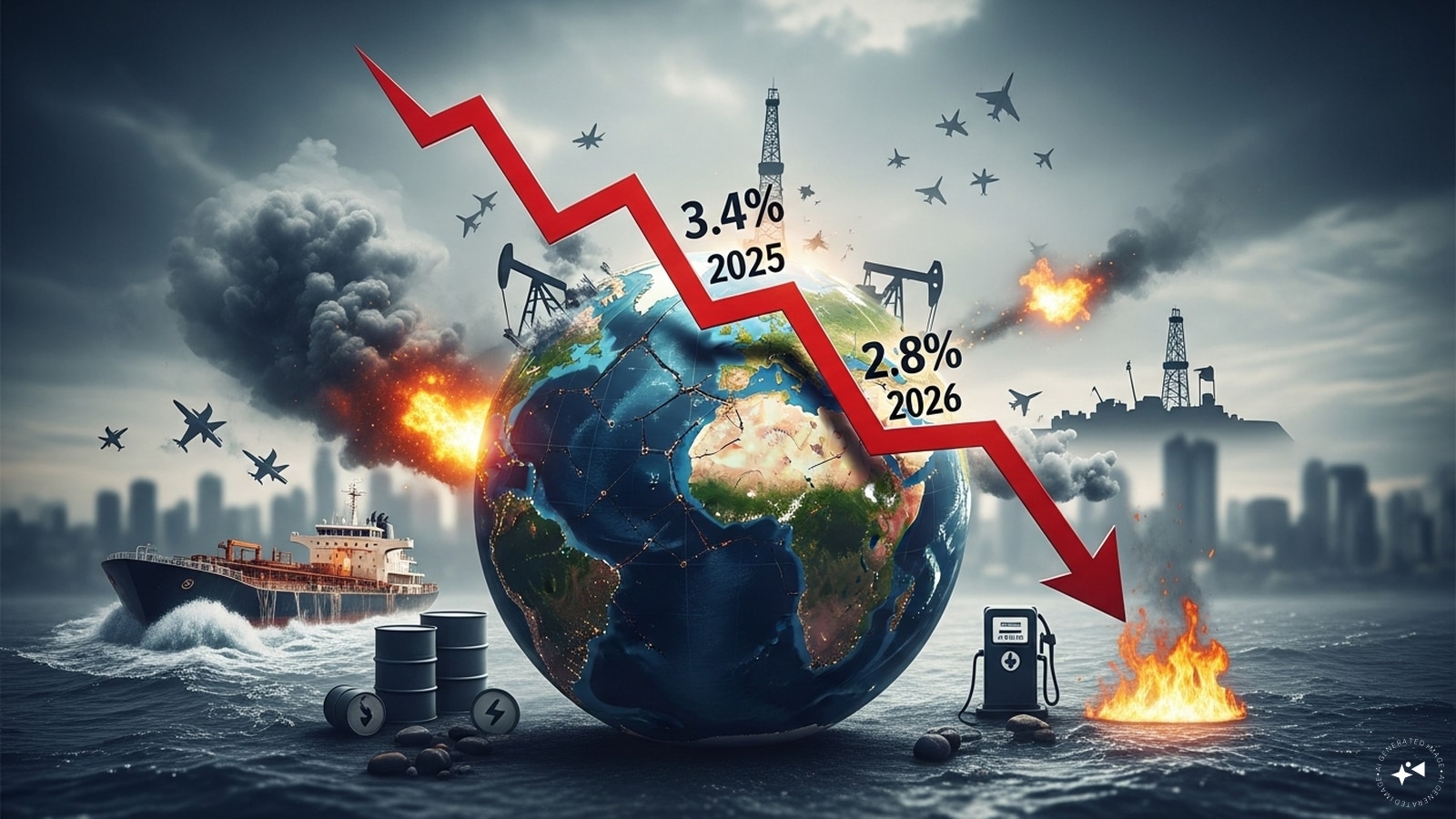
When macroeconomists at the Organisation for Economic Co-operation and Development (OECD) sit in their glass-fronted offices in Paris to revise their global growth forecasts downward, they are not just moving lines on a chart. They are describing Marcus’s empty workbench. They are describing the slow, heavy cooling of an economic engine that was already running on low oil. Additional insights on this are detailed by Harvard Business Review.
The world’s financial architecture is built on the assumption of smoothness. We designed a civilization that relies on the friction-free movement of physical goods, digital capital, and fossil fuels across borders that were supposed to be growing obsolete. We treated stability as a natural law, like gravity. It isn't. Stability is a fragile artificial construct maintained by a delicate balance of deterrence and diplomacy. When that balance shatters, the tax is paid by everyone, everywhere, all at once.
The Mirage of the Isolated Shock
It is easy to look at a geopolitical flashpoint on a map and view it as a localized tragedy. A drone strike on an oil tanker in the Strait of Hormuz feels distant to a consumer buying groceries in Ohio or an entrepreneur launching a software startup in Tokyo. The human cost in the immediate zone of conflict is undeniable and heartbreaking, but the economic cost is often treated as someone else’s problem.
This is an illusion. The modern economy is not a collection of separate rooms; it is an interconnected web of nylon threads. Pull one, and the fabric bunches up miles away.
Consider the arithmetic of a modern container ship. When a vessel is forced to avoid the Suez Canal due to security threats, the immediate cost is not just the extra fuel required to sail around Africa. The real damage is systemic capacity destruction. A ship that spends two extra weeks at sea is a ship that cannot be loaded with new cargo at its next port of call. Global shipping capacity effectively shrinks by ten to fifteen percent overnight, without a single vessel being sunk.
As shipping lines scramble to secure scarce hulls, spot container rates skyrocket. A single forty-foot container that cost $1,800 to move across the ocean twelve months ago suddenly commands $7,500.
Who pays for that? The shipping line absorbs a fraction. The manufacturer absorbs a bit more, watching their margins erode until they bleed red. But eventually, that cost lands squarely on the retail shelf. It is baked into the price of a bicycle, a pair of boots, or a gallon of milk. This is the mechanism by which geopolitical conflict functions as a hidden, regressive tax on the global working class. It bypasses central banks, ignores local monetary policy, and systematically hollows out consumer purchasing power.
The Double Whammy of Crude and Confidence
The OECD’s recent warnings paint a bleak picture of what happens when this friction hardens into a permanent state of affairs. The core of the problem is a twin crisis of energy costs and corporate paralysis.
First, there is the immediate, visceral reaction of the energy markets. The Strait of Hormuz is the world's most critical oil chokepoint. Roughly a fifth of the world’s petroleum consumption passes through this narrow body of water daily. When the United States and Iran exchange threats or kinetic strikes, the risk premium on oil spikes instantly. Even if the physical flow of crude is never fully choked off, the mere probability of a disruption forces insurers to raise premiums on tankers. Traders bid up the price of Brent crude to protect against a worst-case scenario.
For an energy-importing nation like Japan or India, an sustained increase in oil prices behaves exactly like a massive fiscal drain. Money that would have been spent on domestic infrastructure, research and development, or public services is instead transferred abroad to secure basic fuel requirements.
But the second effect is far more insidious, and it is the true driver of the global slowdown: the death of corporate confidence.
Imagine you are the chief financial officer of a mid-sized electronics firm. You have a plan to invest $50 million in a new automated fulfillment hub that will create four hundred jobs. The blueprints are ready. The local government has approved the permits. Then, the headlines break. Missiles are fired in the Gulf. The price of oil jumps seven percent in an afternoon. The OECD releases a statement lowering global growth expectations for the coming fiscal year.
What do you do?
You do what every prudent executive does when the fog descends. You wait. You mothball the expansion plan. You freeze hiring. You hoard cash. You tell the board that it is time to de-risk and wait for clarity.
When ten thousand executives make that identical decision in the same week, economic growth does not just slow down; it evaporates. The capital expenditure that drives innovation and productivity stops dead. The jobs that were about to be created disappear before they ever existed on a ledger. This is how a war of words and asymmetric drone strikes across the world translates into a quiet stagnation in suburbs thousands of miles away.
The Myth of Reshoring and the Reality of Cost
There is a popular counter-narrative to this vulnerability. For the past several years, politicians and pundits have championed the idea of "reshoring" or "friend-shoring"—bringing supply chains back home or restricting them to allied nations. The argument goes that if we decouple our economies from volatile regions and hostile actors, we can insulate ourselves from these global shocks.
It is a seductive theory. It is also an extraordinarily expensive one.
The global supply chain was not built by accident. It was built by decades of ruthless optimization designed to find the absolute most efficient place on Earth to perform every specific task. A smartphone is an archaeological dig of global cooperation: lithium from Chile, cobalt from the Democratic Republic of Congo, design work from California, precision optics from Japan, and assembly in Vietnam.
To tear down this network and rebuild it within national borders requires an unimaginable amount of capital. It means building factories where labor is scarce and expensive, and duplicating infrastructure that already exists elsewhere.
More importantly, it takes time. You cannot build a advanced semiconductor fabrication plant or train a generation of specialized metallurgical engineers in a weekend. It takes a decade. During that transition period, the economy is caught in a purgatory of high transition costs and lingering vulnerability. You are paying the premium for a safer world without actually being safe yet.
The reality is that total self-sufficiency is a fantasy for almost every modern nation. We are locked into interdependence. Our wealth, our comfort, and our survival are tied to the compliance of strangers across the globe. When that compliance breaks down, we discover that the walls we built to protect ourselves are actually just keeping the scarcity inside.
The Human Ledger
To understand the true weight of the OECD's warnings, we must look past the aggregate GDP figures and look at the margins of society, where there is no buffer.
In developing economies, the connection between geopolitical friction and human suffering is direct and brutal. When global growth slows, capital flees emerging markets for the safety of US Treasury bonds. This causes local currencies to plummet against the dollar. Because international commodities like grain, fertilizer, and oil are priced in dollars, these necessities instantly become prohibitively expensive for nations already teetering on the edge of food insecurity.
Consider a small-scale farmer in East Africa. He does not know the details of the naval deployments in the Indian Ocean. He does not read the white papers issued by multilateral institutions in Europe. What he knows is that a bag of imported nitrogen fertilizer now costs double what it did last season because the shipping lane is disrupted and the chemical plant in Europe is paying record prices for natural gas. He buys half as much fertilizer. His yield drops by forty percent. His children eat one less meal a day.
This is the real translation of a 0.5% reduction in global GDP growth. It is not an abstract statistical variance. It is a measurement of human deprivation. It is the sound of choices narrowing for people who already had very few choices to begin with.
Even in wealthier nations, the damage is felt as a slow, corrosive loss of optimism. It is the young couple putting off buying their first home because mortgage rates remain stubbornly high as central banks fight the inflation caused by supply shocks. It is the graduate whose job offer is rescinded because the tech firm decided to execute a defensive restructuring. It is the creeping realization that the future is no longer expanding, but contracting.
The Limits of Monetary Magic
For the better part of two decades, central banks have acted as the paramedics of the global economy. Every time there was a crisis—whether a financial meltdown, a sovereign debt panic, or a global pandemic—they rushed in with the same toolkit: lower interest rates and massive liquidity injections. They flooded the system with money to keep the gears turning.
But the current crisis, born of geopolitical conflict and physical disruption, exposes the hard limits of that magic.
A central bank can print money, but it cannot print a container ship. It cannot lower interest rates to make a missile fly backwards. It cannot use quantitative easing to clear a blocked maritime strait or force an oil refinery to produce more diesel when its feedstock is cut off.
In fact, the old toolkit makes the current problem worse. If central banks cut rates to stimulate an economy slowed down by supply shocks, they simply pump more demand into a system that cannot supply the goods. The result is not growth; it is runaway inflation. This leaves policymakers caught in a trap of their own making. They must keep interest rates high enough to suppress inflation, even if it means starving businesses of the capital they need to adapt to the new, more hostile world.
The responsibility for fixing this does not lie with central bankers or corporate boards. It lies in the realm of statecraft, a discipline that has been neglected in favor of economic efficiency for far too long.
The Long Road Through the Fog
We are entering an era where the cost of doing business will include a permanent premium for chaos. The era of the "peace dividend"—the economic windfall that followed the end of the Cold War—is officially over. The infrastructure of global trade, which we treated as public commons like the air or the sea, is being privatized, weaponized, and carved up into spheres of influence.
Marcus, at his bench in Braunschweig, understands this instinctively. He doesn't need to read the OECD report to know that the old way of working is fractured. He sees it every time he looks at the empty space on the loading dock where the crates used to sit. He adapts. His company is looking into a domestic supplier for the plastic gears, even though the unit cost will be forty percent higher and the tolerances won't be quite as tight.
It is a compromise. The pump will be more expensive to make. The hospital will pay more to buy it. The healthcare system will pass that cost onto the taxpayer.
The machine will keep running, but it will shake. It will make more noise. It will require more energy to produce the same result. The world is not ending, but it is becoming smaller, heavier, and harder to move. The great acceleration has ended; the great drag has begun.