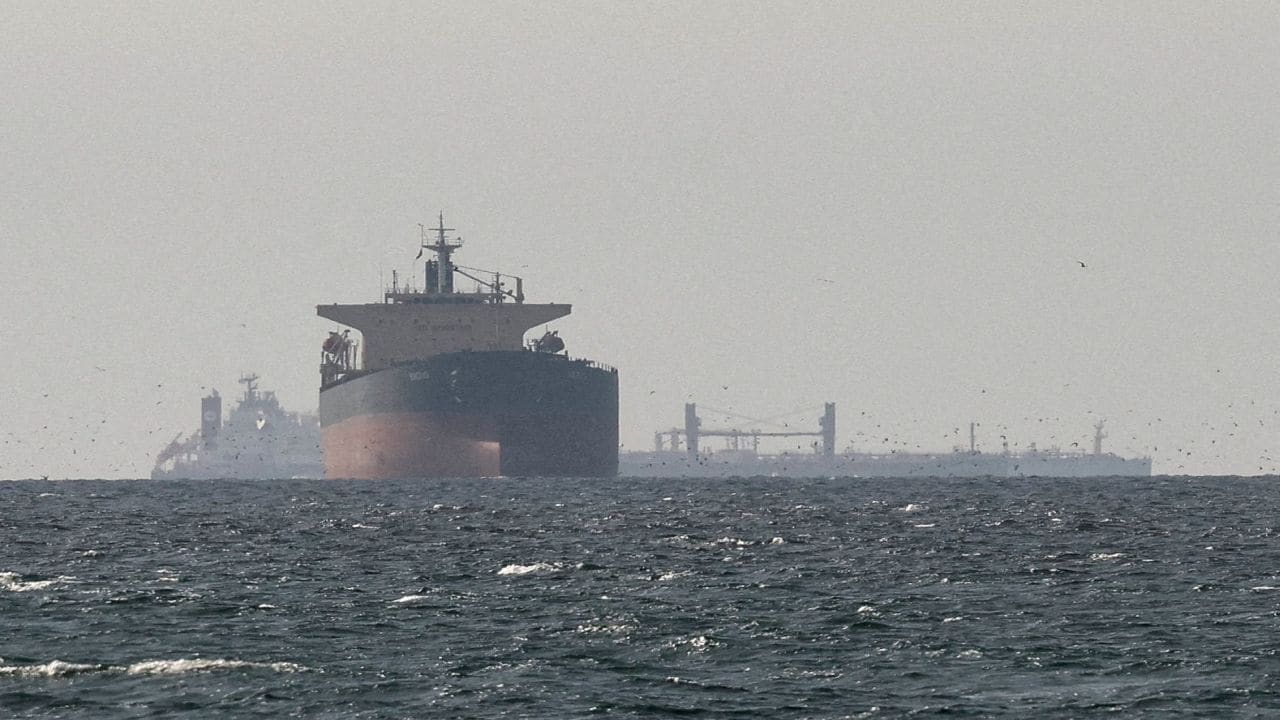
The water in the Strait of Hormuz does not look like geopolitical dynamite. It looks heavy, dark, and deceptively calm, thick with the salt of the Persian Gulf and slicked with the microscopic residue of a billion barrels of transit. If you stand on the deck of a container ship passing through this narrow ribbon of blue, the world feels claustrophobically tight. To your left, the jagged, sun-bleached cliffs of Oman’s Musandam Peninsula rise like broken teeth. To your right, the hazy coastline of Iran stretches out into the shimmering heat.
Between them lies a stretch of water just twenty-one miles wide.
For the crews aboard the massive liquefied natural gas (LNG) carriers pushing through these shallows, the tension is a physical weight. You can feel it in the low hum of the massive turbines beneath your boots and see it in the white-knuckled grip of the watch officer scanning the horizon. This isn't just a shipping lane. It is the jugular vein of the global energy economy. A fifth of the world’s liquid petroleum and a massive chunk of its natural gas must squeeze through this single, precarious doorway every single day.
When Doha opens its mouth to speak about this water, the entire world leans in to listen.
Qatar, the tiny peninsula jutting out into the Gulf like an afterthought, has quietly become an economic titan by mastering the cold science of super-chilled gas. Now, a quiet tremor has rippled through the diplomatic backrooms of the Middle East. Qatari officials have signaled that a proposed temporary toll for ships navigating the Strait of Hormuz is not a hard line in the sand. It is negotiable.
To the casual observer scrolling through financial headlines, it sounds like dry bureaucratic posturing. A minor tax dispute. A footnote in a maritime ledger.
But talk to the people whose lives are tethered to the movement of those ships, and a very different story emerges.
The Ghost in the Ledger
Consider a hypothetical captain named Marcus. He has spent thirty years navigating the world’s choke points, from the pirate-strewn waters of the Malacca Strait to the tight concrete locks of Panama. He knows that in the shipping industry, time is not just money. Time is survival.
When Marcus stands on the bridge and hears rumors of a new transit fee, he doesn’t think about macroeconomic trends or international law. He thinks about the sheer, cascading friction of moving a three-hundred-meter vessel through a bureaucratic minefield.
A toll means stopping. It means inspections. It means paperwork flying between ministries while a vessel burning tons of fuel idling in a current waits for clearance. It means insurance premiums—already inflated by the ever-present threat of regional conflict—skyrocketing overnight.
"Every hour you sit waiting for someone to stamp a document," Marcus might tell you over a mug of bitter galley coffee, "is an hour the market moves away from you. The sea doesn't care about diplomacy. But the accountants do."
The proposed toll is a response to an agonizingly complex reality. Maintaining security, managing traffic, and mitigating environmental risks in one of the busiest waterways on earth costs a fortune. Qatar and its neighbors bear the brunt of that burden. They build the infrastructure, deploy the coast guards, and monitor the shifting sandbars. The idea of a temporary levy to offset these staggering costs makes logical sense on paper.
Yet, the global energy market is a hypersensitive organism. It reacts to the slightest hint of friction the way a thoroughbred horse reacts to a sudden shadow.
When news broke that Qatar was willing to negotiate the terms of this toll, a collective breath was released in trading rooms from London to Tokyo. It was a signal that the adults in the room understood the fragility of the system.
The Anatomy of twenty-one Miles
To truly understand why a few dollars per container or a minor percentage fee on an LNG carrier matters, you have to look at the map.
The Strait of Hormuz is a geographic bottleneck. There are no easy detours. If you are a country like Japan, relying on the Gulf for the vast majority of your crude oil, or a European nation trying to heat homes without Russian pipelines, those twenty-one miles are your life support system.
Imagine the global energy supply as a massive, pressurized pipeline running into a single, tiny valve. Every country is trying to drink from the same pipe. Now, imagine someone places a hand on that valve. They aren't closing it. They are just turning it a fraction of an inch, testing the resistance, feeling how much pressure is building up on the other side.
That is what a toll represents. It is a assertion of ownership over a space that the world likes to pretend belongs to everyone.
Qatar’s willingness to treat the toll as a conversation rather than an ultimatum is a masterclass in economic diplomacy. Doha knows it cannot afford to alienate its global customers. The transition to green energy is a slow, grinding process, but it is happening. If natural gas becomes too expensive or too legally fraught to transport, the world will simply accelerate its search for alternatives.
By declaring the toll negotiable, Qatar isn't backing down. They are inviting the world to the table to acknowledge a fundamental truth: someone has to pay for the safety of the strait.
The Hidden Cost of Comfort
We live in a world designed to hide its own scaffolding. When you flip a light switch in Munich, or pump gas into an SUV in Ohio, you rarely think about the chain of human effort required to make that moment possible.
You don't think about the Qatari engineers working in the blinding heat of Ras Laffan, monitoring the cryogenic cooling units that turn natural gas into a liquid at minus 162 degrees Celsius. You don't think about the deckhands sweating through their coveralls as they secure towlines in the swells of the Gulf.
The debate over the Hormuz toll drags these invisible systems into the light.
It forces us to confront the reality that our comfort is entirely dependent on the stability of a few volatile patches of water. If a temporary toll is implemented poorly, the cost flows downhill. It won't be absorbed by the multi-billion-dollar shipping conglomerates or the state-owned energy giants. It will show up on utility bills in suburban neighborhoods. It will be tacked onto the price of a gallon of milk that had to be trucked across a continent.
The stakes are entirely human.
But the real problem lies elsewhere. The true danger isn't the monetary value of the fee itself. It is the precedent it sets. If the Strait of Hormuz becomes a toll road, what stops the Malacca Strait from doing the same? What prevents a coalition of nations from monetizing the Bab-el-Mandeb or the English Channel?
The ocean has long been viewed as the ultimate global common, a shared expanse where the only rules are those of safe navigation and mutual respect. Introducing transactional barriers, even temporary ones meant for legitimate upkeep, threatens to balkanize the sea.
The Art of the Unspoken Agreement
Diplomacy in the Gulf rarely happens in public. The real work is done in the margins of international summits, over heavy porcelain cups of cardamom-infused coffee, where what is left unsaid carries far more weight than any official press release.
Qatar’s announcement is a classic example of this soft-power ballet. By stating that the toll is negotiable, they have shifted the burden of initiative onto the international community. They have essentially said, We are willing to protect this artery, but we will not do it for free. What is it worth to you?
It is an uncomfortable question for nations that have long taken the free flow of Gulf energy for granted.
Consider what happens next: a series of quiet delegations will arrive in Doha. Bureaucrats from major importing nations will sit across from Qatari officials, poring over maritime charts and financial projections. They will argue over definitions, exemptions, and sunset clauses.
It will be tedious, exhausting work. But it is infinitely preferable to the alternative.
The alternative is a sudden, unilateral decision that catches the market off guard. We have seen what happens when shipping lanes are disrupted by conflict or political gridlock. Ships are rerouted around the Cape of Good Hope, adding weeks to voyages and burning millions of gallons of extra fuel. Supply chains groan and snap. Shortages loom.
By choosing the path of negotiation, Qatar is choosing predictability. In the volatile world of international trade, predictability is the rarest and most valuable commodity of all.
The sun sets over the Strait of Hormuz in a blaze of furious orange, casting long, dark shadows from the supertankers pushing their way out toward the Arabian Sea. On the bridge of one of those ships, a radar screen sweeps rhythmically, painting a green picture of a world defined by narrow channels and invisible borders.
The crew on board doesn't know the outcome of the meetings in Doha. They don't know what the final percentage will be, or who will sign the checks.
They only know that the water beneath them is deep, the passage is narrow, and the rest of the world is waiting on the other side of the horizon, desperately hoping the door stays open.