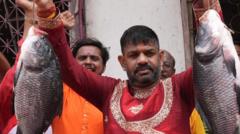
The visual recurring motif of Indian politicians posing with fish during campaign cycles is not a whimsical cultural quirk but a calculated deployment of semiotic capital designed to signal specific economic and identitarian alignments. In a high-stakes electoral environment, the "fish pose" serves as a high-density communication tool that addresses three distinct strategic variables: regional food sovereignty, caste-based labor identification, and the rejection of a homogenized national diet. To understand the mechanics of this tactic, one must analyze the intersection of protein economics and the demographic distribution of the Indian electorate.
The Triple Logic of Piscine Campaigning
The deployment of fish in political imagery operates within a structured framework that can be categorized into three primary pillars. Each pillar addresses a specific segment of the voter psychology and responds to the prevailing tensions within the Indian federal structure.
1. The Signaling of Regional Authenticity
In states like West Bengal, Kerala, Assam, and Bihar, fish consumption is deeply integrated into the ontological definition of the "local." When a politician handles a fish—specifically high-value species like the Hilsa (Tenualosa ilisha) or the Rohu (Labeo rohita)—they are engaging in a performance of cultural boundary-setting. This performance functions as a counter-narrative to "Sanskritization," a sociological process where lower-caste or regional groups adopt the customs of higher-castes (often including vegetarianism) to seek upward mobility.
By publicizing the act of buying, holding, or eating fish, the politician signals a refusal to conform to a centralized, often North Indian-centric, dietary norm. This is a deliberate "insider" signal. The message is binary: I consume what you consume, therefore I represent your interests against external cultural homogenization.
2. Labor Identification and the Blue Economy
Beyond the plate, the fish is a tool of production. India is the world’s third-largest fish producer, contributing roughly 1.1% to the national GDP and over 7% to the agricultural GDP. The sector supports approximately 28 million people, many of whom belong to Traditional Fisherfolk Communities (TFCs) which often correlate with specific Scheduled Caste (SC) or Other Backward Class (OBC) blocks.
- The Proximity Metric: By physically holding a fish in a marketplace (mandi) or at a landing center, a candidate reduces the perceived social distance between the political elite and the manual labor force.
- The Commodity Validation: The choice of fish matters. A large, healthy specimen signals a thriving local ecosystem and, by extension, the success of local resource management—or the urgent need for its protection against industrial trawling.
3. Protein Politics and Secular Signaling
Dietary choices in India are frequently weaponized as markers of religious or ideological purity. In this context, the fish becomes a "secular" protein. Unlike beef, which is hyper-politicized and legally restricted in many states, or chicken, which is viewed as a globalized commodity, fish occupies a space that is both traditional and religiously inclusive for large swaths of the Hindu, Muslim, and Christian populations in coastal and riverine belts.
Publicly engaging with fish allows a candidate to project a "pro-choice" dietary stance without the extreme electoral risks associated with more controversial meats. It is a strategic middle ground that reinforces a pluralistic identity.
The Cost Function of the Piscine Image
While the benefits of this imagery are clear, the execution carries inherent risks and "noise" that can dilute the strategic intent. The efficacy of the fish pose is governed by a set of authenticity constraints.
The Authenticity Constraint
If a politician appears uncomfortable or handles the fish incorrectly—holding it by the tail instead of the gills, or showing visible aversion to the smell or texture—the signal backfires. It transforms from a sign of solidarity into a "tourist" moment, highlighting the candidate’s disconnection from the working class. The voter perceives the act as transactional rather than relational.
The Seasonal and Economic Context
The timing of these displays often coincides with periods of high inflation or seasonal bans on fishing. If a politician poses with an expensive fish during a price surge, it can be interpreted as a display of tone-deafness or elitism. Conversely, posing with fish during a breeding-season ban can signal a lack of policy knowledge regarding conservation laws.
Resource Allocation and the Coastal Belt Strategy
The concentration of this imagery is not uniform across the subcontinent. It follows a predictable geographic and economic distribution:
- The Eastern Corridor (West Bengal and Odisha): Here, the fish (specifically the Hilsa) is a symbol of premium cultural status. Strategy here focuses on "Prestige Signaling."
- The Southern Littoral (Kerala, Tamil Nadu, Andhra Pradesh): The focus shifts to "Labor Solidarity," where politicians often meet with fishing unions. The fish is a representative of the "Blue Economy" and the threat of international maritime competition.
- The Hinterland (Bihar and Eastern Uttar Pradesh): In these regions, freshwater aquaculture is a burgeoning industry. The fish represents "Developmental Success" and the promise of new revenue streams for rural farmers.
The Mechanistic Link Between Diet and Ballot
The reason this tactic persists is rooted in the "Availability Heuristic." Voters are more likely to trust a candidate who shares their daily sensory experiences. Food is the most visceral of these experiences. When a politician enters the sensory "realm" of the voter—the sights and smells of the fish market—they bypass intellectual skepticism and tap into primal tribal recognition.
This is a form of Micro-Targeting through Semioptics. While digital campaigns use data to target social media feeds, the physical fish act targets the physical environment. It creates a "viral" image that circulates through local WhatsApp groups, reinforcing the candidate’s brand as a "soil-of-the-earth" leader.
Strategic Divergence: Fish vs. Other Symbols
To quantify the value of the fish, one must compare it to other common political symbols used in the Indian landscape:
| Symbol | Target Demographic | Primary Signal | Risk Profile |
|---|---|---|---|
| Agricultural Tools | Rural Farmers | Hard work / Tradition | Low / Generic |
| Religious Icons | Specific Faith Groups | Moral Authority | High (Polarizing) |
| Technology/Tablets | Urban Youth | Modernity / Progress | Moderate (Elitist) |
| Fish | Coastal/Riverine Workers | Cultural Identity / Labor | Moderate (Authenticity) |
The fish is uniquely positioned because it bridges the gap between "Tradition" and "Economic Utility." It is both an ancient cultural symbol and a modern commodity.
Bottlenecks in the Piscine Narrative
Despite its effectiveness, several factors are currently creating a "bottleneck" for this strategy:
- The Rise of Industrial Aquaculture: As fish production moves from traditional capture to industrial ponds, the "rugged" image of the fisherman is being replaced by the "industrialist." This shifts the symbolic value of the fish from labor to capital, which may not resonate as strongly with the working-class base.
- Climate Instability: Declining fish stocks due to ocean warming and river pollution make the "abundance" signaled by a politician holding a large fish look increasingly disconnected from the reality of the struggling small-scale fisher.
- Generational Shifts: Younger voters in urbanizing centers may prioritize different markers of progress, such as infrastructure or digital access, making the fish pose feel dated or performative.
Structural Execution of the Campaign Image
To maximize the impact of this strategy, campaign managers must adhere to a strict operational protocol:
- Species Selection: Use a species that is currently in season and accessible to the median voter.
- Location Choice: Avoid sanitized environments. The background must be a high-traffic, high-noise local market to ensure the "grit" of the environment transfers to the candidate’s persona.
- Physical Interaction: The candidate must engage in the transaction. Simply looking at the fish is insufficient; they must inspect it, discuss the price, and ideally, demonstrate knowledge of its quality. This creates a "Mastery Signal."
The persistence of the fish in Indian political imagery is evidence of a sophisticated understanding of the electorate's move toward localized, identity-driven politics. As national narratives become more polarized, the ability to anchor a campaign in the tangible, edible, and regional becomes an essential tool for survival in the competitive landscape of Indian democracy. The strategic play is to move beyond the visual and integrate these symbolic gestures into a hard-policy framework that addresses the specific economic grievances of the communities these symbols represent.


:strip_icc()/pic2513216.jpg)