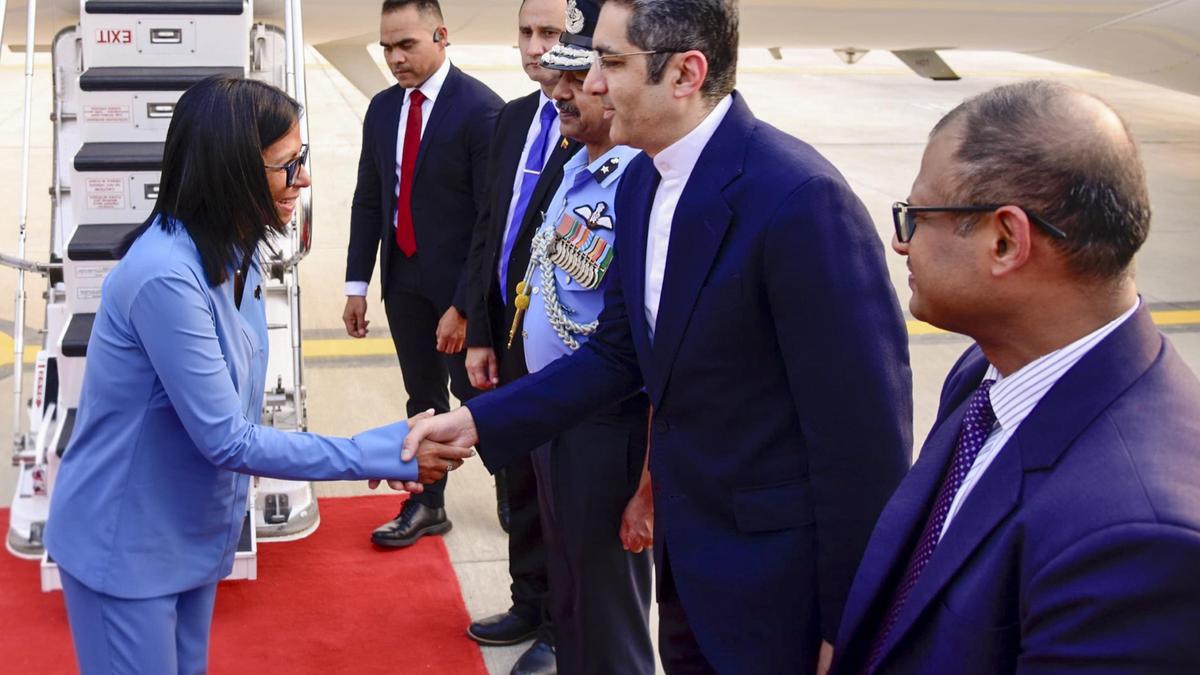
The global diplomatic press corps has a predictable playbook. When a state official from a sanctioned nation touches down in New Delhi, the resulting coverage reads like a boilerplate press release. The mainstream narrative surrounding Venezuelan Executive Vice President Delcy Rodríguez’s recent arrival in India follows this exact script. Journalists dutifully repeat the official line: this is a strategic working visit aimed at deepening bilateral ties, diversifying energy portfolios, and building a robust multipolar world order.
It is a comforting narrative. It is also entirely detached from economic reality.
The lazy consensus treats India’s engagements with Venezuela as a masterclass in strategic autonomy—a calculated move by New Delhi to balance its Western alliances while securing cheap crude from the Global South. But if you look past the standard diplomatic handshakes, the numbers tell a completely different story. This isn't a forward-looking energy alliance. It is a desperate attempt to resurrect a ghost ship.
Treating Venezuela as a viable, long-term pillar of Indian energy security ignores the structural decay of Caracas’s infrastructure and the hard financial realities of modern refining. The premise that India can simply pivot back to Venezuelan crude to offset Middle Eastern volatility is flawed.
The Cargo Cult of Sanctions Relief
The foundational myth of the India-Venezuela relationship is that geopolitics is the only barrier to trade. The argument goes like this: when Washington eases sanctions, Indian state-owned and private refiners can immediately ramp up imports of cheap Venezuelan heavy crude, saving billions. When Washington tightens sanctions, the flow stops.
This perspective mistakes a symptom for the cause.
I have spent decades analyzing energy supply chains and corporate asset allocations. The real bottleneck is not the Office of Foreign Assets Control (OFAC) in Washington. The real bottleneck is the catastrophic, systemic collapse of Venezuela’s domestic energy infrastructure.
Petróleos de Venezuela S.A. (PDVSA) is an empty shell of its former self. Years of chronic underinvestment, brain drain, and systemic corruption have broken the back of the country's oil production capabilities. In the early 2000s, Venezuela pumped over three million barrels per day. Today, it struggles to maintain a fraction of that, frequently hovering under 900,000 barrels per day.
Venezuelan Crude Production Over Time:
2000: ~3,200,000 bpd
2026: ~850,000 bpd (Estimated)
No amount of diplomatic goodwill or high-level working visits can magically fix cracked upgraders, rusted pipelines, and water-logged oil fields. When Indian refiners look at Venezuela, they are not looking at a sleeping giant. They are looking at an industrial graveyard.
The Heavy Crude Trap Why Price Discounts Are an Illusion
To understand why this relationship is structurally flawed, you have to look at the chemistry of the crude itself. Venezuela’s primary export to India has traditionally been Merey 16, an ultra-heavy, sour crude blend.
Mainstream economic analysts often look at the steep discounts on Merey crude and assume Indian refiners are scoring a massive win. This is a fundamental misunderstanding of refinery economics.
Refining ultra-heavy crude is not a simple plug-and-play operation. It requires highly complex, capital-intensive secondary processing units like delayed cokers and hydrocrackers to break down the dense, sulfur-heavy molecules into high-value products like diesel and gasoline.
- High Processing Costs: Processing heavy Venezuelan crude requires significantly more energy and chemical catalysts, driving up operational expenditure.
- Corrosion and Maintenance: The high Total Acid Number (TAN) and sulfur content of Merey crude accelerate equipment corrosion, forcing refiners into more frequent, costly maintenance shutdowns.
- The Yield Problem: Even the most advanced complex refineries cannot turn a barrel of sludge entirely into gold. The yield of low-value petroleum coke and heavy fuel oil is inherently higher with Venezuelan crude than with lighter, sweeter alternatives.
Indian giants like Reliance Industries and Nayara Energy possess some of the most sophisticated, high-complexity refineries in the world, specifically designed to process heavy bottom-of-the-barrel crudes. I have watched these companies optimize their slates for years. But sophistication does not mean blindness to risk.
When you factor in the massive shipping distances from the Orinoco Belt to the western coast of India, the increased freight insurance premiums, the prolonged transit times, and the technical headaches of processing high-sulfur sludge, that tempting discount evaporates. Venezuela is not offering a bargain; it is charging a premium for volatility.
Dismantling the People Also Ask Premise
When casual observers look into this geopolitical pairing, they tend to ask the wrong questions because they are operating on outdated assumptions.
Does India need Venezuela to diversify away from Russian oil?
This question assumes India is looking for an exit strategy from its current trade patterns. It isn't. The massive influx of discounted Russian Urals completely transformed Indian refining economics. Urals is a medium-sour crude that is significantly easier and cheaper to process than Venezuelan Merey. Russia has demonstrated a consistent, highly organized ability to deliver millions of barrels per day through a massive shadow fleet, completely bypassing traditional Western financial bottlenecks. Venezuela cannot compete with Russian logistics, reliability, or volume. Expecting Caracas to replace Moscow is like expecting a local courier to replace a global freight network.
Can India pay for Venezuelan oil using alternative currencies or barter systems?
This is a favorite talking point among advocates of de-dollarization. They point to past arrangements where India explored paying for crude using rupees or trading engineering goods and medicines for oil.
In the real world, these barter mechanisms are a logistical nightmare. PDVSA needs hard cash—specifically U.S. dollars or euros—to pay its remaining skilled workforce and import the foreign equipment required to keep its fields semi-functional. It cannot fix an oil well with rupee-denominated bank credits stuck in a Mumbai escrow account. Barter trade sounds revolutionary in a policy paper, but it fails immediately on the factory floor.
The Washington Shadow Game
The ultimate blind spot in the mainstream consensus is the belief that India can completely ignore the geopolitical leverage of the United States.
Let’s be brutally honest about the power dynamics. Indian corporations are deeply integrated into the Western financial ecosystem. They rely on U.S. dollar clearing mechanisms, Western maritime insurance, and European technology providers.
Imagine a scenario where an Indian refiner decides to aggressively expand its off-take of Venezuelan crude in open defiance of U.S. policy. The immediate consequence isn't just a sternly worded letter from Washington. The consequence is the potential loss of access to secondary markets, the freezing of international dollar transactions, and severe reputational damage that could tank their stock price on global exchanges.
No corporate board in Mumbai or New Delhi is going to risk billions of dollars in Western trade and financial access just to secure a few token shipments of unreliable, low-quality crude from Caracas. The working visits and diplomatic handshakes are a form of political theater. They allow India to maintain its stance as a leader of the Global South and keep a foot in the door just in case Venezuela ever stabilizes. But it is a hedging strategy, not an operational reality.
The Strategic Shift Nobody Is Talking About
While the media focuses on oil, the true disruption in global energy is happening elsewhere. India’s long-term strategic goals are rapidly shifting toward decarbonization and green hydrogen. The country is investing heavily in solar infrastructure, domestic battery manufacturing, and alternative energy vectors.
Every corporate dollar and state resource poured into chasing unstable, high-sulfur fossil fuels from half a world away is a distraction from the real game: achieving domestic energy independence through technology, not resource extraction.
If you are an energy investor or an industrial strategist, do not buy into the hype of a renewed India-Venezuela golden era. The structural math simply does not work. The infrastructure in Venezuela is too broken, the logistical costs are too high, the refining penalties are too severe, and the geopolitical risks are too punitive.
Stop looking at diplomatic arrivals as a sign of economic alignment. They are the dying echoes of an old energy paradigm that has already lost its relevance. The future of Indian energy security isn't hidden in the depleted fields of the Orinoco Belt; it is being built in the tech hubs of Bengaluru and the solar farms of Rajasthan. Treat the Caracas-New Delhi oil pipeline for what it truly is: a historical artifact.