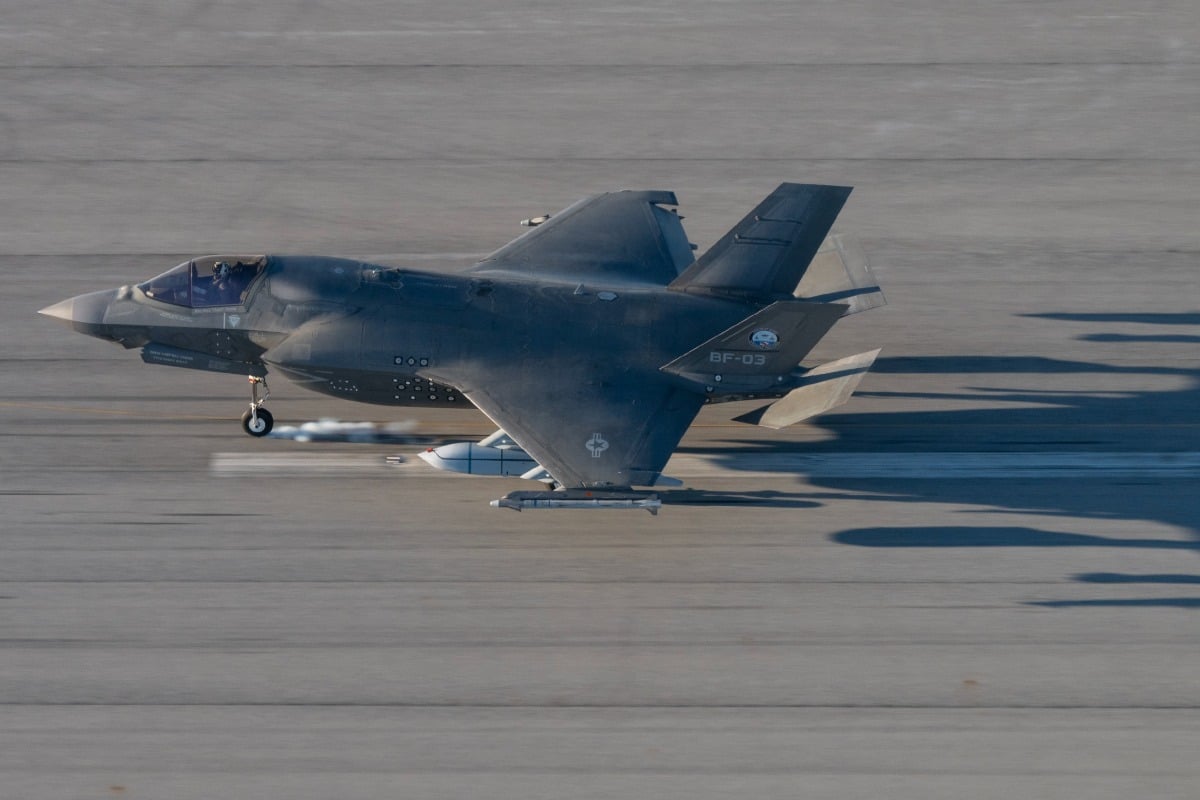
The U.S. Air Force is quietly dismantling a single-source monopoly on its premier long-range strike weapons. Driven by the stark realization that American factories cannot build munitions fast enough for a major conflict, defense officials are currently seeking a second production source for the Joint Air-to-Surface Standoff Missile and the Long-Range Anti-Ship Missile. Lockheed Martin has held an exclusive grip on these programs for years. By opening the blueprints to a rival builder, the Pentagon is attempting an aggressive, historically difficult industrial pivot to solve a crippling capacity crisis before a shooting war forces their hand.
For decades, the defense establishment prioritized stealth, precision, and technological sophistication over sheer mass. That calculation backfired. Simulated war games over the Taiwan Strait routinely end in a sobering scenario where American forces run out of precision-guided munitions within the first week of conflict.
The bottleneck is not funding. The bottleneck is the factory floor.
The Fragility of a Single Assembly Line
To understand how the Air Force arrived at this point, one must look at the structural consolidation of the defense industrial base since the end of the Cold War. In the 1990s, dozens of prime contractors were encouraged to merge, reducing overhead but stripping the nation of redundant manufacturing capacity.
Lockheed Martin’s facility in Troy, Alabama, has been the sole birthplace of the Joint Air-to-Surface Standoff Missile (JASSM) and its maritime sibling, the Long-Range Anti-Ship Missile (LRASM). These weapons are critical. They allow bombers and fighter jets to strike heavily defended enemy targets from hundreds of miles away, well outside the reach of modern air defense systems.
When a single facility holds the keys to an entire class of strategic weapons, any disruption becomes a national security vulnerability. A fire on the line, a shortage of specialized microchips, or a localized labor strike can halt the flow of vital munitions to the front lines.
Furthermore, the current production rate is simply inadequate for a peer-on-peer conflict. The Air Force wants thousands of these missiles, but a single prime contractor, working within the constraints of traditional aerospace manufacturing, faces steep physical limits on how fast it can scale. Machine tools must be ordered years in advance. Specialized technicians require extensive vetting and training.
By bringing in a second builder, the Air Force is not necessarily looking to replace the incumbent. It is trying to build a duplicate engine for the American war machine.
Technical Data Packages as Weapons of Statecraft
The mechanism for this shift hinges on something called a Technical Data Package (TDP). This is the complete blueprint of the missile, containing every engineering drawing, material specification, software code, and assembly instruction required to build the weapon from scratch.
Historically, defense contractors guarded their intellectual property with extreme ferocity. Propelled by recent legislative mandates and a shift in Pentagon acquisition strategies, the government has asserted greater rights over these technical data packages.
Traditional Acquisition Model:
[Government Funds R&D] -> [Contractor Owns Data] -> [Single-Source Monopoly]

Modern Competitive Model:
[Government Funds R&D] -> [Government Secures TDP] -> [Dual-Source Bidding]
Under this dual-source strategy, the Air Force intends to hand Lockheed Martin’s proprietary blueprints to a competitor. That rival—likely another major defense prime like Raytheon or Boeing, or perhaps an agile challenger like Anduril—will be tasked with building the exact same missile to the exact same specifications.
This is far more complex than printing a document on a different machine. A new builder must establish an entirely separate supply chain for rocket motors, warheads, and seeker heads. They must calibrate their own tooling to match tolerances measured in fractions of a millimeter.
The transition period will be fraught with friction. The first few dozen missiles off the new line will require exhaustive testing to ensure they perform identically to the original design. If the software integration fails or a substitute material behaves unexpectedly under high g-forces, the entire program faces delays.
The Counter Argument to Multi Sourcing
While the strategic benefits of duplication are obvious, the financial reality is highly contentious. Defense economists have long pointed out that splitting a production run between two companies can actually drive up the unit cost of each missile.
When a single company builds 500 missiles a year, it benefits from economies of scale. It can buy raw materials in bulk and optimize its labor force. If you split that order—giving 250 to Company A and 250 to Company B—both factories operate at lower efficiency.
Estimated Financial Trade-offs of Dual-Sourcing
+-----------------------------------+-----------------------------------+
| Advantages                        | Disadvantages                     |
+-----------------------------------+-----------------------------------+
| Higher total production surge capacity | Increased initial tooling and setup costs |
| Protection against facility supply chain failures | Loss of pure economy of scale savings |
| Competitive pressure on unit pricing over time | Duplicated administrative and testing overhead |
+-----------------------------------+-----------------------------------+
The upfront cost to tool up a second factory is immense. Taxpayers must foot the bill for new specialized test equipment, cleanrooms, and robotic welding stations before a single piece of hardware leaves the facility.
The Air Force is betting that long-term competitive pressure will offset these initial setup costs. When two corporate giants know they must bid against each other every fiscal year for the lion's share of the missile contract, they are forced to find internal efficiencies. They trim fat, optimize their internal supply chains, and keep their profit margins disciplined.
More importantly, the Pentagon is signaling that capacity is a capability. In a protracted conventional war, having an extra factory line is worth more than a slight discount on the balance sheet.
The Rocket Motor Bottleneck
Even if the Air Force successfully qualifies a second prime contractor to assemble the outer shell and integrate the electronics, a deeper problem remains unaddressed. The entire American missile portfolio relies on a dangerously shallow pool of sub-tier suppliers.
The primary bottleneck for almost all American precision munitions is the solid rocket motor. For years, the domestic market for these motors was effectively a duopoly controlled by Aerojet Rocketdyne and Northrop Grumman. While new entrants like Ursa Major and X-Bow are attempting to disrupt this space, the capacity to pour volatile chemical propellants into precision-machined casings remains severely constrained.
If a new missile builder relies on the exact same rocket motor suppliers as the original builder, the dual-sourcing strategy achieves very little. The two prime contractors will simply end up fighting over the same limited supply of components, driving up prices without adding a single extra missile to the inventory.
To make this program a success, the Air Force must enforce deep supply-chain diversification. The second source must find, vet, and qualify alternative suppliers for every critical component, down to the thermal batteries and radar altimeters.
Operational Realities on the Flight Line
For the airmen maintaining these weapons on the tarmac, a dual-sourced missile program introduces significant logistical headaches.
If Company A and Company B build the exact same missile to the same technical data package, they should theoretically be completely interchangeable. In reality, subtle differences in manufacturing techniques often emerge. A specific diagnostic tool that works on a Lockheed-built missile might throw an error code when plugged into a competitor-built variant due to minor differences in internal wiring harnesses or firmware revisions.
The military's logistical tail must adapt to track these variants down to the serial number. Armorers must be certified to handle hardware from both sources, and field manuals must be updated to account for any minor discrepancies in handling, storage, or troubleshooting protocols.
Changing the Corporate Culture of Defense
The move to break the JASSM and LRASM monopoly is ashot across the bow to the traditional defense industry. For decades, the business model was predictable: win a cost-plus development contract, secure the production monopoly, and enjoy decades of guaranteed sustainment revenue.
By weaponizing technical data packages, the Pentagon is changing the rules of engagement. Companies can no longer treat a government-funded weapons program as a permanent corporate annuity.
This strategy will test whether the aerospace sector can still innovate under pressure. It forces corporate boards to invest their own capital into manufacturing agility rather than relying on government hand-outs to build out facilities.
The success of this initiative will not be measured in press releases or successful test flights. It will be measured by the monthly output figures recorded in shipping manifests over the next three to five years. The Air Force is making a high-stakes gamble that competition can fix a broken industrial base, and the clock is ticking.
The ultimate test of this policy will occur when the next major international crisis erupts, demanding a massive, immediate surge in munitions delivery. If the secondary production lines are not fully operational and independent by then, the Pentagon will find itself holding a collection of expensive blueprints instead of the weapons required to deter an adversary. Production lines cannot be willed into existence during a crisis; they must be forged, tested, and funded long before the first shot is fired.