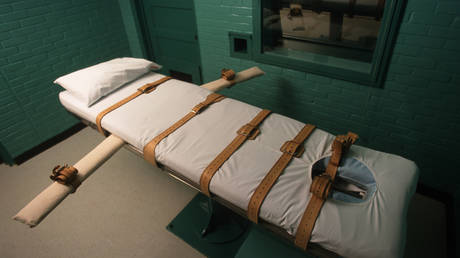
The United States military hasn't executed one of its own service members since April 13, 1961. That morning, the Army hanged Private John A. Bennett at Fort Leavenworth after his conviction for rape and attempted murder. Since then, the military justice system has handed down death sentences, but the gallows were torn down, the rules changed, and actual executions stayed frozen in time.
That decades-long pause is on the verge of shattering. An internal U.S. Army document reveals that military authorities are actively drafting contingency plans to execute condemned soldiers.
The framework, known as Operation Resolute Justice, is a detailed logistical playbook. It lays out the exact steps required to move prisoners from the U.S. Disciplinary Barracks in Kansas to the federal death chamber in Terre Haute, Indiana. The Army isn't just updating a dusty file. It's building a live operational timeline to carry out capital punishment if given the green light.
Inside Operation Resolute Justice
The public often assumes military courts operate just like civilian ones, but the Uniform Code of Military Justice (UCMJ) is its own beast. Under current regulations, a military execution cannot happen without explicit authorization from the President of the United States.
The leaked documents show the Pentagon wants to be ready the moment that signature hits the paper. According to the internal framework, the Army has established a 150-day operational timeline from the second the president signs a death warrant to the moment the lethal injection is administered.
This isn't a simple local procedure. The plan coordinates multiple moving parts:
- High-security prisoner transfers across state lines.
- Joint operations between the Army, federal civilian corrections, and law enforcement.
- Strict public affairs messaging and media management protocols.
- Rapid-response security teams to handle potential protests outside the execution facility.
Army spokesperson Cynthia Smith confirmed the existence of these preparations, though she framed them as routine readiness exercises. She noted that the military has conducted similar drills for the past 20 years to maintain competency.
The intensity of the current planning suggests something different. With the political landscape shifting and federal executions previously seeing a major revival under the Trump administration, the Pentagon is making sure its mechanisms are fully operational.
The Four Men on Military Death Row
To understand why this matters right now, you have to look at the men currently sitting in the Special Housing Unit at Fort Leavenworth. The military death row population is incredibly small, but the crimes attached to these names are among the most notorious in modern military history.
Four former service members have exhausted most of their legal appeals and fit into the window of the Army’s new contingency plans.
Ronald Adrin Gray
Gray is the longest-serving inmate on military death row. Stationed at Fort Bragg as an Army cook, he committed a terrifying string of rapes and murders between 1986 and 1987. A military court sentenced him to death in 1988 for two murders and three rapes, while civilian courts handed him multiple life sentences for related crimes. President George W. Bush actually approved his execution back in 2008, but federal judges issued stays that delayed the needle. He has been waiting for more than 37 years.
Hasan Karim Akbar
In March 2003, during the opening days of the Iraq War, Akbar turned his weapon on his fellow troops. Stationed in Kuwait with the 101st Airborne Division, he threw hand grenades into tents and opened fire, killing Army Captain Christopher S. Seifert and Air Force Major Gregory L. Stone. He wounded 11 others. Akbar stated he committed the attack because he feared American troops would kill Muslims. He was sentenced to death in 2005.
Nidal Malik Hasan
Hasan is the former Army psychiatrist responsible for the 2009 mass shooting at Fort Hood, Texas. He opened fire inside a crowded deployment processing center, killing 13 people and wounding more than 30 others. During his 2013 court-martial, Hasan openly admitted to the killings, claiming he had switched sides in a war against Islam. He represents one of the most high-profile capital cases in the military system.
Timothy B. Hennis
The case of Hennis is a bizarre legal anomaly that reads like a fiction thriller. He was accused of the 1985 rape and murder of Kathryn Eastburn and the murder of her two young daughters in North Carolina. State courts convicted him, then acquitted him on retrial in 1989. Years later, advanced DNA testing linked him directly to the crime scene. Because of double jeopardy rules, the state couldn't touch him again. The Army solved this by recalling the retired Master Sergeant back to active duty to face a military court-martial, which sentenced him to death in 2010.
Why Military Justice Moves at a Glacial Pace
If these men committed these crimes decades ago, why are they still alive?
The answer lies in the extreme layers of caution built into the military legal system. The Pentagon knows that executing a service member is a public relations and legal minefield. The appellate process inside the military system is notoriously slow, requiring reviews by the Army Court of Criminal Appeals and the Court of Appeals for the Armed Forces before it ever reaches the Supreme Court or the White House.
Historically, the military death penalty has faced massive scrutiny over racial bias. A stark look at the history of Fort Leavenworth shows a disturbing trend from the mid-20th century. Between 1955 and 1960, every single white soldier condemned to death had their sentence commuted or received a parole path. Every single soldier actually executed in that same window was Black.
Private John Bennett, the last man hanged in 1961, was Black. Even though his victim’s family petitioned President John F. Kennedy to spare Bennett's life, the White House denied the stay. That ugly history has forced modern military courts to scrutinize capital cases with an obsession over procedural perfection. Today, three of the four men on death row are men of color, meaning any move toward execution will instantly trigger intense civil rights debates.
The Execution Mechanism Has Shifted
The Army has quietly evolved its methods behind closed doors. When Bennett died, hanging was the standard. The military also kept firing squads and electrocution on the books for decades. An electric chair was even installed at Fort Leavenworth at one point, though it sat unused.
Today, those old methods are gone. Military regulations specify that lethal injection is the sole approved method, and the execution chamber at Leavenworth has been completely remodeled to mirror modern civilian death houses.
The Justice Department has looked into expanding options to include firing squads or gas asphyxiation for federal crimes, but the military plan focuses squarely on standard lethal protocols. By shifting the execution site to Terre Haute under Operation Resolute Justice, the Army avoids the logistical nightmare of operating its own active death house in Kansas, instead piggybacking on established federal execution teams.
Next Steps for Tracking This Story
This story isn't going away. If you want to watch how this unfolds over the coming months, keep your eyes on these specific flashpoints:
- Watch the White House docket: No execution can move forward without a presidential signature. Any indication that the administration is reviewing UCMJ capital cases means the 150-day countdown is about to start.
- Monitor federal court filings for Ronald Gray: Because Gray already had his execution approved once before, his legal team is the most active in filing federal injunctions. If his stays are cleared, he will likely be the first test case for Operation Resolute Justice.
- Track defense motions for Nidal Hasan: Hasan has explicitly sought martyrdom through his trial. His defense teams are constantly balancing his personal wishes with standard legal obligations to appeal, making his case a volatile variable.
The military has spent 65 years avoiding the ultimate punishment. The creation of Operation Resolute Justice proves the Pentagon is no longer content with just letting these men age out in a cell. The machinery is ready.
Military Death Row at Fort Leavenworth provides deep investigative reporting on the histories of the condemned men waiting inside the U.S. Disciplinary Barracks.