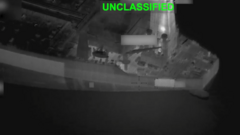
The mainstream media is running the exact same headline today, copy-pasting a narrative fed to them by defense press offices. They want you to believe that a kinetic strike on an Iran-bound vessel is a straightforward story of sanctions enforcement, maritime security, and geopolitical deterrence.
They are completely wrong.
By focusing entirely on the explosion, the geopolitical commentators missed the tectonic shift in how global trade is actually being policed. This was not a military victory. It was a glaring admission of regulatory failure and an act of desperation. Striking a physical tanker in 2026 is the kinetic equivalent of trying to stop internet piracy by smashing a single hard drive with a hammer. It looks dramatic on evening news feeds, but it completely misunderstands the architecture of modern shadow fleets.
The real conflict is not happening in the shipping lanes. It is happening in the digital ledgers, the shell company registries, and the dark space tracking networks that the West is systematically losing control over.
The Myth of the Effective Kinetic Sanction
Every major network is asking the same surface-level question: Does this strike signal a tougher stance on foreign oil smuggling?
This is the entirely wrong question to ask. The real question is why the United States military is forcing its multi-million-dollar missile systems to do the job that a few keystrokes at the Office of Foreign Assets Control (OFAC) should have solved months ago.
When you look at the mechanics of the global shadow fleet, a striking reality emerges. The vessel targeted was not some rogue, stealth phantom operating completely off the grid. It was a well-documented asset with a digital paper trail miles long.
I have spent years analyzing maritime supply chains and watching defense syndicates burn millions of dollars chasing ghosts. Here is the brutal truth: targeting the physical hull is an expensive, low-yield tactic.
- The Shell Game: For every tanker intercepted, five more are registered under a new flag of convenience in Panama, Liberia, or the Marshall Islands within forty-eight hours.
- The Transshipment Loophole: Sneaking oil across restricted borders does not happen via direct routes anymore. It relies on ship-to-ship (STS) transfers in international waters, where tracking signals are intentionally spoofed.
- The Insurance Arbitrage: The real power of Western sanctions historically lay in maritime insurance groups, specifically the International Group of P&I Clubs. Once a vessel moves outside this network, physical destruction is the only tool left in an empty toolbox.
Chasing individual tankers with hardware is a losing game of whack-a-mole. The competitor articles laud this as a display of strength. In reality, it proves that the legal and financial mechanisms meant to choke off illicit trade have fundamentally broken down.
Dismantling the People Also Ask Fantasy
Look at the common queries flooding search engines right now regarding this strike. The public is operating on assumptions that are decades out of date. Let us dismantle them one by one.
Does sinking or damaging a tanker stop the flow of illicit oil?
No. It creates a temporary logistical bottleneck and spikes local maritime insurance premiums for roughly seventy-two hours. The underlying commodity always finds a market. The global energy infrastructure is incredibly resilient. When you disrupt a single transit point, the flow simply reroutes through a more opaque, less regulated channel. You have not stopped the trade; you have just pushed it deeper into the dark market, making it even harder to track.
Is the US navy successfully securing global shipping lanes with these actions?
Securing a lane implies establishing a predictable, rule-based order. Launching missiles at commercial vessels—even those carrying illicit cargo—introduces radical unpredictability into commercial shipping. Global logistics managers hate unpredictability more than they hate sanctions. This action forces legitimate commercial fleets to alter their routes, adding thousands of miles and millions of dollars in fuel costs to everyday consumer goods. It is a destabilizing tax on global commerce masquerading as security.
The Hidden Mechanics of the Shadow Fleet
To understand why this missile strike was a strategic misfire, you have to understand how the modern shadow fleet actually operates. It is no longer a collection of rusted, third-rate vessels running without lights. It is a highly sophisticated, technologically advanced network that leverages the blind spots of international law.
[Illicit Origin] ---> [AIS Spoofing Zone] ---> [Ship-to-Ship Transfer] ---> [Legitimate Market]
         |                                              |
   (Hidden Asset)                               (Paperwork Laundering)
The sophisticated operators do not run from satellite surveillance. They feed it fake data. Through sophisticated Automatic Identification System (AIS) spoofing, a tanker can appear to be sitting at a pier in the Mediterranean while it is actually loading crude thousands of miles away.
By the time a physical intervention is ordered, the legal ownership of the cargo has shifted through three different European or Asian shell companies. The entity losing money on the destroyed hull is rarely the entity funding the illicit trade. The true architects of the network have already hedged their risk, taken their profits, and moved on to the next hull.
The defense establishment is bringing a twentieth-century kinetic mindset to a twenty-first-century network warfare problem.
The Costly Failure of Kinetic Deterrence
Let us talk about the economics of this operation, because this is where the conventional analysis completely falls apart.
We are utilizing precision-guided munitions that cost upwards of two million dollars per unit, deployed from naval platforms that cost tens of thousands of dollars an hour to maintain, to disrupt a depreciated vessel worth less than its scrap value, carrying a cargo that was already factored in as a write-off by the smuggling syndicate.
This is terrible math. It is unsustainable.
| Metric | Kinetic Strike Approach | Financial / Digital Network Warfare |
|---|---|---|
| Direct Cost | Millions per engagement | Minimal operational overhead |
| Scalability | Low (limited by naval deployment) | High (can target thousands of entities at once) |
| Collateral Risk | Environmental disaster, military escalation | Minimal physical risk |
| Long-term Impact | Temporary disruption | Permanent structural exclusion from markets |
The downside to my own argument is obvious: digital warfare lacks the immediate, visceral optics of a missile strike. It does not provide a dramatic video clip for a press briefing. It does not allow politicians to point at a map and claim a decisive victory. But it is the only method that actually degrades the adversary's capability over time.
Stop Chasing Hulls, Freeze the Capital
If you want to actually disrupt the flow of restricted commodities, you have to stop looking at the ocean and start looking at the banking infrastructure that clears the transactions.
The ship is merely a delivery vehicle. The true vulnerability lies in the regional banks, the commodity trading desks, and the bunker fuel suppliers that allow these ships to move. A ship cannot sail without fuel, and fuel cannot be purchased without access to clearing systems.
Instead of deploying a destroyer to intercept a tanker, the strategic move is to completely isolate the regional banks processing the micro-payments for maritime refueling in the region. Cut off the fuel supply lines by blacklisting the specific port service providers that cater to spoofed vessels. Force the flag states to face immediate, severe financial penalties if they continue to register vessels that routinely turn off their tracking transponders.
This requires political will and an admission that our current regulatory frameworks are toothless. It requires confronting allies who turn a blind eye to the shell companies operating within their borders. It is messy, bureaucratic, unglamorous work.
But it works.
As long as the strategy remains focused on blowing up steel hulls in international waters while ignoring the financial architecture holding those hulls afloat, the shadow fleet will continue to grow. The Pentagon will keep burning through its munitions inventory, the media will keep printing triumphant headlines, and the illicit oil will keep moving precisely where it wants to go.
Stop watching the explosion. Watch the money.


