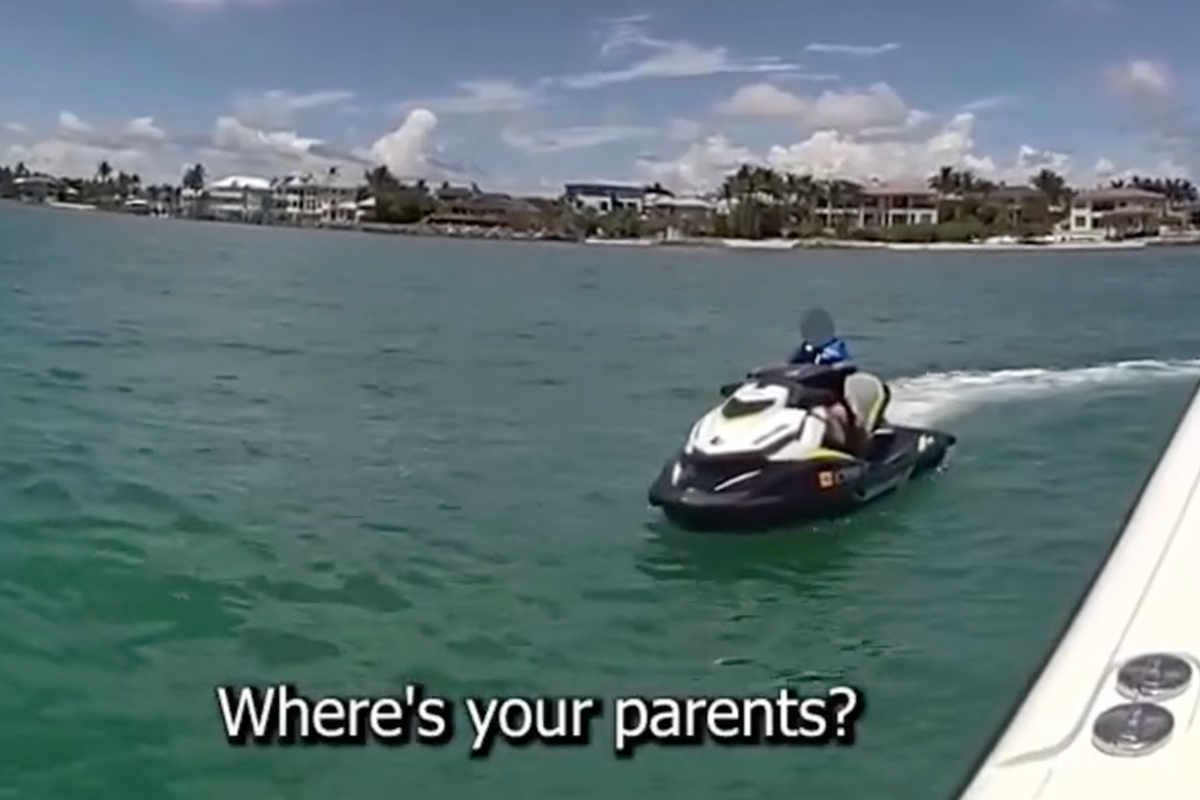
The internet erupted into its predictable, collective gasp when Florida law enforcement stopped an eight-year-old child piloting a personal watercraft solo. The headlines practically wrote themselves, dripping with judgmental adjectives and overt condemnation of the parents. Every armchair safety expert jumped on the bandwagon to decry the absolute recklessness of the situation.
They are all looking at the wrong problem.
The lazy consensus screams that the danger here is inherently tied to age. The narrative dictates that a child on a watercraft is a self-evident tragedy waiting to happen, while an adult at the helm represents safety and responsibility. This is a fundamentally flawed premise. The obsession with arbitrary age thresholds completely obscures the real, systemic crisis on our waterways: competency, not chronology.
The Illusion of the Adult Operator
We have a bizarre cultural blind spot when it comes to maritime operations. We assume that turning 18 or 21 magically endows a human being with the situational awareness, physics comprehension, and respect for hydrodynamic forces required to command a high-performance vessel.
It does not.
Go to any boat ramp in America on a holiday weekend. You will witness a parade of full-grown adults who cannot back a trailer, do not know who has the right of way in a crossing situation, and have zero understanding of how a jet pump actually steers a personal watercraft. They assume that because they have a driver's license and a credit card, they are qualified to command 300 horsepower on open water.
The data tells a brutal story. Year after year, Coast Guard accident statistics reveal that the overwhelming majority of open-water accidents, collisions, and fatalities are caused by adult operators. Specifically, adults with plenty of life experience but absolutely zero formal training. Alcohol consumption, excessive speed, and a total disregard for navigation rules are overwhelmingly adult vices on the water.
An eight-year-old operating a vessel within their physical capabilities is a statistical anomaly. The real threat to public safety is the 45-year-old executive who just bought a supercharged watercraft and treats a crowded bay like a private drag strip.
Mechanical Reality Doesn't Care About Your Birth Certificate
To understand why the age panic is a distraction, we have to look at how these machines actually operate. A personal watercraft does not use a rudder. It relies on directed thrust. If you let off the throttle completely, you lose the ability to steer.
This single mechanical reality is the cause of countless rental-fleet accidents every summer. When panic sets in, the untrained instinct of an adult is to chop the throttle and turn the handlebars. The machine continues traveling in a straight line at high speed, directly into the obstacle they are trying to avoid.
Learning to overcome that instinct requires muscle memory and deliberate practice. It does not require a mustache or a voter registration card. A child who has been systematically trained on the mechanics of thrust-directed steering, throttle modulation, and weight distribution can react with greater technical precision than an adult who is panicking for the first time on a machine they do not understand.
This is not a defense of letting toddlers roam free on the ocean. It is a reality check about what actually constitutes safety on the water. Safety is a function of training, mentorship, and operational constraints.
The Hypocrisy of Youth Sports and Motorsports
Our collective outrage is highly selective and hypocritical.
We celebrate seven-year-olds racing motocross bikes at 40 miles per hour over dirt obstacles. We applaud pre-teens piloting go-karts at competitive speeds on asphalt tracks. We accept youth competitive skiing, where kids hurtle down icy mountains at speeds that could cause catastrophic injury.
Why? Because those ecosystems have established frameworks of coaching, progression, and protective gear. The activity is respected as a discipline.
Yet, when it comes to the water, we treat the entire environment as a mindless amusement park. We assume watercraft are toys, and therefore, any child operating one must be a victim of parental neglect. If that eight-year-old in Florida had been wearing a properly fitted life jacket, operating a machine equipped with a programmed learning key that limits top speed, and running drills under direct adult supervision within line of sight, the risk profile changes drastically.
The knee-jerk reaction to ban, fine, and demonize prevents us from having the conversation that actually matters: creating standardized, progressive competency tracks for young mariners.
The True Cost of Incompetence
I have spent decades watching people interact with the water. I have seen multi-million dollar yachts smashed against concrete docks because the owner thought their business acumen translated to seamanship. I have seen rentals flipped, swimmers buzzed, and ecosystems damaged—almost exclusively by adults who refused to read a manual or take a basic course.
If we want safer waterways, we need to stop staring at birth certificates and start demanding proof of capability.
The current system of granting automatic maritime privileges based purely on age is a failure. Several states allow adults born before certain years to operate vessels with absolutely no education requirements whatsoever. That means a senior citizen with failing eyesight and zero experience can legally drop a massive cabin cruiser into a crowded channel, while a teenager who has spent hundreds of hours learning navigation rules faces legal scrutiny.
The solution is not to simply lock kids out of the cockpit until they turn 16 or 18. The solution is to mandate rigorous, practical testing for every single person who wants to squeeze a throttle, regardless of when they were born.
Dismantling the Standard Safety Narrative
When you look at the standard safety checklists pushed by regional authorities, they focus heavily on reactive measures: life jackets, fire extinguishers, and whistles. While these are necessary tools for survival after an incident occurs, they do nothing to prevent the incident itself.
Proactive safety is entirely behavioral. It requires an understanding of stopping distances, hull dynamics, and environmental variables like wind and current. A well-trained operator respects these variables. An entitled operator ignores them.
The Florida incident shouldn't be used as a catalyst for a parental witch hunt. It should be used to highlight the absolute vacuum of mandatory, practical education in our boating culture. We have accepted a baseline of mediocrity on the water that we would never tolerate on our roads or in our skies.
Stop asking how old the operator is. Start asking what they know.


