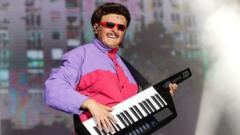
The internet is currently mourning a man who is almost certainly eating a bowl of cereal in a Los Angeles mansion right now, laughing at his own analytics.
If you bought into the breathless reports that internet-subversive pop star Oliver Tree died in a tragic helicopter crash, you didn't just get fooled by a fake news cycle. You fell face-first into a meticulously engineered piece of performance art. The competitor outlets running breaking news alerts about his body being "returned to the US" are operating on a level of journalistic laziness that would be hilarious if it weren't so deeply embarrassing for the industry.
They are treating a professional troll like a conventional pop star. That is the foundational mistake.
Oliver Tree has "retired" at least four times. He has claimed to be legally banned from releasing music. He has physically assaulted interviewers on camera as part of a bit. To report on his death based on unverified social media updates or obscure foreign press aggregates is to completely misunderstand the mechanics of modern digital celebrity.
This isn't a tragedy. It is a marketing campaign disguised as a eulogy.
The Anatomy of the Stunt Market
Let's look at the cold, hard logic of how the attention economy operates. I have spent over a decade analyzing media manipulation and digital audience metrics, watching public relations firms orchestrate crises out of thin air to juice streaming numbers.
When a typical artist drops an album, they do a radio tour. They do late-night television. They spend millions on billboards. Oliver Tree doesn't do that because he understands something far more profound about the current digital environment: outrage and shock out-index standard promotion by a factor of ten.
The standard media outlet looks at a headline about a helicopter crash and asks, "How quickly can we aggregate this for search traffic?"
They do not ask the basic checklist questions required of actual journalism:
- Where is the official National Transportation Safety Board (NTSB) or international equivalent report?
- Which local authorities confirmed the recovery of the body?
- Why is the primary source of information always connected back to a digital ecosystem controlled by the artist's camp?
In a traditional newsroom, an unconfirmed death requires multi-source verification. In the current click-driven media environment, a screenshot of a TikTok video counts as an ironclad source. The competitor pieces covering this story are doing nothing more than laundering a PR stunt through their own domain authority to steal a slice of the search volume.
Dismantling the Premium on Shock
People are asking online: "Is Oliver Tree actually dead?"
The very premise of the question is flawed. The real question you should be asking is: "Why am I so easily conditioned to believe a narrative that has zero official institutional backing?"
Think about the sheer logistics required to fake an international incident. In a real fatal aviation accident, government bodies issue public statements. Coroners file public records. Embassies handle the repatriation of remains with strict legal oversight. None of this exists for this supposed crash. Instead, we have the digital equivalent of a smoke machine and mirrors.
Look at the historical precedent. This is the exact playbook executed by Andy Kaufman in the 1970s and 1980s, updated for an era where algorithmic feeds dictate reality. Kaufman wrestled women and picked fights with professional wrestlers to blur the line between reality and kayfabe (the staging of portrayed events as real). Oliver Tree has simply scaled this model using short-form video platforms.
The Cost of the Counter-Strategy
If you are a creator or a marketer looking at this and thinking, "Great, I should fake a catastrophe to get famous," understand the downside of this high-risk approach.
I have watched brands try to replicate this kind of edge-case marketing and completely incinerate their consumer trust. It works for Oliver Tree because his entire brand identity is built on a foundation of profound insincerity. His fans do not expect earnestness from him; they expect to be tricked. They are active participants in the joke.
If a mainstream brand or a conventional artist attempts to manipulate an audience with themes of mortality, the backlash is swift and permanent. You cannot build a sustainable career on existential deception unless your entire audience is explicitly in on the grift.
The absolute truth of the matter is that the media did not get tricked by Oliver Tree. The media tricked itself because it prioritized speed over accuracy. They wanted the clicks that come with a tragic celebrity passing, and in their rush to cash the check, they became the punchline of the artist's next project.
Stop refreshing the news feeds looking for a funeral announcement. Expect a music video instead.