The sky over southern Lebanon does not clear after an explosion. It thickens. A heavy, greasy smoke hangs in the air, smelling of pulverized concrete, burnt rubber, and the distinct, metallic tang of iron. It clings to the back of the throat. For those who live along this fractured border, that smell is the true calendar of their lives. It marks the days not by dates, but by strikes.
When the missiles struck the village of Teir Debba, the sound did not travel as a simple boom. It arrived as a physical wave, rattling the teeth in the skulls of people miles away. In an instant, a quiet afternoon crumbled. A residential building, a place where people brewed cardamom-heavy coffee and argued about mundane bills, became a tomb of jagged rebar and grey dust.
Ten lives vanished into that dust. Among them were paramedics, volunteers who wore the bright fluorescent vests of rescue workers, and a child whose life was measured in single-digit years.
To the outside world, this is a headline. It is a push notification that pops up on a glowing smartphone screen, stayed for a second, and then brushed away to make room for an email or a social media update. It reads like a ledger. Ten dead. Including paramedics. Including a child. But statistics are a defense mechanism. They are the sterile language we use to keep the horror of a shredded reality at arm's length.
Step closer. Look at the dirt.
The Mathematics of a Tragedy
A civilian casualty is never just one person. When a missile hits a home in southern Lebanon, the blast radius extends far beyond the physical reach of the shrapnel. It ripples outward through families, through villages, through generations.
Consider the paramedics. These are not professional soldiers hiding in concrete bunkers. They are the local mechanics, the teachers, the university students who decided that when the sky falls, they will be the ones who run toward the ruin. They wear the insignia of the Civil Defense or the Islamic Health Association, organizations that function as the thin, frayed line between life and death in a region where state infrastructure has long since collapsed.
When the first strike hits, their routine begins. The siren wails—a frantic, mechanical shriek that slices through the smoke. They scramble into aging ambulances, the tires spinning on loose gravel. They know the rules of modern warfare. They know about the "double-tap."
The double-tap is a tactical calculation. A missile strikes a target. First responders rush to the scene to pull the living from the debris. Then, a second missile strikes the exact same coordinate. The logic is brutal: eliminate the rescue effort, maximize the chaos, ensure that the wounded stay buried. It transforms the act of mercy into a suicide mission.
Yet, they go anyway.
On this day, the calculation worked with lethal precision. The paramedics arrived to do their jobs. They stretched out their hands to clear the concrete from a neighbor’s face. Then came the second roar. In the calculus of statecraft and military strategy, these men were listed as collateral. In the reality of Teir Debba, they were sons who would never walk back through their own front doors, leaving behind mothers who would spend the rest of their days staring at empty chairs.
The Weight of a Small Shoe
Then there is the child.
We often read about children in war zones as symbols. They are used to evoke a quick, fleeting burst of pity before the reader moves on to the sports section. But a child in a war zone is not a symbol. A child is a collection of loud laughs, sticky fingers, favorite toys, and an intense, overwhelming fear of loud noises.
In southern Lebanon, children have learned to read the sky better than meteorologists. They know the difference between the low, throat-rattling growl of a reconnaissance drone—the "um-kamel" that buzzes endlessly like a mechanical mosquito—and the sudden, catastrophic tearing sound of an F-16 jet splitting the sound barrier. They play games in the hallways because the rooms with windows are too dangerous. They sleep with their shoes on, just in case the house collapses in the middle of the night and they have to run across broken glass.
When a missile hits, it doesn't just stop a child’s heart. It obliterates their entire universe. The bedroom with the drawings taped to the wall, the small plastic bicycle left in the courtyard, the routine of schoolbooks and evening meals—all of it is ground into fine powder.
The child killed in this strike did not know the political geography of the Middle East. They did not understand the grand chess game played between governments in Beirut, Tel Aviv, and Washington. They only knew the sudden, terrifying darkness of a ceiling falling down.
To report this as a standard news item is to fail the basic duty of human observation. It treats a slaughter as an administrative error.
The Myth of Precision
The official statements issued after these strikes follow a predictable, weary script. Targets are described as "terrorist infrastructure." The public is assured that every precaution was taken to minimize civilian harm. The language is clean, sanitized, and entirely unmoored from the bloody mud of the actual site.
We are told we live in an era of precision warfare. Satellites can read a license plate from orbit. Smart bombs can be guided through a specific window pane. If this precision is real, then the deaths of paramedics and children cannot be dismissed as accidental errors. If the technology is that perfect, then the targets were hit exactly as intended.
But if it was a mistake, then the myth of precision crumbles. It reveals a terrifying truth: that the machinery of modern war is blunter, cruder, and far more indifferent to human life than its creators care to admit. A five-hundred-pound bomb does not negotiate. It does not check identity cards. It expands outward in a sphere of fire and pressure, converting everything within its radius—whether it is a rocket launcher or a crib—into dust.
The survivors of these strikes are left to sift through that dust with their bare hands. They look for teeth. They look for familiar scraps of clothing. They look for any piece of their loved ones that can be gathered up and placed into a wooden box for burial.
The physical injuries are easy to document. The broken limbs, the shrapnel wounds, the third-degree burns—these can be photographed and tallied by human rights organizations. The psychological damage is different. It is invisible, but it is absolute.
Imagine living in a house where the roof could turn into an anvil at any second. Every door slam becomes a mortar attack. Every thunderstorm becomes a bombardment. The nervous system becomes permanently fried, locked in a state of high alert that never, ever resets. This is the unseen casualty list of the war in southern Lebanon. It numbers in the hundreds of thousands. It is the destruction of sanity, the execution of peace, carried out day after day, strike after strike.
The Vanishing Border
The border between Israel and Lebanon is defined on maps by a thin blue line. In reality, it is a scar.
For decades, this landscape has been a theater of cyclical violence. The names of the villages change, the models of the missiles get more advanced, but the script remains identical. An escalation leads to a retaliation, which triggers an offensive, which ends in a temporary ceasefire, leaving both sides to bury their dead and prepare for the next round.
But this current iteration feels different. The scale is wider. The red lines that used to govern this conflict—the unspoken rules that kept civilian centers relatively safe from the worst of the fighting—have been erased. Everything is a target now. A hospital is a suspected command center. An ambulance is a suspected transport vehicle. A home is a suspected safehouse.
When everything is suspected, nothing is safe.
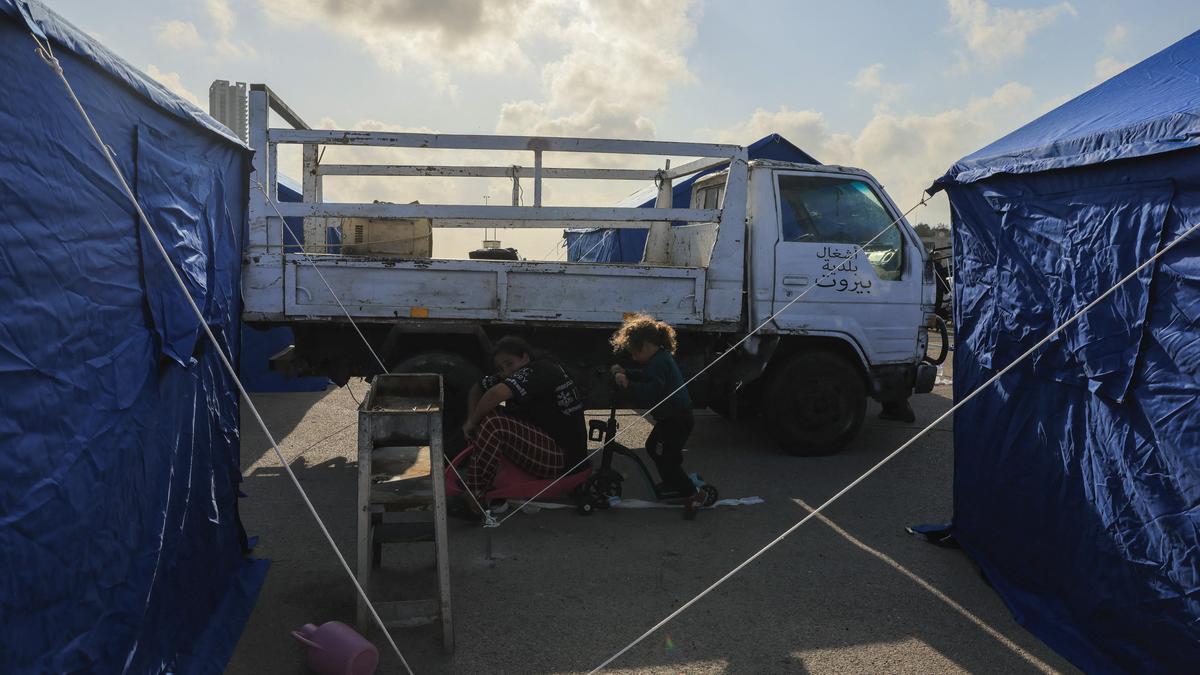
The people who remain in these southern villages are often those who have nowhere else to go. The wealthy left months ago, renting apartments in Beirut or fleeing abroad. The people left behind are the elderly who refuse to leave the land they have farmed for eighty years, the poor who cannot afford the exorbitant rent in the north, and the stubborn who believe that leaving their homes means surrendering their existence.
They stay, tending to their olive trees under the shadow of hovering drones. They watch the hillsides burn from white phosphorus shells. They live in a state of suspended animation, waiting for the sky to open up.
The Silence of the Aftermath
The day after the strike in Teir Debba, the rescue workers who survived returned to the scene. There was no time for a funeral, no space for a formal wake. The rubble still smoked, and there were rumors that more bodies were trapped beneath the collapsed basement stairs.
They dug with shovels. They dug with their fingernails.
A crowd gathered around the perimeter, their faces pale beneath the coating of grey dust. Nobody spoke. The usual wailing of grief had given way to a profound, exhausting silence. It is the silence that comes when a community realizes that help is not coming, that the world is looking elsewhere, and that their deaths have been deemed acceptable losses in a war without an end date.
A worker reached down and pulled a small, pink shoe from the debris. He turned it over in his hand, shook out the concrete dust, and set it gently on top of a shattered cinder block. He did not cry. He just stared at it for a long moment before picking up his shovel and turning back to the pile.
The shoe sat there as the sun began to drop behind the hills, a tiny, bright speck of color against a grey landscape of ruin. It remained there long after the cameras had packed up, long after the reporters had filed their stories, and long after the world had forgotten that ten people had died on a Tuesday afternoon in a village they could not find on a map.