The kettle was halfway to a whistle when the kitchen plunged into a heavy, suffocating blackness. It wasn’t the flickering uncertainty of a dying bulb. It was the sudden, absolute erasure of the modern world. Outside the window, the familiar silhouette of the Cairngorms had vanished, swallowed by a sky that had turned a bruised, violent shade of purple. Storm Dave hadn’t just arrived; he had broken down the door.
For those living in the path of the storm across Scotland, this wasn't a headline about "disruption." It was the sound of the wind screaming through the eaves like a freight train that refused to pass. It was the smell of damp wool and the guttering flame of a single emergency candle.
The Fragility of the Grid
We take the hum of the refrigerator for granted. We assume the Wi-Fi will always be there to tether us to the rest of humanity. But as ten thousand homes across the north and north-east found out, that connection is held together by copper wires and hope. When Dave tore through the power lines, he didn't just cut the electricity. He cut the heat. He cut the news. He left families huddled under duvets in the dark, listening to the rhythmic thwack of debris hitting the roof.
Engineers from Scottish and Southern Electricity Networks (SSEN) weren't sitting in warm offices looking at spreadsheets. They were out in it. Imagine standing on a sodden hillside in sixty-mile-per-hour gusts, horizontal sleet stinging your eyes, trying to repair a high-voltage line while the earth turns to soup beneath your boots. It is a brutal, thankless fight against physics. They managed to restore power to thousands within hours, but for the remaining households, the night was a long, cold lesson in the limits of our infrastructure.
A Nation at a Standstill
Travel is often framed as a series of choices. Do I take the train or the car? Do I leave now or in twenty minutes? Storm Dave removed the luxury of choice.
On the tracks, the Highland Main Line became a ghost road. Network Rail Scotland issued the kind of warnings that sound bureaucratic on paper but feel like a gut punch when you’re standing on a freezing platform in Inverness. "Do not travel." The words were final. Fallen trees and flooding had turned the iron veins of the country into a chaotic mess of splintered wood and rising water.
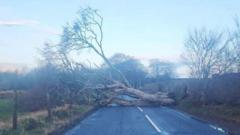
The roads were no kinder. On the A9, the spine of the Highlands, lorries were buffeted by gusts that threatened to flip them like toys. Smaller roads were worse, blocked by the ancient giants of the forest that had finally given up their grip on the soil. To drive was to gamble with the unpredictable weight of a falling branch or the sudden, invisible depth of a flash flood.
The Human Cost of a Name
We name storms to make them easier to track, but naming them also gives them a personality. Dave felt personal. He felt like an intruder.
Consider a hypothetical family in a remote glen near Aviemore. Let’s call them the MacLeods. For them, the storm wasn't a data point on a meteorologist's map. It was the frantic effort to move the sheep to lower ground before the winds peaked. It was the realization that the landline was dead and the mobile signal had evaporated with the power. It was the eerie silence of a house that usually hums with life, now reduced to the sound of a battery-operated radio crackling with weather updates.
This is the invisible stake of a Scottish storm. It isn't just about delayed trains or a missed day of work. It’s about the isolation that creeps in when the lights go out. It’s the vulnerability of the elderly neighbor who relies on an electric heater, or the parent wondering if the freezer full of food will last until the morning.
The Anatomy of the Gale
The science behind Dave was a perfect, miserable storm of atmospheric pressure. A deep low moved across the Atlantic, tightening its grip as it hit the Scottish coastline. The geography of Scotland acts like a funnel for these systems, squeezing the wind through the glens and over the peaks until it reaches speeds that can peel the lead off a church roof.
Met Office warnings—yellow, amber, and the dreaded red—are often debated in the comfort of a sunny afternoon. But when the wind hits the 80mph mark, the debate ends. At that speed, the air becomes a physical weight. It pushes against your chest. It turns everyday objects into projectiles. A garden chair becomes a missile. A loose slate becomes a blade.
The Morning After the Chaos
As the sun began to struggle through the clouds the following morning, the scale of the wreckage became clear. Scotland didn't look broken, but it looked weary.
The disruption didn't end when the wind died down. The cleanup is a slow, methodical grind. It involves chainsaws clearing the tracks and divers checking bridge foundations for scour damage. It involves the quiet heroics of neighbors checking on neighbors, sharing flasks of tea and stories of how loud the wind sounded at 2:00 AM.
We live in an age where we believe we have conquered the elements. We build taller, we travel faster, and we light up the night until the stars disappear. Then a storm like Dave arrives to remind us that we are still at the mercy of the sky. Our systems are efficient, but they are brittle. Our schedules are tight, but they are irrelevant when the North Sea decides to move inland.
The true story of the storm isn't found in the statistics of megawatts lost or miles of track cleared. It is found in the quiet resilience of a person sitting in the dark, waiting for the flicker of a lamp to signal that the world has returned to normal. It is the collective breath of a nation held until the gusts finally subside, leaving behind a landscape that is slightly different, slightly scarred, and profoundly silent.
The wind eventually stops. The lights eventually come back on. But for a few hours, everyone in the path of the storm remembers exactly how small we are.