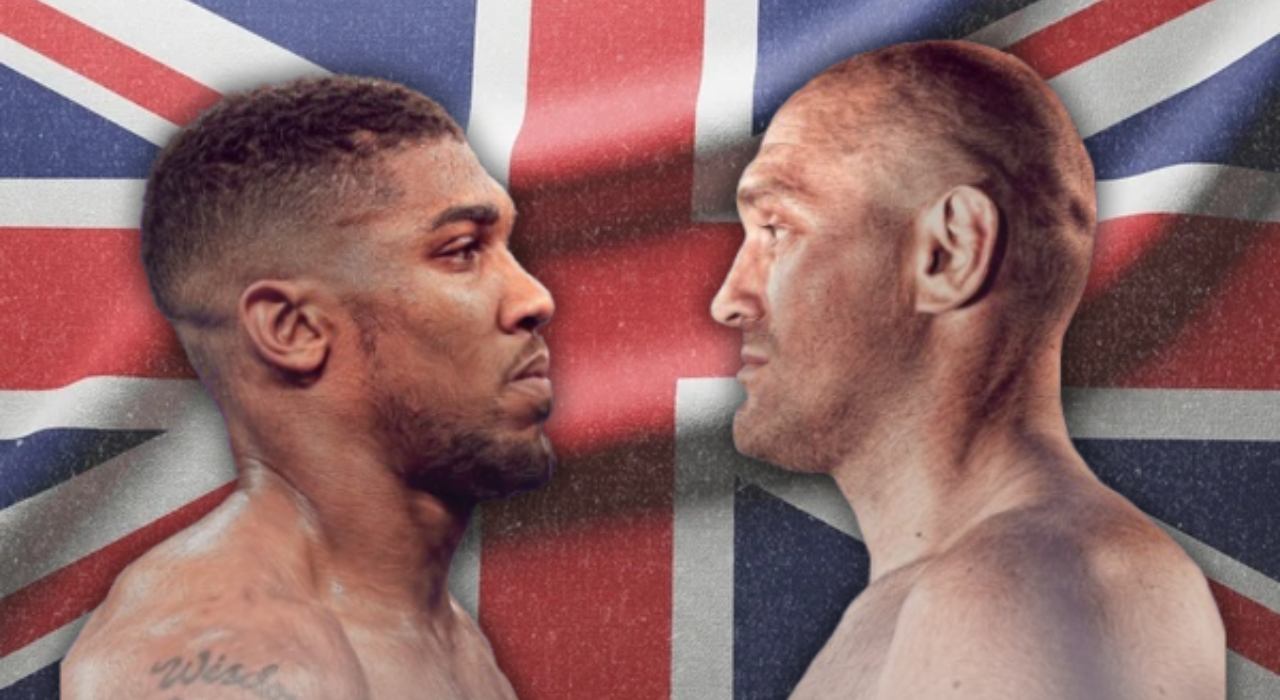
The floor of a boxing gym in Morecambe smells of the same things it did thirty years ago. It is a thick, cloying cocktail of industrial-grade disinfectant, dried sweat, and the metallic tang of blood hitting a canvas. Tyson Fury stands in the center of this world, a man who has spent a lifetime trying to outrun his own shadow, only to find that the shadow has finally grown large enough to eclipse the sun.
Across the country, in a high-tech facility that feels more like a Silicon Valley startup than a temple of pugilism, Anthony Joshua is moving with the mechanical precision of a Swiss watch. He is the image of the modern athlete, a brand as much as a brawler, a man who carries the weight of a nation’s expectations on shoulders that look like they were carved from granite.
For a decade, these two have been the ghosts haunting one another's careers. They were the "what if" whispered in every pub from Manchester to Watford. Now, the ink is dry. The contracts are signed. In 2026, the two titans of British heavyweights will finally meet, but the ring isn't in a smoke-filled hall or a rainy stadium. It’s on a digital platform that reaches two hundred million homes simultaneously. Netflix has arrived to claim the crown.
The Long Road to the Middle
To understand why this matters, you have to understand the ache of the British boxing fan. We are a people who have been promised the world and handed a receipt for a pay-per-view that never happened. The fight between Fury and Joshua was supposed to happen in 2021. It was supposed to happen in 2023. Every time the negotiations neared the finish line, ego, money, or the dizzying complexity of broadcast rights tripped the runners.
Think of a young fan who was twelve years old when Joshua won gold in London. That fan is now a grown man or woman with a mortgage and a different perspective on the world. They have watched these two men rise, fall, and reinvent themselves. They saw Joshua lose his soul in New York and find it again in the desert. They saw Fury descend into a darkness so profound he nearly drove his Ferrari off the edge of the world, only to climb back up and claim the throne.
This isn't just about a belt. Those leather straps are trinkets. This is about the resolution of a national identity crisis. We have the "Gypsy King," the mercurial, unpredictable force of nature who fights like a man possessed by demons. And we have "AJ," the poster boy of the establishment, the athlete who rebuilt himself after the world told him he was finished.
The Digital Colosseum
The entry of Netflix into this arena changes the physics of the sport. Traditionally, boxing was a walled garden. You paid your entry fee—a steep $80 or £25—and you sat in your living room, hoping the stream didn't buffer at the moment of the knockout.
By moving this showdown to a streaming giant, the "biggest fight in British history" ceases to be an event for the hardcore few. It becomes a global moment. Imagine a billion people watching a single screen. This isn't a metaphor; it is the logical conclusion of the streaming wars. When the bell rings in 2026, the barrier to entry won't be a premium price tag, but a simple subscription.
The invisible stakes are staggering. If this succeeds, the old model of sports broadcasting dies. The monolithic cable networks that have held sports hostage for forty years are watching this contract with the same trepidation a condemned man watches the clock. They know that if Netflix can pull off a heavyweight title fight without a hitch, the NFL, the Premier League, and Formula 1 are next.
The Human Cost of a Signed Paper
Tyson Fury is thirty-seven. Anthony Joshua is thirty-six. In the world of heavyweight boxing, these are the twilight years. They are fighting for their legacies, but they are also fighting against the inevitable decay of their own bodies.
Every punch taken in a career that spans twenty years leaves a mark. Some marks are visible—the scar tissue over Fury’s eyes, the slight heaviness in Joshua’s gait. Others are invisible. They are the lapses in memory, the ringing in the ears that never quite stops, the way the light seems a little too bright the morning after a sparring session.
They are doing this because they have no choice. A fighter can only retire when the question that defines them is answered. For ten years, that question has been: Who is the best of this generation? Joshua knows that if he retires without facing Fury, his two world title reigns will always have an asterisk next to them. People will say he dodged the giant. Fury knows that if he walks away now, he will be remembered as a brilliant entertainer who never truly cleared the board. They are both trapped in a room with only one exit, and that exit is guarded by the other man.
The Silence Before the Storm
There is a specific kind of silence that falls over a crowd just before a heavyweight fight begins. It’s not a peaceful silence. It’s heavy. It’s the sound of eighty thousand people holding their breath because they know that at any second, they might witness something they can never unsee.
Heavyweight boxing is the only sport where a single mistake can end a career or change a life forever. It isn't like football, where a missed goal can be redeemed in the next minute. In the ring, there is no "next minute" if your chin meets a four-hundred-pound force.
When these two men finally touch gloves in 2026, it won't just be a sporting event. It will be a cultural exorcism. All the hype, all the failed negotiations, all the social media insults, and all the "he said, she said" of the last decade will evaporate.
There will be no more room for narratives. There will be no more marketing. There will only be the sound of leather on skin and the desperate, ragged breathing of two men who have given everything to arrive at this exact moment.
We often talk about sports as a distraction, a way to escape the mundanity of our own lives. But a fight like this is the opposite. It is a confrontation with reality. It reminds us that despite all our technology, all our streaming platforms, and all our digital noise, we are still creatures of bone and blood, capable of immense bravery and devastating failure.
The lights will dim. The Netflix logo will chime. And for twelve rounds, the world will stop turning.
The boy who watched Joshua in 2012 will sit next to his own child. The man who saw Fury beat Klitschko in a fever dream in Germany will lean forward in his chair. They will all be looking for the same thing: the truth.
In the end, the winner won't just take the belts. They will take the story. They will become the definitive chapter in the history of British sport, while the loser will become a footnote, a cautionary tale of what happens when you wait just a little too long to prove who you are.
The air in London will be cold that night, but the heat inside the arena will be enough to melt the clouds. Two men. One ring. A billion eyes. The wait is almost over.