The headlights of a semi-truck at midnight do not look like light. They look like a solid wall of blinding white chrome rushing toward you at seventy miles per hour. For anyone who has ever broken down on the shoulder of an interstate, the sheer kinetic terror of that environment is unforgettable. The ground shakes. The air pressure drops so violently it pulls at your clothes. The noise is a deafening, mechanical roar. It is a place built strictly for machines, entirely hostile to fragile human flesh.
Yet, on a recent moonless night in California, a man stepped off the gravel shoulder and walked directly into the center lanes of a major freeway.
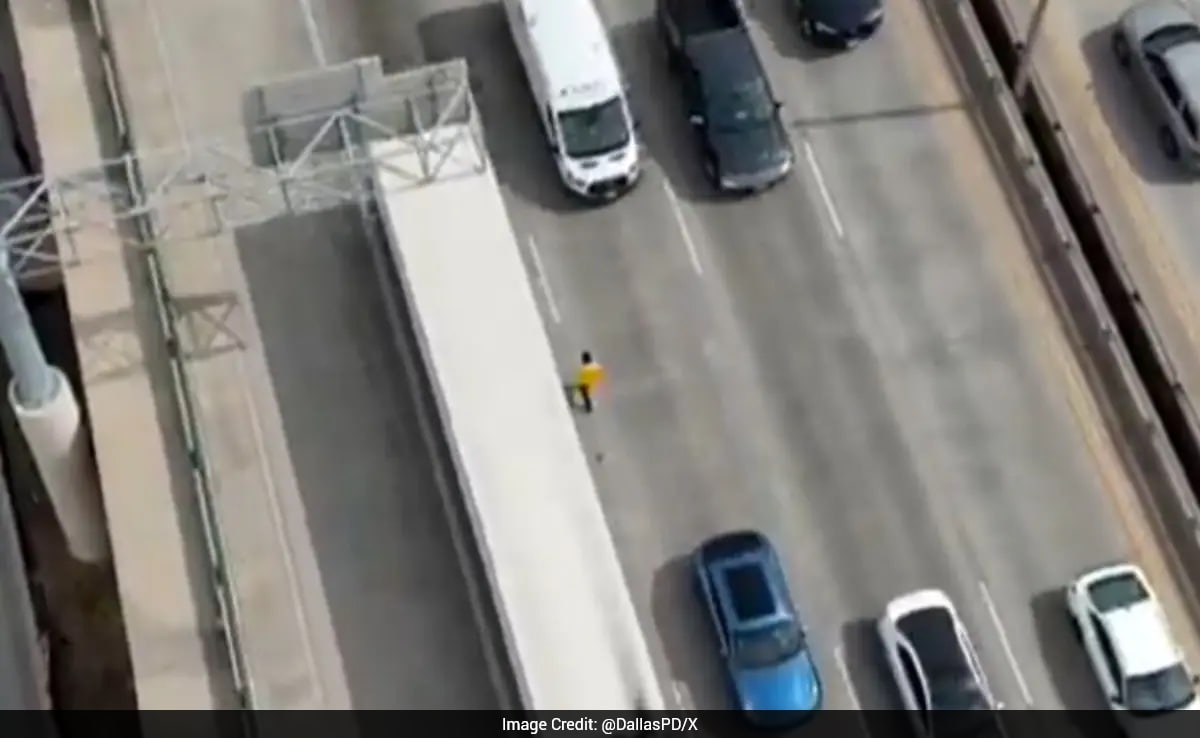
He was not running. He was not trying to cross to the other side. He was simply wandering, a dazed silhouette drifting between lanes as high-speed traffic swerved, braked, and screamed around him. To the drivers slamming on their brakes, he was a ghost appearing out of the darkness. To the emergency dispatchers receiving a flood of panicked 911 calls, he was a tragedy waiting to happen.
In the old days of policing—which really means just a few years ago—resolving this situation was a high-stakes gamble. Officers would arrive, park their cruisers to block traffic, and step out into the pitch black with nothing but flashlights and hope. They would scan the dark asphalt, trying to spot a moving shadow before a vehicle struck him, or worse, struck them. It was an exercise in collective breath-holding.
This time, the first responder to arrive on the scene did not breathe, did not wear a badge, and did not care about the dark. It hummed.
The Blind Spot of the Highway
When a crisis erupts on a high-speed roadway, time behaves strangely. Minutes stretch into eternities. The Chula Vista Police Department, located just north of the Mexican border, knows this pressure intimately. They handle an environment where urban density meets fast-moving transit corridors.
Consider the logistical nightmare facing a dispatcher when those 911 calls started rolling in. Callers are moving fast. They are disoriented by the dark.
"He's near the exit," one says.
"No, he’s a mile past it," says another.
The information is contradictory, fragmented, and decaying by the second.
If officers drive blind into a freeway incident, they risk causing the exact pileup they are trying to prevent. Turning on high-beams can blind oncoming traffic. Walking the lanes puts lives in jeopardy. The traditional tools of law enforcement—the cruiser, the spotlight, the megaphone—are blunt instruments when surgical precision is required.
But while the ground patrol units were still navigating the approaching ramps, a small team inside the station shifted their focus to a screen. They were utilizing a program known as Drone as a First Responder. It is a system that treats unmanned aerial vehicles not as tech toys or post-incident investigative tools, but as the literal vanguard of public safety.
Within seconds of the first dispatch, a drone launched from the roof of the police headquarters. It did not have to battle traffic. It did not have to wait for stoplights. It climbed straight up into the night sky, leveled off, and streaked toward the coordinates at over thirty miles per hour.
An Eye Unblinking
Up there, the world looks different. The chaos of the freeway resolves into predictable rivers of red and white lights. But more importantly, the drone sees what the human eye cannot.
Equipped with a thermal imaging camera, the drone translates the cold, dark world into a spectrum of heat signatures. On the operator's screen, the frozen asphalt of the freeway appeared as a dull, dark gray. The engines of the rushing cars were bright, blazing white embers.
And there, right in the middle of the dark gray ribbon, was a tiny, glowing human shape.
The contrast was stark. The individual was walking aimlessly, stepping across the dotted white lines that dictate where cars should travel. Through the camera lens, the operator watched a massive heat signature—a commercial truck—bear down on the smaller shape. At the last possible second, the truck veered, its brakes flashing white hot as it narrowly missed the pedestrian.
Seeing this unfold in real-time alters the psychology of a rescue. The drone operator was not guessing where the man was. They were anchoring him in space.
"I've got him," the operator relayed over the radio. "He's in the center lanes, just north of the overpass. Units, hold your position back, I will guide you in."
This shifted the power dynamic entirely. Instead of a frantic search in the dark, the ground officers now possessed an omniscient guide. The drone hovered hundreds of feet above, completely silent to the chaos below, tracking every step the man took. It became a digital guardian angel, keeping its unblinking, thermal eye fixed on a soul who seemed completely lost to the world.
The Choreography of a Rescue
What followed was a masterclass in modern, tech-assisted de-escalation.
Historically, rushing a person in a mental health crisis or a state of severe disorientation with flashing lights and barking commands can trigger a fight-or-flight response. On a sidewalk, that is dangerous. On a freeway, it is fatal. If the man panicked and ran, he would step directly into open traffic.
The drone allowed for a completely different approach: patience.
As police cruisers approached, the drone operator directed them precisely where to slow down and create a rolling block, safely tapering the flow of traffic behind them without causing a sudden, catastrophic pileup. The officers did not need to blind the area with high-beams or search the ditches. They knew exactly where the man was standing because the drone’s camera was feeding live video directly to the mobile data terminals inside their cruisers.
They could see his posture. They could see he was unarmed. They could see he was exhausted.
When the officers finally stepped out of their vehicles, they didn’t do so with weapons drawn or voices raised. They approached from the specific angle suggested by the aerial view—an angle that cut off the man’s path toward the active lanes of traffic, gently herding him back toward the safety of the shoulder.
The man, overwhelmed and clearly unable to cope with the reality around him, did not fight. He didn't run. The presence of the officers, arriving calmly and deliberately right where he stood, seemed to break the spell of his disorientation. Within moments, they escorted him off the asphalt and into the back of an ambulance.
No shots fired. No vehicles crashed. No lives lost.
The Changing Definition of Contact
It is easy to look at a story like this and see a neat piece of tech journalism. A gadget helped save a guy. It's a good headline.
But the implications cut much deeper than a single successful intervention on a California highway. We are witnessing a profound shift in how communities handle crisis, vulnerability, and public safety.
For decades, the public conversation around policing has been stuck in a frustrating loop, swinging between demands for stronger enforcement and calls for de-escalation. The missing piece of that puzzle has often been the luxury of information. When an officer arrives at a scene with zero context, high adrenaline, and limited visibility, the margin for error shrinks to a razor's edge.
Information is the antidote to fear.
By sending a thermal-equipped drone ahead of human beings, the entire nature of the initial contact changes. The drone doesn't have an adrenaline surge. It doesn't get startled by a sudden movement. It doesn't feel the primal urge to protect itself from a fast-moving vehicle. It simply gathers truth and distributes it to the people who need it to make life-or-death decisions.
There is a vulnerability in admitting that our old systems were fundamentally blind. It is uncomfortable to realize how many past tragedies on dark roads might have been avoided if we simply had a better vantage point. But acknowledging that limitation is the only way to move past it.
The sky above our cities is no longer just empty space; it is becoming a layer of protection.
As the ambulance pulled away into the night, carrying a man toward medical evaluation instead of a morgue, the drone spun its rotors and climbed back into the dark. It flew back toward its rooftop perch, ready for the next call, leaving the freeway to return to its loud, mechanical rhythm. Down on the asphalt, the white and red lights resumed their endless, rushing river, completely unaware of how close they had come to swallowing a life, and how quietly a machine had pulled that life back from the brink.