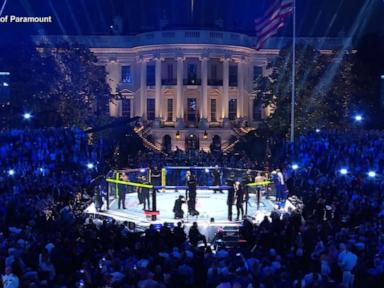
The grass of the White House South Lawn is usually manicured to a degree that feels almost sacred. It is a stage for state arrivals, Easter egg rolls, and the soft thrum of Marine One blades. But by one o’clock on a warm Monday morning, that historic turf was buried beneath forty tons of steel, a massive canopy cutting into the Washington night sky, and a canvas stained with the sweat and spilled blood of two men who had just spent twenty minutes trying to dismantle each other’s ribcages.
Justin Gaethje stood on top of the chain-link fence, looked down at the President of the United States, and flipped backward into the air.
When his bare feet slapped the canvas, the sound carried a strange, heavy finality. He was bruised, his liver screaming from early body shots, and his face mapped with the fierce reality of a four-round war. Over his shoulder hung the UFC lightweight championship belt. Over the other, the American flag. A few feet away, Donald Trump—celebrating both his 80th birthday and a sprawling prelude to the nation’s 250th anniversary—leaned over the apron to shake the new champion’s hand.
It was a scene that defied a century of political gravity. This was not a standard photo opportunity. It was the absolute collision of raw, modern spectacle and the oldest institutions of American power.
To understand how a cage-fighting ring ended up parked outside the Oval Office, you have to look past the political theater and examine the human mechanics of a twenty-five-year friendship. Back in 2001, when mixed martial arts was still widely condemned by politicians as human cockfighting, the sport was effectively exiled from mainstream American venues. It was broke, misunderstood, and toxic to advertisers.
Dana White, the young, hyper-aggressive executive trying to save the sinking ship, needed someone with a venue and a streak of defiance. He found Trump, who opened the doors of the Trump Taj Mahal in Atlantic City to the ostracized sport.
That choice created a debt.
Consider what happens when a billionaire and a fight promoter share a mutual language of survival. Decades later, with Trump back in the Executive Mansion and White sitting on a global sports empire, the return on that early investment materialized on the executive branch's doorstep. White openly admitted the logistics were a nightmare, a sixty-million-dollar singular extravaganza that pushed his company to its absolute financial and operational limits. But the promise was kept.
The days leading up to the fights felt volatile. Washington weather forecasts threatened severe thunderstorms, the kind of heavy, humid summer downpours that could turn an open-air metal structure into a lightning rod. Meteorologists on the payroll filed hourly updates, checking radar screens as tension grew behind the scenes. Simultaneously, legal challenges crawled through the courts, with watchdog groups attempting to pull the plug on the event by arguing it blurred the lines between state-sanctioned historical commemoration and private corporate marketing.
The clouds never broke. The injunction was denied. The show went on.
Step into the crowd that night and the atmosphere felt heavy, a thick mixture of military dress uniforms, corporate titans, and tech executives like Mark Zuckerberg sitting ringside. The south portico had been converted into a fighter walkout tunnel. Think about the surreal contrast: athletes who make a living by fracturing bones pacing through hallways lined with oil paintings of early American presidents, walking past a military honor guard, and stepping out onto a red carpet under the glare of production lights.
The fights themselves were structured for maximum impact. The matchmakers had deliberately loaded the card with heavy hitters and aggressive strikers, avoiding the slow, technical ground wrestling that can sometimes lose a mainstream crowd. The strategy worked with terrifying efficiency. Five consecutive knockouts turned the outdoor arena into a pressure cooker of noise. After each victory, the ritual was identical. The blood-slicked winner would step through the cage door, bypass the media, and walk straight to the front row to pay respects to the president.
But the night revealed the chaotic, unpredictable nature of live, unscripted microphones. During an undercard interview, heavyweight Josh Hokit exited the cage, handed Trump a victory chain, and used his post-fight broadcast moment to launch an ugly, conspiratorial insult at former First Lady Michelle Obama. It was a stark reminder of what happens when the raw, unfiltered culture of the combat sports world is given an international platform on the most sensitive political stage in the world. The immediate, sharp condemnation from critics highlighted the razor-thin tightrope the event was walking.
By the time the main event commenced, the crowd was emotionally exhausted but hyper-focused. Justin Gaethje was a massive underdog. He was facing Ilia Topuria, an undefeated, ferocious champion who seemed to possess an almost mystical precision in his hands.
The early rounds felt like a slow execution. Topuria moved with devastating fluidity, pinning Gaethje against the fence directly in front of the presidential seating area. He targeted Gaethje’s midsection with hooks that echoed through the outdoor microphone setup. For anyone watching closely, it looked like a matter of time before the American challenger collapsed.
But the true core of combat sports isn't found in a fighter’s dominance; it is found in their capacity to endure suffering. Gaethje survived the initial onslaught by relying on sheer, stubborn resilience. By the third round, the momentum began to shift in a brutal, visible way. Topuria’s face began to swell, the pristine technique cracking under the pressure of Gaethje’s relentless counterattacks. By the fourth round, Topuria was fighting through a mask of his own blood, his vision severely compromised.
When the ringside doctor stepped onto the apron between rounds, he looked into the champion's eyes and signaled to the corner. The fight was stopped. An impossible upset was sealed.
As the clock crept past one in the morning, the South Lawn erupted into a massive fireworks display, the explosions illuminating the Washington Monument to the cadence of John Philip Sousa’s marches. Trump stepped inside the cage, standing beside Gaethje and the fighter’s mother, surrounded by the debris of tape, water bottles, and the physical remnants of a brutal contest.
Gaethje, breathing heavily into the microphone, looked out at the thousands of screaming spectators spread across the lawn and the nearby Ellipse. His words were simple, stripped of complex political rhetoric, grounding the entire surreal evening in a basic human truth. He noted that centuries ago, the country itself was a massive underdog, facing impossible odds against an established empire. He looked at his belt, looked at the White House behind him, and stated that survival simply required sticking in the fight when you are getting hit the hardest.