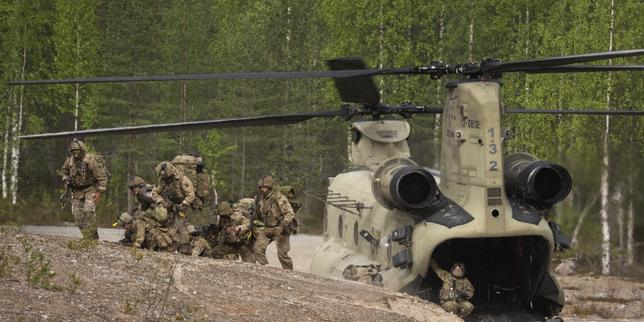
The European continent isn't just dealing with a diplomatic standoff. It's preparing for actual bog warfare. Fifty kilometers from the Russian border, in the brutal, mosquito-infested, muddy expanse of northern Finland, thousands of soldiers are learning a harsh lesson. You can have the most advanced tech in the world, but it doesn't mean anything when your multi-million dollar armored vehicle sinks up to its axles in peat.
NATO forces are currently executing massive, high-stakes exercises in the Finnish wilderness. Since Finland joined the alliance, the geopolitical calculus changed completely. The border NATO shares with Russia doubled overnight. Now, troops from the US, UK, France, and various Baltic states are trying to figure out how to survive, move, and fight in a place that wants to swallow them whole. For an alternative look, read: this related article.
This isn't your standard desert or open-plains drill. This is a gritty, wet, and exhausting reality check.
The strategic nightmare of the Finnish border
People who look at maps think warfare is about straight lines and rapid tank advances. It isn't. Not here. Related coverage on this trend has been published by The Guardian.
Finland shares a 1,340-kilometer border with Russia. Most of it consists of dense pine forests, massive boulder fields, and treacherous bogs. If an incursion happens, it won't look like Operation Desert Storm. It will be a slow, grinding fight through choke points.
Western armies spent decades fighting asymmetric wars in dry environments. They got used to air superiority and clear roads. In the Finnish taiga, the trees block your satellite signals. The swamps trap your wheels. Thermal imaging cameras struggle to peer through the dense canopy.
NATO leadership realized they had a massive gap in their capabilities. They needed the Finns to teach them how to fight in the North.
What the Finns know that the rest of NATO forgot
The Finnish military didn't build its army for global expeditionary warfare. They built it for one specific job: stopping a massive invasion from the east.
While Western Europe spent the post-Cold War era downsizing its militaries, Finland kept conscription. They have a reserve force of 900,000 citizens. They know every rock, every logging trail, and exactly when a frozen swamp becomes a muddy death trap.
Here is what the Finns are teaching foreign troops right now.
Light infantry beats heavy armor
If you drive a heavy tank onto a Finnish forest path, you're a sitting duck. The Finns rely on highly mobile, decentralized units. They use cross-country skis in the winter and light, tracked all-terrain vehicles like the Bandvagn 206 in the spring thaw. They hit hard from the flanks and disappear back into the trees.
Logistics are a nightmare
In the sub-Arctic, everything breaks. Batteries die twice as fast. Fuel thickens. Soldiers burn 5,000 calories a day just staying warm and moving through the brush. NATO forces are discovering that their standard supply chains fall apart when roads don't exist. You have to carry everything on your back or rely on small, hidden supply caches.
Electronic warfare is the default
You have to assume the enemy is listening to every radio frequency and jamming your GPS. Finnish troops train constantly without digital comms. They use old-school paper maps and field telephones with physical wires. For American or British soldiers hooked on digital battle networks, this is a massive culture shock.
The psychological toll of the northern wilderness
You can't appreciate the sheer scale of isolation until you're out there. The forests feel endless. The bogs smell like rotting vegetation. In the summer, the sun never sets, ruining sleep schedules. In the winter, the dark is oppressive, and the cold drops below minus thirty.
Soldiers from warmer climates face severe psychological fatigue within days. The environment forces constant vigilance. If you get wet, you hypothermia risks skyrocket. If you make too much noise, the silence of the forest betrays your position for miles.
It's a lesson in humility for foreign troops. They quickly realize that survival comes before tactics.
Geopolitical friction points that nobody talks about
This training isn't happening in a vacuum. It's a direct message to Moscow. Every explosion echoing through the trees near Rovaniemi or Sodankylä is heard across the border.
But it also creates internal friction within NATO.
Integrating different military cultures is incredibly difficult under these conditions. French doctrine relies heavily on centralized command and speed. British doctrine emphasizes grit and small-unit initiative. Merging these styles with the ultra-pragmatic, defensive mindset of the Finns takes time.
There's also the issue of equipment compatibility. A rifle that works perfectly in the French countryside might jam when fine Finnish granite dust gets into the mechanism. Radios don't always talk to each other across different national networks. These exercises are designed to break things now so they can fix them before a real conflict breaks out.
How to track the evolution of Arctic defense
If you want to understand how this region is changing, don't just read political press releases. Watch the infrastructure.
Keep an eye on Sweden and Norway's rail networks. The Nordic countries are currently upgrading their east-west rail links. This allows NATO to land troops on Norway's Atlantic coast and move them rapidly across Sweden into Finland.
Monitor the procurement of cold-weather gear. When major Western militaries start buying thousands of specialized snowmobiles and Arctic-grade tents, it shows exactly where they expect the real trouble to start.
Pay attention to the deployment of drone tech in dense forests. Standard quadcopters hit branches. The military that perfects small, autonomous drones capable of navigating tight forest canopies will hold a massive advantage in the taiga.
The era of easy defense planning is over. The West is finally waking up to the reality of northern warfare, and the learning curve is steep, muddy, and cold.


