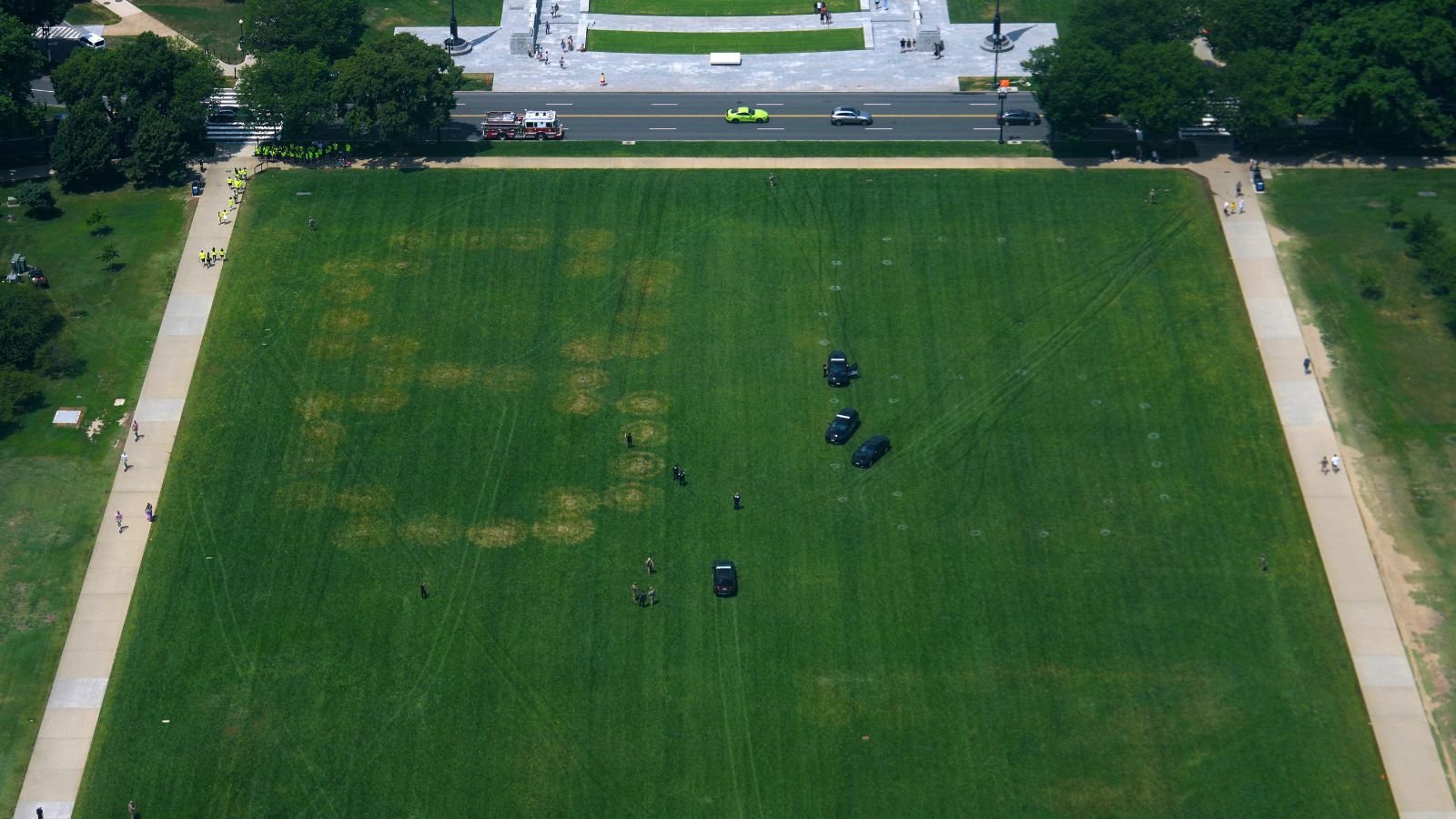
A massive, decaying numerical message reading 8647 has appeared on the grass of the National Mall in Washington, D.C., triggering a federal investigation and highlighting a sharp conflict between political free speech and national security. Discovered near the World War Two Memorial by a Reuters photographer positioned atop the Washington Monument, the giant digits were not painted onto the turf. Instead, they emerged over several days as the grass died and turned brown, contrasting sharply with the surrounding green lawns. Federal law enforcement officials are now treating the incident as a potential threat against President Donald Trump, the 47th president of the United States.
The primary query surrounding the incident is no longer what the numbers mean, but how they got there and what they signal for the rule of law. The term 8647 combines restaurant shorthand—"86," meaning to refuse service to a customer or discard an item—with "47," denoting the current presidency. While political dissidents defend the sequence as a protected, non-violent slogan calling for the removal of the president from office, the Department of Justice and the White House view it as an implicit incitement to violence.
The physical manifestation of this code on the most heavily monitored parkland in America represents a major security breach that has caught the National Park Service and the U.S. Park Police completely off guard.
The Chemistry of Dissident Vandalism
What makes the National Mall incident distinct from standard acts of political graffiti is the technical sophistication of its execution. Law enforcement sources confirm that the numbers were invisible from the ground when applied. EarthCam time-lapse footage reveals that the code gradually burned its way into the lawn over the course of forty-eight hours.
This gradual browning points to a calculated deployment of specific chemical agents.
Herbicide Deployment and Delayed Reactions
To achieve a delayed-onset burn on a highly managed turfgrass ecosystem, perpetrators likely utilized a systematic or selective herbicide rather than a fast-acting contact chemical like glyphosate.
A high-concentration application of an organic compound or a commercial agricultural regulator would allow the individual to walk across the Mall undetected, applying a clear liquid that only kills the plant tissue after prolonged exposure to sunlight.
- The Collection of Evidence: U.S. Park Police forensic teams have harvested grass and soil core samples from the dead zones of the numbers.
- The Forensic Timeline: Investigators are running gas chromatography-mass spectrometry tests to pinpoint the exact chemical compound used, which will help determine the exact window of application.
- The Ground Blindspot: Because the layout is so massive, the shapes were mathematically mapped out via GPS or pre-calculated pacing, rendering the message unreadable to patrolling officers at eye level until the grass completely died.
The Legal Warfare Over a Four-Digit Code
The chemical burning of the National Mall is the latest escalation in a escalating legal battle over the criminality of the phrase itself. The federal government has aggressively pursued individuals using the term, arguing it crosses the line from political dissent into a literal threat against the life of the president.
The most prominent battleground is the federal indictment of former FBI Director James Comey.
The Case Against James Comey
In April, the Department of Justice indicted Comey over an Instagram post depicting seashells arranged on a beach to spell out 8647. Prosecutors argue the post constitutes a federal felony under statutes prohibiting threats against the president. Comey has aggressively counter-sued, retaining high-profile defense council to argue that the phrase is entirely protected under the First Amendment as rhetorical hyperbole.
The legal community is deeply divided. Some constitutional scholars argue that the restaurant slang "86" is fundamentally ambiguous, traditionally meaning to remove, cancel, or reject, and does not meet the strict legal definition of a "true threat" established by Supreme Court precedent.
The Justice Department counters that within the current political environment, the term carries a lethal subtext that cannot be ignored.
[Political Protest] ◄─── Is "8647" Protected Hyperbole? ───► [Federal Threat]
(Defended by First Amendment)                               (Prosecuted by DOJ)
The Flag Ruling Precedent
Just days before the National Mall incident, a federal judge dealt a blow to the administration's legal strategy. The court blocked the National Park Service from enforcing a ban against an anti-Trump protest group that sought to fly an 8647 flag near federal property. The judge ruled that the government could not engage in viewpoint discrimination without definitive proof of imminent, lawless action.
The chemical etching of the Mall directly challenges that ruling, forcing authorities to pivot from regulating speech to investigating property destruction on a national monument.
Security Failures on America’s Front Lawn
The timing of the vandalism has caused significant embarrassment within the Department of the Interior. The National Mall is currently undergoing extensive cosmetic renovations overseen by the executive branch, including work on the Lincoln Memorial Reflecting Pool, which was hit with spray-painted 8647 graffiti earlier this spring.
Furthermore, the space is actively hosting massive crowds for the FIFA World Cup Fan Zone and preparing for the upcoming "Freedom 250" national independence festivals.
The Surveillance Gap
The National Mall is one of the most surveilled outdoor spaces on earth, monitored by a web of federal cameras, park rangers, and secret service details. The fact that an individual or group could map out and apply a chemical agent across a massive swath of lawn near the World War Two Memorial without detection reveals a critical vulnerability in park security.
With international tourists and sports fans packing the capital, the perimeter security around these historic green spaces has proven surprisingly porous.
The U.S. Park Police, assisted by National Guard personnel and federal investigators, have cordoned off the affected area with tarps and barriers. However, masking the dead grass does little to alter the strategic reality. The perpetrators utilized the biology of the lawn itself to bypass physical security checkpoints, transforming the landscape into a time-delayed political billboard.
The investigation now hinges on matching the chemical signature found in the soil samples with commercial purchasing records and reviewing specialized thermal imaging archives from regional security cameras.