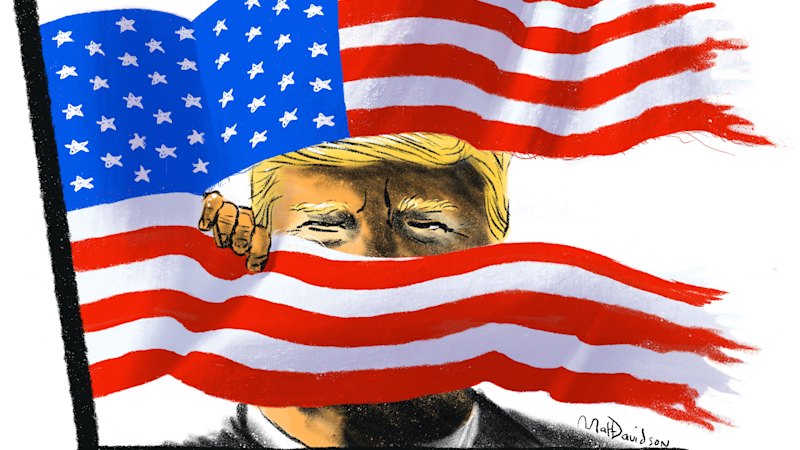
The United States is marking its 250th anniversary not with a unified celebration, but against a backdrop of deep, structural polarization that many observers characterize as a cold civil war. This internal hostility is not a sudden malfunction of modern politics, but rather a predictable recurrence of a historical cycle. The country was founded on a fundamental disagreement about the scope of federal power, individual liberty, and identity. Modern political tribalism simply continues this legacy. To understand the current gridlock, one must look past the daily political noise and examine the structural, economic, and institutional engines driving Americans apart.
The Friction in the Foundation
American stability has always been an illusion maintained by temporary compromises. The Constitution itself was a bundle of contradictions, designed to keep a fragile coalition of states together rather than to establish a permanent social consensus. It set up a system where minority rule could legally override majority preference through mechanisms like the Electoral College and the equal representation of states in the Senate.
When national identity fractures along geographic and cultural lines, these structural features do not promote compromise. They weaponize gridlock. The current political climate is a direct result of these eighteenth-century mechanisms operating in a highly sorted, media-saturated environment.
Political scientists refer to this as negative partisanship. Voters are no longer motivated by a shared vision or even by a deep love for their own party. Instead, they are driven by an intense fear and loathing of the opposition. When both sides view the other not as political rivals but as existential threats, the traditional machinery of governance breaks down. Legislation becomes impossible, leaving executive orders and judicial decrees as the only functional methods of policy-making.
The Economic Engines of Discontent
Cultural battles often grab the headlines, but the underlying fuel for this cold civil war is economic divergence. Over the past forty years, the American economy has split into two distinct realities.
On one side are the highly educated, technologically advanced urban hubs that benefit directly from global trade and capital flows. On the other side are the deindustrialized rust belts, rural communities, and hollowed-out manufacturing towns that have seen their economic security vanish.
+-----------------------------------+-----------------------------------+
| Urban/Technological Hubs         | Deindustrialized/Rural Areas      |
+-----------------------------------+-----------------------------------+
| - Knowledge and service economy   | - Traditional manufacturing/agri  |
| - High concentration of capital   | - Capital flight, lower wages     |
| - Population growth & diversity   | - Brain drain, aging demographic  |
| - Globalized economic alignment   | - Localized, vulnerable markets   |
+-----------------------------------+-----------------------------------+
This economic sorting aligns perfectly with the political divide. Wealthier, denser areas vote reliably for one faction, while working-class, rural areas vote for the other. This creates a dangerous dynamic where economic resentment is easily channeled into cultural grievances. When a factory closes or a main street dies, it is not viewed merely as a consequence of market forces. It is interpreted as a deliberate betrayal by distant elites who hold different values.
The numbers back this up. Wealth inequality in the United States has reached levels not seen since the Gilded Age. The top one percent of households hold more wealth than the entire middle class combined. When a society distributes its rewards so unevenly, the social contract dissolves. People lose faith in institutions, whether they are banks, courts, or the press. Once that trust is gone, conspiracy theories and populist rhetoric fill the vacuum.
The Echo Chamber and the Death of Shared Facts
A nation cannot function without a baseline of shared reality. Historically, mass media acted as a centralizing force. While far from perfect, a handful of major networks and newspapers forced a broad, consensus-driven narrative onto the public.
The internet dismantled that structure. The modern media environment is a hyper-fragmented ecosystem optimized for engagement, and nothing drives engagement like outrage.
Algorithms are explicitly designed to feed users content that confirms their existing biases and amplifies their anxieties. This has transformed political discourse into a permanent feedback loop. One side reads a completely different set of facts, interpretations, and warnings than the other. They are not arguing about how to solve a problem; they are arguing about whether the problem even exists.
Consider how institutional credibility has eroded along partisan lines. A regular citizen now chooses their source of scientific data, legal analysis, and economic reporting based on their political affiliation. If a court rules against their preferred candidate, the court is corrupt. If an economic indicator is negative, the data is rigged. This total erosion of institutional authority makes it impossible to arbitrate disputes peacefully or authoritatively.
Institutional Paralysis and the Path Forward
The federal government is increasingly incapable of addressing systemic issues. The legislative branch, designed to be the primary arena for national debate, has largely abdicated its responsibilities due to the filibuster and extreme gerrymandering. Representatives are more accountable to their radical primary voters than to the general electorate, removing any incentive for cross-party negotiation.
With Congress stalled, power has shifted to the executive branch and the judiciary. Presidents use executive actions to implement sweeping policy changes, which are then immediately challenged in court and overturned by the next administration. This creates a volatile, unpredictable policy environment. It is governance by whiplash.
The Supreme Court, once viewed as an impartial arbiter, is now seen by large segments of the population as a political weapon. This is a critical vulnerability. When the judiciary loses its perceived neutrality, the legal framework holding the federation together begins to crack. States have already started openly defying federal directives and court rulings on issues ranging from immigration to environmental regulation.
Fixing this requires structural reform, not just better political rhetoric. Steps like ending partisan gerrymandering, reforming the primary system, and updating campaign finance laws are necessary to reduce the incentives for extremism. However, these changes are incredibly difficult to implement because the people with the power to change the rules are the very ones who benefit from the current system.
The United States at 250 is an empire defined by its internal contradictions. It remains an economic and military superpower, yet its political core is hollowed out by mutual distrust. The friction we see today is the true American tradition, a continuous re-litigation of the foundational conflict over who belongs, who rules, and what the nation actually stands for.