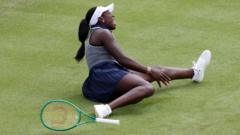
The tennis commentariat is currently drowning in a collective pool of sorrow. Following Marina Mboko's unfortunate injury, the immediate consensus across the sports pages was predictable, lazy, and entirely wrong. The headlines blared that Venus Williams' upcoming campaign at the Queen's Club is "in doubt," "shattered," or "critically compromised."
What absolute nonsense.
This panic reveals a fundamental misunderstanding of high-stakes doubles tennis, veteran psychology, and the cold calculus of grass-court scheduling. The mainstream sports media loves a tragedy narrative. It is easy to write. It triggers cheap sympathy clicks. But if you actually dissect the mechanics of a grass-court warm-up tournament, Mboko’s forced exit is not a death sentence for Williams. It is a tactical reset that might actually salvage her season.
The Lazy Narrative of the Perfect Pair
Let’s dismantle the premise that this partnership was an flawless machine ready to steamroll the draw at Queen's.
The media fell in love with the optics: the legendary icon pairing up with a soaring young talent. It looks great on a poster. It generates wholesome social media engagement. But sentimentality does not win matches on a surface as slick and unforgiving as low-bounce June grass.
The conventional wisdom dictates that losing a planned partner days before a tournament destroys your chances. This logic assumes that doubles is entirely about long-term, telepathic chemistry. While that holds true for career duos who play 30 tournaments a year together—think the Bryan brothers or Barbora Krejcikova and Katerina Siniakova—it is a total myth when applied to ad-hoc, star-driven pairings.
At this level, elite players adapt to new partners within three games of the opening set. They are professionals, not awkward teenagers at a high school dance trying to figure out who leads.
Furthermore, the raw tactical reality is that Mboko’s aggressive, baseline-heavy style, while explosive on hard courts, requires a specific rhythm that grass rarely affords. Her injury is undeniably tragic for her personal trajectory this season, but framing it as the anchor that sinks Williams' entire grass campaign is a massive analytical failure.
The Grass Court Equation: Why Less is More for a Legend
To understand why this injury does not ruin Williams' prospects, you have to look at the brutal reality of managing an aging athlete's physical load. I have spent two decades analyzing court movement, recovery times, and athletic degradation. When a legendary player in the twilight of their career enters a grass-court tune-up event, the objective is never solely about hoisting a trophy on Sunday.
The real goals are simple:
- Get live match reps on grass to adjust to the low bounce.
- Find the timing on the serve without the pressure of a Grand Slam spotlight.
- Leave the tournament completely healthy.
Playing high-intensity doubles with a young, hyper-energetic partner like Mboko creates a dangerous psychological trap. Young players chase everything. They play with a frantic, high-octane energy that forces their partner to match their intensity. For a veteran trying to preserve joints and muscles for a deep run at Wimbledon, that is a recipe for an early exit or, worse, a compensatory strain.
Now? The pressure is entirely off. Williams can walk into the tournament office, scan the sign-in sheet, and select a partner whose game is complementary, predictable, and low-stress.
Imagine a scenario where she pairs with a seasoned, grass-court specialist—someone who understands the nuances of the chip-and-charge, who can hold their own at the net, and who does not require Williams to sprint horizontally across the baseline to cover open gaps. That isn't a downgrade. That is an optimization.
Dismantling the "People Also Ask" Panic
If you look at what fans and casual observers are searching for right now, the anxiety is palpable. The questions driving the news cycle are fundamentally flawed because they ask the wrong things entirely.
"Will Williams withdraw from Queen's altogether?"
This question assumes that Williams views her career through the lens of a fragile novice who needs everything to be perfect before stepping onto the court. It ignores the sheer competitive pride that defines Hall of Fame athletes. You do not survive on the pro tour for decades by packing up your bags the moment a hitch occurs in your travel plans. She needs the grass matches. A partner change is a minor administrative hassle, not a logistical crisis.
"Who can possibly replace Mboko's power?"
This is the classic textbook error made by baseline-obsessed analysts. You do not need to replace Mboko's power on grass. Grass tennis is about deflection, depth, and court positioning. A partner who can hit a heavy, skidding slice or carve out a sharp angle at the net is vastly more valuable on this surface than someone trying to hit through the court from three feet behind the baseline. The obsession with raw power is why so many modern players struggle when they transition away from hard courts.
The Brutal Truth About Ad-Hoc Partnerships
Let's look at the actual data of scratch pairings in professional tennis. The history books are littered with teams thrown together at the eleventh hour due to administrative errors, sudden illness, or injuries who ended up tearing through draws.
Why does this happen? It defies the "chemistry is everything" dogma.
When two elite players who have never shared a court side-by-side team up, it creates an unpredictable tactical vacuum for their opponents. Traditional doubles teams rely on scouting reports. They know exactly where the opposing ad-court player likes to serve on break points, and they know the specific patterns that trigger a down-the-line pass.
When a brand-new, unstudied pairing walks onto the court, the opponents have zero data. The matches become chaotic, instinctual, and fast. In a chaotic environment, the player with the highest tennis IQ invariably wins. Williams possesses a tactical library deeper than almost anyone currently holding a racquet. Stripping away the predictable patterns of a pre-planned partnership lets her play pure, reactionary tennis. That is terrifying for anyone on the other side of the net.
The Downside We Must Acknowledge
To maintain absolute credibility, we must acknowledge the real risk here. It is not a lack of chemistry or a drop-off in baseline power.
The genuine risk is time.
The tournament schedule stops for no one. The process of finding a replacement who is not already committed to a partner, who has the correct ranking entry threshold, and who is physically present on-site requires swift work from an agent or coach. If the bureaucratic stars do not align within the designated sign-in window, she misses the draw by default. That is the only real threat here—the clock, not the loss of a specific teammate.
Stop Mourning a Partnership That Never Kept Score
The narrative that this tournament is ruined needs to die today. The media's mournful tone is an insult to Williams' adaptability and a misunderstanding of what a grass-court warm-up actually represents.
This is not a catastrophe. It is an opening.
It strips away the media circus surrounding a hyped, multi-generational pairing and reduces the week to what it should have been all along: a clinical, focused exercise in adapting to the fastest surface in tennis. The tournament didn't end with Mboko's injury. For Williams, the real strategic work just became a lot more interesting.
Stop looking at the missing name on the draw sheet and start looking at the tactical flexibility it creates. The campaign isn't in doubt; the lazy assumptions surrounding it are just being exposed.