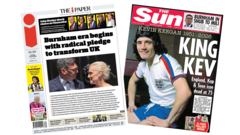
The Smell of Newsprint at Dawn
Fresh newsprint has a distinct bite. It hits you before the morning tea even steams—a sharp mix of industrial solvent, damp paper, and raw ambition.
On May 6, 2017, that smell carried a different weight across the North of England. Front pages were landing on doorsteps, slap-dash across wooden counters in Manchester newsagents, and sliding into rack displays at station kiosks.
Two names commanded the black ink.
Andy Burnham. Kevin Keegan.
To an outsider, the pairing looked accidental, a quirk of the daily news cycle. One was a former Cabinet minister stepping out from Westminster’s shadow to become Greater Manchester's first elected mayor. The other was an icon of football royalty, making headlines again as Newcastle United fans clamored for a return to glory under a familiar hero.
It was a moment where politics, sport, and regional pride slammed together on the front pages.
A Shift in the Soil
Power in Britain had traditionally flowed through one city.
Decisions were made in London, whispered in quiet corridors, stamped in Whitehall, and distributed down outward links to the provinces. If you lived in the North, you got used to the feeling of receiving policy rather than shaping it.
Then came the devolution deal.
When Andy Burnham stood before the cameras after his victory, the headline writers did not hesitate. "Burnham Era Begins," declared the papers. It sounded almost regal. But behind the theatrical press ink lay a gritty, unglamorous reality. Burnham was taking on a newly created role: managing transport, housing, and local budgets across ten boroughs that had often competed rather than cooperated.
Consider what happens when a city decides to steer its own ship.
Imagine a local commuter, let's call her Sarah. For years, Sarah paid three separate fares to three different bus operators just to travel eight miles across town. The buses were late. The tickets were expensive. The accountability was nonexistent because the decision-makers sat miles away.
Burnham’s arrival was not just a political win; it was an experiment in localized friction. Could a single regional figure pull the levers hard enough to fix Sarah’s bus ride?
The stakes were quietly massive. If local governance failed here, the entire argument for decentralization would collapse back into the London orbit.
The Return of the Messiah
While political reporters were analyzing regional budgets, the sports desks were brewing their own brand of drama.
"King Kev"—Kevin Keegan—remained a symbol of unadulterated passion in the North East.
Football in cities like Newcastle is not a pastime. It is a shared pulse. When the club wobbled, the city felt the chill. When Keegan’s name re-entered the headlines, it ignited a visceral memory of the mid-1990s, when his "Entertainers" played with a furious, heart-on-sleeve intensity that nearly snatched the Premier League title.
Keegan represented an emotional truth that spreadsheets and corporate owners often missed. Sports management is rarely just about tactical diagrams or financial fair play compliance. It is about collective belief.
Newcastle fans did not just want wins; they wanted their identity reflected back at them from the touchline. Keegan was the embodiment of that identity: explosive, earnest, and deeply devoted to the supporters.
When the papers splashed "King Kev" across the back pages alongside political headlines, they captured a twin longing across the North—a demand for control, respect, and leaders who understood the soul of the places they represented.
When Two Worlds Meet on Page One
Pick up a newspaper from that morning, and you see the underlying architecture of British identity laid bare.
On the left column: civic authority, transport networks, housing targets, and regional devolution.
On the right column: sporting heritage, fan rebellion, tactical nostalgia, and emotional catharsis.
They seem like completely separate worlds. They are not.
Both stories were fundamentally about belonging. They were about communities insisting that their stories mattered just as much as the debates inside the Palace of Westminster or the boardrooms of international conglomerates.
When a community feels forgotten, it clings fiercely to its symbols. A charismatic mayor promising local control. A legendary football manager who made fans feel ten feet tall. They are two sides of the exact same coin.
The Unwritten Next Chapter
The headlines eventually faded into yellowing archives.
Burnham went on to fight long, noisy battles over public transport control and regional funding, reshaping how local government operated. Keegan’s legacy remained permanently etched into Newcastle folklore, a benchmark for passion that future managers would forever be measured against.
Front pages do not just record what happened yesterday. They capture the precise moment a community reaches out its hands to grab the steering wheel.
The newsagent closes the shop door. The ink dries. The noise of the early morning commute begins again, loud and relentless, echoing across streets that are finally learning to tell their own stories.