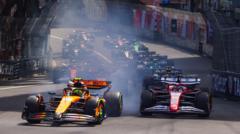
The Formula 1 paddock is currently obsessed with a delusion.
With the 2026 regulations rapidly approaching, the media has rallied around a comfortable narrative: the introduction of active aerodynamics—specifically the "X-mode" and "Z-mode" configurations designed to create a "yo-yo" effect of high downforce in corners and ultra-low drag on straights—will finally fix the Monaco Grand Prix. They are telling you that variable rear and front wing angles will create the drag differentials necessary to force overtaking on the narrowest street circuit on Earth.
They are completely wrong.
The belief that active aerodynamics will cure Monaco’s lack of passing misses the fundamental physics of modern racing. Worse, it misinterprets why Monaco matters in the first place.
The Physics of the Illusion
Let’s dismantle the engineering myth first. The 2026 regulations dictate a dual-state aerodynamic system. In the corners, cars run in Z-mode, maximizing downforce. On the straights, the system shifts to X-mode, shedding drag to boost top speed and conserve energy from the downsized internal combustion engine and uprated electrical systems.
The lazy consensus says: "Car A sheds drag in X-mode, gets a massive straight-line speed boost, and blows past Car B into Sainte Devote."
This ignores basic track geometry. To understand why this fails, look at the actual layout of the Circuit de Monaco.
The main straight at Monaco isn’t a straight; it’s a curved acceleration zone measuring a measly 660 meters from the exit of Anthony Noghes to the braking zone at Turn 1.
In a standard drag-reduction scenario, you need distance for a top-speed differential to manifest as a passing maneuver. At 2026 power outputs, where the electrical deployment is capped and heavily reliant on harvesting, a car switching into X-mode on a short straight achieves its terminal velocity almost instantly. Because both the leading and trailing cars will utilize X-mode on the straight, the net delta in drag between the two vehicles shrinks to nearly zero.
Unlike the traditional Drag Reduction System (DRS), which gives an exclusive aerodynamic advantage to the attacker, 2026’s active aero is a baseline car behavior. If everyone drops drag at the same time, nobody gains an advantage.
I have spent years analyzing telemetry data from tight street circuits. When you reduce drag across the entire grid simultaneously, you don't increase overtaking. You simply compress the braking zones.
By arriving at Sainte Devote or the Chicane at a higher terminal velocity, drivers must brake earlier and harder. When braking zones shrink in duration, the window of opportunity for a driver to "send it" down the inside vanishes entirely.
Why Bigger Batteries Make Passing Harder
The 2026 power unit regulations shift the energy split significantly, targeting an almost 50/50 balance between the 1.6-liter V6 engine and the electrical energy storage systems. The MGU-K will deliver nearly triple the electrical power of the previous generation.
This introduces a catastrophic variable for street racing: derating.
On a massive circuit like Spa-Francorchamps or Monza, a car can harvest energy effectively over a long lap. At Monaco, there is nowhere to efficiently harvest 350kW of energy without actively slowing down. Drivers will be forced to harvest under braking into the few heavy deceleration zones: Sainte Devote, the Chicane, and Rascasse.
Imagine a scenario where the leading car knows its tires are fading. In the current era, a pursuing car can look for an alternative line. In 2026, the leader will simply deploy their massive reserve of electrical energy out of Portier and Anthony Noghes—the two critical acceleration zones leading onto Monaco's brief straightaways.
Because the trailing car is trapped in dirty air through the preceding corners, its tires will overheat faster, reducing its traction out of the corner apex. The leading car uses a massive burst of electrical power to clear the danger zone, then aggressively harvests energy on the short straights where passing is already impossible.
The result? The 2026 regulations will give the lead car an even more potent defensive shield. The "yo-yo" effect isn't an overtaking tool; it is a defensive multiplier.
The Weight Problem Everyone Is Ignoring
The FIA has openly stated its desire to reduce the weight of the 2026 cars, aiming for a reduction of around 30 kilograms. It is an admirable goal, but it is a drop in the ocean.
Modern F1 cars are roughly 4.7 meters long and 2 meters wide. They have the footprint of a mid-sized commercial SUV.
+-------------------------------------------------------------+
|                                                             |
|                 Modern F1 Car Footprint                     |
|            (Approx. 4.7m Long x 2.0m Wide)                  |
|                                                             |
+-------------------------------------------------------------+
  ===========================================================
                 Width of Monaco Track At Apex
  ===========================================================
No amount of active aerodynamics can change the immutable laws of spatial geometry. Monaco was designed in 1929 for cars that were narrower than a modern hatchback and weighed less than 600 kilograms.
When a track is barely three cars wide at its widest point, and exactly one car wide at its apexes (like the Grand Hotel Hairpin), passing requires cooperation, an accident, or a catastrophic strategic blunder.
Active aero does not shrink the physical width of the carbon fiber bodywork. It does not alter the fact that two modern cars cannot fit side-by-side through Mirabeau. To argue that variable wing angles will solve a problem caused by physical displacement is an insult to the intelligence of anyone who understands basic dimensions.
Stop Trying to Fix the Wrong Problem
The entire debate around Monaco stems from a flawed premise: that a good motor race requires overtaking.
This is a modern obsession born out of a desire for constant, hyperactive stimulation. We have been conditioned by artificial DRS highways to believe that a race with three overtakes is a failure, and a race with eighty overtakes is a classic.
Monaco is not a race about passing. It is a race about tension.
The brilliance of Monaco lies in its absolute intolerance for error. It is the only weekend of the year where qualifying is the definitive peak of motorsport execution. Watching a driver flirt with structural disaster at 160 miles per hour between unforgiving armco barriers for 70 seconds is infinitely more compelling than watching a car pass another with an open rear wing on a four-mile asphalt runway in the desert.
When you try to force Monaco to be like Bahrain or Austin, you ruin it.
If you want overtakes, watch go-karts. If you want to watch elite athletes operate on the knife-edge of psychological collapse where a four-millimeter miscalculation ends their weekend, you watch Monaco.
The Real 2026 Danger: Strategy Extinction
If active aerodynamics and the new power units won’t create overtaking, what will they do to Monaco? They will likely kill the last remaining element of genuine tactical unpredictability: tire strategy.
Because the 2026 cars will rely heavily on shifting aerodynamic profiles to maintain balance, the cars will become hyper-sensitive to changes in mechanical grip. When a car transitions from X-mode to Z-mode, the sudden loading of the suspension requires predictable tire compliance.
If a team attempts an aggressive strategy—such as running an ultra-soft compound to undercut a rival—the rapid degradation of that tire will disrupt the aero-to-mechanical balance required during the rapid wing transitions. Teams will take fewer risks. They will converge on the exact same safe, predictable, single-stop strategies.
The grid will qualify on Saturday, shift into a mechanical train on Sunday, and use their active aero to match each other's speeds exactly.
The Actionable Truth for F1 Management
If Formula 1 truly wants to alter the dynamic of street racing, it needs to stop looking at air and start looking at rubber.
Instead of building complex, heavy hydraulic actuation systems to flip wings up and down like a startled bird, the sport needs to implement track-specific regulations.
- Mandate ultra-high-degradation tires exclusively for circuits with an average speed below 100 mph. Create a tire that drops three seconds of performance over five laps if pushed too hard.
- Remove the tire blanket systems entirely for street tracks, forcing drivers to manage cold rubber on slick painted lines and manhole covers.
- Shrink the rims. Move away from the heavy 18-inch wheels back to 13-inch wheels with massive sidewalls that allow cars to hit curbs without shattering their suspension geometry, encouraging tighter lines and bolder placement.
These are mechanical solutions that address the actual limitation of street racing: mechanical grip and placement precision. Active aerodynamics is an engineering solution looking for a problem that doesn't exist on the streets of Monte Carlo.
The 2026 regulations will bring faster straight-line speeds, complex energy management challenges, and fascinating engineering subplots. But if you are buying a ticket to the Casino square grandstand in 2026 expecting a festival of overtaking born from the magic of "yo-yo racing," save your money. The walls are just as close, the cars are just as wide, and physics does not care about marketing hype.