The air inside a military bunker smells of static electricity, stale coffee, and quiet panic. It is a universal scent, shared by young men and women in camouflage from Tehran to Arlington. While world leaders trade threats that dominate global news feeds, nineteen-year-old soldiers sit in darkness, watching green radar screens blink, waiting to see if a wall of fire is coming their way.
Geopolitics often sounds like a game played with plastic pieces on a cardboard map. We read headlines about strategic deterrence and regional posture, forgetting that every postured asset requires a human heartbeat to operate. When the rhetorical temperature rises, the ground level grows freezing cold with dread. For a more detailed analysis into similar topics, we suggest: this related article.
Consider the recent escalations between Washington and Tehran. The language coming from the highest offices of power has abandoned the traditional, cautious dialect of diplomacy. It has been replaced by something far raw, visceral, and dangerous.
The Arithmetic of Escalation
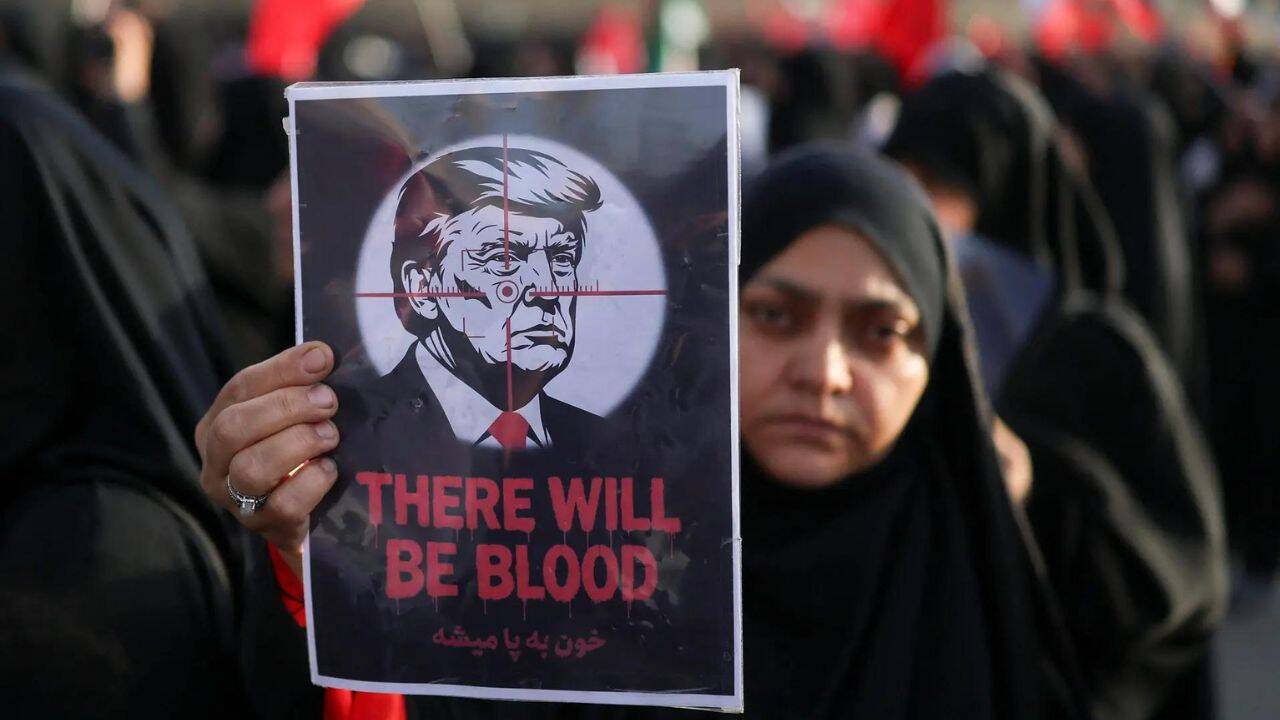
When former U.S. President Donald Trump warned Iran that any strike on American interests would meet a response hit even deeper than before, he was executing a familiar playbook: maximum pressure via maximalist language. The calculus relies on the psychological intimidation of the adversary. It assumes the other side will calculate the cost, see the disproportionate ruin promised, and blink. To get more details on this issue, detailed coverage is available on NPR.
But brinkmanship requires a willing partner in rational restraint.
The response from Iranian military commanders skipped past tactical counter-arguments entirely. Tehran vowed that if the red line were crossed, no American soldier would return alive. It is a statement designed to bypass the intellect and strike directly at the gut of the American public. It targets the collective trauma of flag-draped coffins arriving at Dover Air Force Base in the middle of the night.
This is no longer a negotiation over centrifuges or economic sanctions. It is a blood feud broadcast in real-time.
To understand the weight of these words, step away from the podiums and look at a hypothetical civilian—let us call her Maryam, a schoolteacher living in the suburbs of Isfahan. She does not control the Islamic Revolutionary Guard Corps. She does not vote in elections that change the trajectory of her country's foreign policy. Yet, when the radio broadcasts threats of strikes that will hit deeper, her immediate reality shifts. She looks at her children, she calculates how many dry goods are left in the pantry, and she wonders if the sky will tear open tomorrow.
Across the ocean in Georgia, a mother named Sarah watches the same news cycle. Her son is an infantryman deployed to a small, dusty outpost in Iraq. When Tehran promises that no soldier returns alive, Sarah does not see a geopolitical chess move. She sees her son’s face. She feels a physical ache in her chest that does not dissipate when the television is turned off.
The true currency of these threats is not military hardware; it is human anxiety.
The Mirage of Control
There is an illusion among policymakers that escalation can be precisely calibrated. They believe you can turn the dial up to an eight, hold it there to extract a concession, and then dial it back to a two.
History proves this is a fantasy.
Miscalculation is the engine of modern warfare. In 1914, Europe’s empires believed their intricate alliance systems and aggressive mobilizations were tools of deterrence. They thought the sheer terror of their industrial war machines would force their rivals to back down. Instead, a single stray bullet in Sarajevo triggered a mechanical sequence of events that none of them could stop. The gears of mobilization ground up a generation.
The current language between the United States and Iran flirts with that same mechanical inevitability.
When one side promises total destruction and the other promises absolute slaughter, the room for diplomatic maneuver shrinks to nothing. If a low-level drone operator makes a technical error, or a rogue militia commander fires a rocket without authorization, the leaders are trapped by their own public bravado. They must strike back with maximum force, not because it makes strategic sense, but because they promised their domestic audiences they would.
The Unseen Stakes
We often measure the cost of tension in oil prices and stock market dips. The financial press analyzes how a conflict in the Strait of Hormuz will disrupt global supply chains, adding pennies to the gallon at gas pumps in Ohio or Berlin.
Those metrics are real, but they are superficial.
The deeper cost is the erosion of the international imagination. When conflict is treated as inevitable, peace becomes an absurd concept. Generations grow up in the shadow of permanent hostility, learning to view the people on the other side of the border not as humans with families, dreams, and flaws, but as an existential threat that must be neutralized.
The language of no return alive and hitting deeper strips away the nuance required to solve complex problems. It reduces centuries of history, culture, and grievance into a binary choice: destroy or be destroyed.
The young soldiers in the bunkers understand this better than anyone. They know that if the orders are given, the men who wrote the speeches will not be the ones breathing through gas masks or dragging comrades through the mud. The politicians will remain in their well-lit briefing rooms, adjusting their ties for the evening broadcast, explaining why the sacrifice was necessary.
The radar screen continues to blink in the darkness. The silence between the threats is where the real terror lives, a quiet space where millions of people hold their breath, waiting to see if the egos of powerful men will finally set the world on fire.