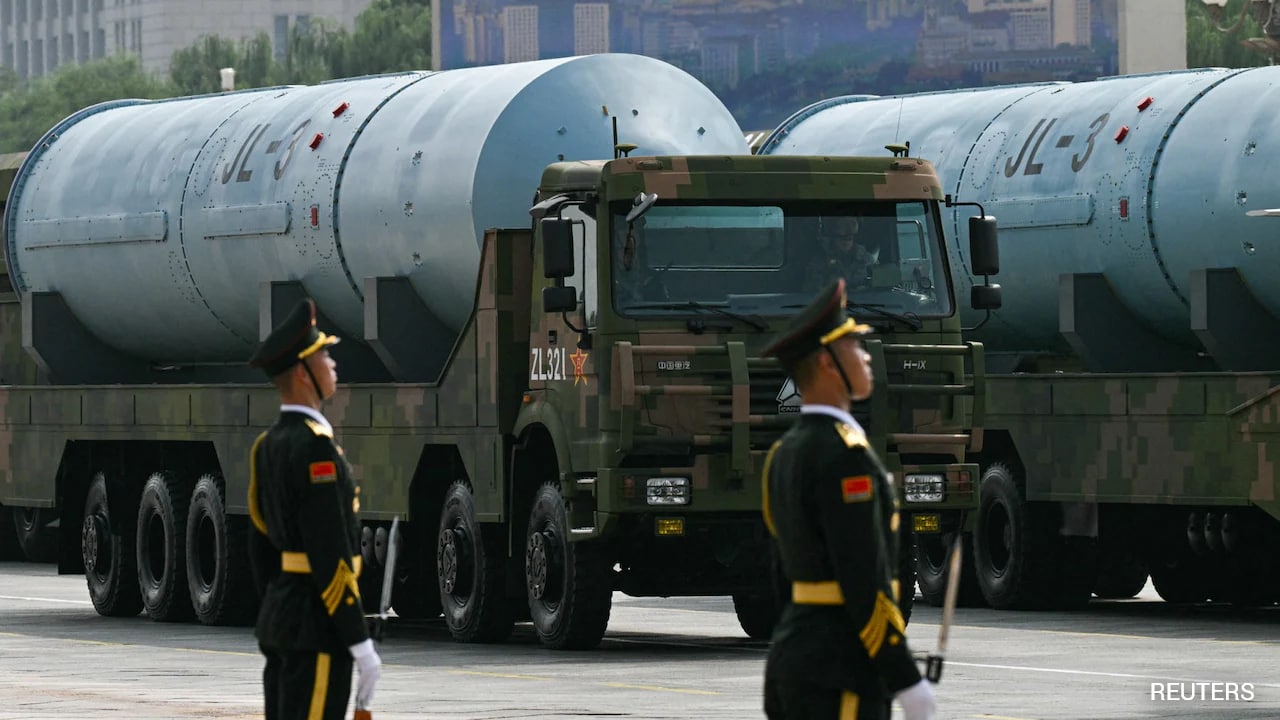
The operational architecture of nuclear deterrence relies entirely on the interplay between survivability, reach, and signaling clarity. When the Chinese People’s Liberation Army Navy (PLAN) launched an intercontinental-range submarine-launched ballistic missile (SLBM) into the high seas of the Pacific Ocean, it was not an isolated training event. It was a structural validation of the final leg of China’s nascent nuclear triad. Coming less than two years after the People’s Liberation Army Rocket Force (PLARF) executed its land-based intercontinental ballistic missile (ICBM) test in September 2024, this maritime launch signals a transition from theoretical capability to verified operational readiness.
The geopolitical discourse surrounding these developments often defaults to reactive rhetoric, characterizing open-ocean launches as reckless displays of power. Such narratives obscure the precise strategic calculus driving Beijing's actions. To accurately assess the balance of power in the Indo-Pacific, analysts must isolate the underlying engineering requirements, military signaling mechanisms, and defensive architectural shifts that define contemporary strategic deterrence.
The Triad Duplication: Mechanics of the Sea-Based Leg
Nuclear posture is governed by the structural requirement for a secure second-strike capability. While land-based silos are highly precise and road-mobile launchers offer operational flexibility, both remain vulnerable to sophisticated counterforce strikes. The sea-based leg of a nuclear triad solves this vulnerability through acoustic signature reduction and continuous oceanic concealment.
The July 2026 test utilized either a Julang-2 (JL-2) or a newer Julang-3 (JL-3) SLBM deployed from a strategic nuclear submarine (SSBN), likely a Type 094 or its advanced variant. The technical parameters of this system reveal a calculated expansion of reach:
- The Range Vector: The JL-3 has an estimated operational range between 8,000 and 12,000 kilometers. Fired from the relative security of protected bastions like the South China Sea or Bohai Gulf, a missile with this flight profile can project force across the continental United States without requiring the SSBN to breach vulnerable oceanic choke points.
- The Payload Constraint: Utilizing a dummy warhead, the flight verified the structural integrity of the post-boost vehicle and the accuracy of the guidance systems over extended trajectories.
- The Telemetry Network: Operating such tests requires complex space-and-sea-based data collection. The positioning of PLAN satellite tracking vessels, such as the Yuan Wang class, in the Pacific during the launch indicates an extensive command-and-control framework capable of tracking high-velocity re-entry vehicles in real time.
This sea-based launch mirrors the engineering objectives of the September 2024 land-based DF-31AG ICBM test, which traveled roughly 11,500 kilometers to waters near French Polynesia. By executing both tests within a 22-month window, Beijing has verified the mechanical reliability, launch command workflows, and full attack profiles of its dual long-range strike vectors.
Signaling Architecture and Regional Friction Functions
State-level military testing operates as a sophisticated signaling matrix where the intended recipient is rarely the entity closest to the splashdown zone. China's choice of the South Pacific as a terminal point introduces a complex friction function involving multiple international actors.
[PLAN SSBN Launch Point]
         │
         ▼ (Extended Ballistic Trajectory)
[Near Guam & Marshall Islands Tracking Systems]
         │
         ▼ (Terminal Re-entry)
[South Pacific High Seas / Exclusive Economic Zones]
The notification protocol utilized by Beijing reveals a calculated diplomatic hierarchy. By alerting regional neighbors such as Australia, New Zealand, and Japan only hours before the launch, China satisfied the bare minimum requirements of international transparency while maximizing the psychological impact of the demonstration.
This short-notice framework serves two distinct strategic objectives:
First, it establishes operational normalization. By explicitly framing these long-range open-ocean tests as routine annual training, Beijing seeks to systematically desensitize the international community to its expanding military footprint. What was once a historic exception—the 2024 test was the first such acknowledged Pacific ICBM test in 44 years—is being actively repositioned as standard operating procedure.
Second, it tests allied intelligence integration. The missile’s flight path adjacent to major American tracking assets in Guam and the Marshall Islands indicates a lack of concern regarding Western technical data collection. Instead, it invites observation to underscore the credibility of the deterrent. The deployment of specialized U.S. open-ocean tracking assets, such as RC-135 Cobra Ball electronics intelligence aircraft, confirms that the technical performance of the delivery system was monitored, cataloged, and validated by its primary target audience: Washington.
Structural Bottlenecks and Systemic Risk Factors
Despite the successful flight profile of the SLBM, a clear-eyed evaluation of China's strategic posture reveals significant structural dependencies and operational limitations. A blue-water nuclear deterrent is not achieved simply by deploying an advanced missile; it requires an entire ecosystem of stealth, sustainment, and secure communication.
The primary vulnerability remains acoustic signature management. While Western SSBNs operate with extreme quietness, making them nearly impossible to track in deep water, older generations of the PLAN Type 094 fleet possess distinct acoustic signatures that make them susceptible to Allied anti-submarine warfare (ASW) networks. If an SSBN can be trailed from its homeport, its value as an un-targetable second-strike asset plummets.
Furthermore, geography imposes strict operational bottlenecks on sea-based deployment. To enter the deep trenches of the Western Pacific where tracking becomes difficult, Chinese submarines must navigate narrow straits and shallow choke points throughout the First Island Chain. These corridors are heavily monitored by fixed underwater sensor arrays, maritime patrol aircraft, and hunter-killer submarines operated by the United States and its regional partners.
The final constraint is the risk of miscalculation. Short-notice strategic launches through international airspace disrupt commercial aviation corridors and maritime shipping lanes, raising the baseline level of regional tension. In an environment lacking robust, mature crisis-communication channels between Beijing and Washington, the compression of launch notification windows shortens the decision-making timeline for adversarial command centers, elevating the risk of an escalated response to a non-kinetic test.
Strategic Realignment Matrix
The completion of successive land and sea-based long-range missile tests accelerates defensive re-alignments throughout the Indo-Pacific. Rather than deterring regional opposition, the high-profile nature of these launches provides structural justification for accelerated military modernization among U.S. allies.
The rapid signing of the mutual defense pact between Australia and Fiji, alongside Tokyo's shifting defense spending allocations, demonstrates a regional pivot toward institutionalized balancing strategies. The implementation of minilateral security arrangements, such as AUKUS, will likely see increased prioritization of advanced underwater detection capabilities, quantum computing applications in ASW, and expanded deployment of autonomous surveillance vessels designed to counter PLAN deployments before they clear regional choke points.
The strategic play moving forward will not center on diplomatic protests or toothless calls for unilateral disarmament. Instead, Western defense architectures must adapt by shifting investments away from legacy surface platforms toward distributed undersea sensor grids and extended-range integrated air and missile defense (IAMD) nodes. To offset the verified reach of China’s dual-vector delivery systems, regional architectures must focus on denying Chinese SSBNs unmonitored access to the deep-water deployment zones of the Central Pacific, thereby neutralizing the strategic leverage Beijing seeks to extract from its newly validated triad.