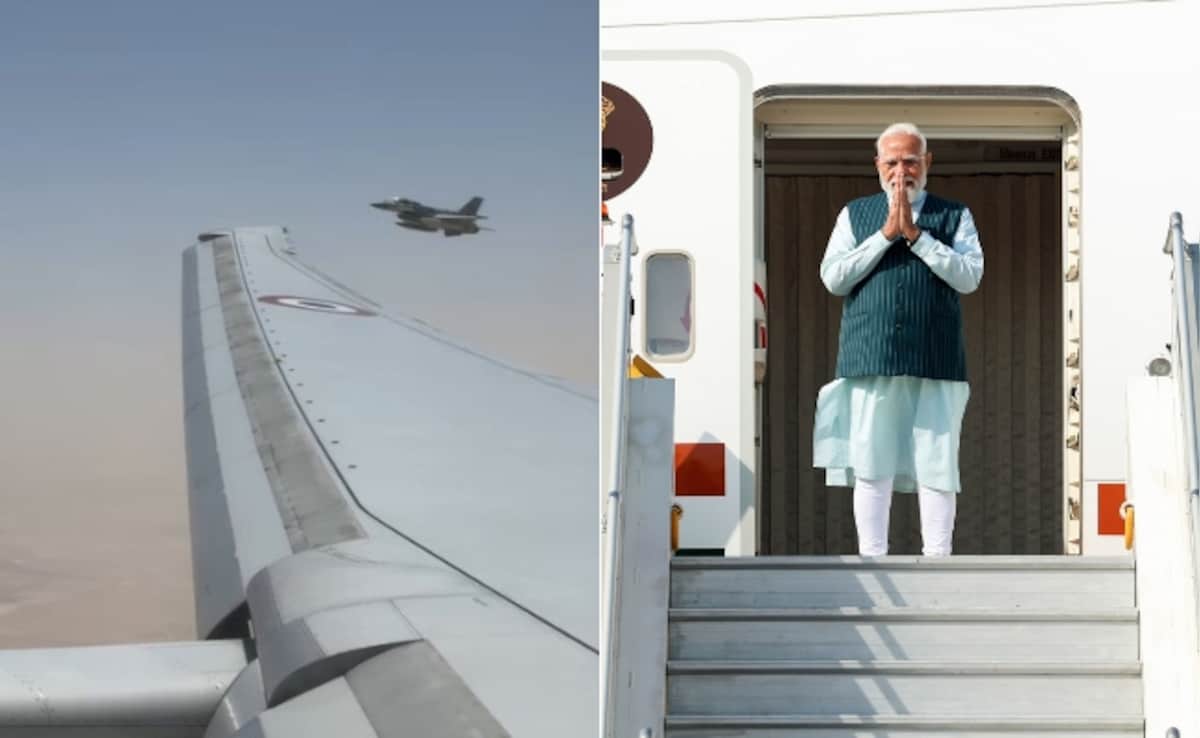
The aerial escort of a foreign head of state by a host nation’s fighter jets is frequently dismissed by mainstream media as a mere "ceremonial gesture" or a visual spectacle for social media consumption. Such a surface-level interpretation ignores the multi-layered functional utility of these maneuvers. When the United Arab Emirates (UAE) scrambled F-16 Block 60 "Desert Falcons" to flank Indian Prime Minister Narendra Modi’s aircraft upon entry into Emirati airspace, it executed a precise protocol designed to signal defense interoperability, sovereign commitment, and the hardening of a strategic corridor.
To understand the gravity of this event, one must deconstruct the physics and the politics of the "Aerial Guard of Honor." This is not a random flight path; it is a calculated deployment of high-value military assets to validate a specific bilateral hierarchy. Recently making news in this space: The Ryazan Strike and the End of Russian Interior Security.
The Triad of Diplomatic Aviation Logic
The deployment of supersonic fighter jets to accompany a non-combatant transport aircraft operates within three distinct frameworks: Sovereign Signaling, Tactical Interoperability, and Psychological Deterrence.
1. Sovereign Signaling and the Reciprocity Function
In the grammar of international relations, the "Escort Protocol" serves as a high-fidelity signal of status. The UAE’s decision to utilize the F-16 Block 60—one of the most advanced variants of the platform globally—functions as a deliberate display of the host’s military readiness. By placing these assets in close proximity to a visiting leader, the host nation communicates that the guest's security is now a direct extension of the host's national integrity. More information regarding the matter are covered by The Washington Post.
The logic follows a strict "Costly Signaling" theory:
- Asset Allocation: The fuel, pilot flight hours, and maintenance cycles required for such a sortie represent a tangible economic expenditure.
- Risk Assumption: Operating high-performance jets in tight formation with a large-body commercial or government aircraft requires extreme precision. Any error results in a catastrophic international incident.
- Visibility: The maneuver is designed to be documented. It is a visual proof of "High-Level Access," suggesting that the relationship has moved beyond trade memos into the realm of integrated security.
2. Tactical Interoperability and Airspace Coordination
Beyond the cameras, an escort mission is a live-fire test of the Air Traffic Control (ATC) and Air Defense (AD) integration between two nations. When PM Modi’s Boeing 777 (Air India One) crossed from international waters into the UAE’s Flight Information Region (FIR), the handoff required seamless data link synchronization.
The F-16s do not simply "fly alongside." They integrate into a temporary Combat Air Patrol (CAP) bubble. This involves:
- Identification Friend or Foe (IFF) Synchronization: Ensuring that the visiting aircraft is recognized by local surface-to-air missile (SAM) batteries as a protected asset.
- Vectoring and Speed Matching: A Boeing 777 cruises at approximately Mach 0.84. F-16s, designed for much higher speeds, must operate at the lower end of their performance envelope, requiring high angles of attack and constant throttle management.
- Communication Silos: The pilots of the escorting jets and the flight crew of the VVIP aircraft maintain a dedicated frequency, bypassing standard civilian ATC channels for a portion of the descent.
3. The Psychological Hardening of the Corridor
The UAE occupies a volatile geographic position. By escorting the Indian Prime Minister, the UAE military demonstrates its "Command of the Air" to regional observers. It is a statement of kinetic capability. It informs third-party actors that the airspace is monitored, controlled, and that the protection of the visiting dignitary is absolute.
Technical Specifications The F-16 Block 60 Variable
The choice of aircraft for the escort is never incidental. The UAE Air Force (UAEAF) operates the F-16E/F Block 60, a variant specifically developed for the Emirates with technologies that, at the time of their induction, surpassed those used by the US Air Force.
The presence of the AN/APG-80 Active Electronically Scanned Array (AESA) radar on these jets is significant. While the mission is ceremonial, the sensors on these aircraft are actively scanning the surrounding environment. This creates a moving "sensor shield" around the Prime Minister. If a rogue drone or an unidentified aircraft were to approach the flight path, the escorting jets would have a target lock before the VVIP aircraft's own defensive suites even registered the threat.
The Strategic Pivot From Energy to Security
Historically, the India-UAE relationship was defined by a buyer-seller dynamic focused on hydrocarbons. The F-16 escort symbolizes the death of that limited perspective. It reflects the transition into a Comprehensive Strategic Partnership.
The Security-Trade Correlation
There is a direct mathematical correlation between the frequency of military honors and the volume of non-oil trade. India and the UAE have moved toward a target of $100 billion in bilateral trade. High-level military gestures like the F-16 escort are lead indicators for:
- Joint Defense Production: Discussions regarding the manufacturing of ammunition and small arms.
- Maritime Domain Awareness: Shared intelligence on Persian Gulf and Indian Ocean transit lanes.
- Counter-Terrorism Integration: Harmonizing no-fly lists and financial tracking of extremist groups.
Logistics of the VVIP Flight Path
The arrival at Abu Dhabi’s presidential airport involves a choreographed sequence that begins 100 nautical miles out.
- The Intercept: The F-16s loiter at a predetermined waypoint. As Air India One enters the zone, the jets maneuver into a "V" or "Echelon" formation.
- The Visual Acknowledgment: Pilots often pull alongside the cockpit or the passenger windows, providing a "wing salute." This is the moment usually captured by onboard photographers.
- The Break-off: As the VVIP aircraft enters the final approach for landing (usually below 5,000 feet), the fighter jets perform a high-G "pitch out" or "break," returning to their base while the transport aircraft continues to the tarmac.
This sequence minimizes the risk of wake turbulence affecting the larger aircraft during the sensitive landing phase while maximizing the visual impact for the arrival ceremony.
Limitations and Risks of Aerial Escorts
While effective as a tool of statecraft, the maneuver carries inherent risks that planners must mitigate.
- Mechanical Failure: A mid-air stall or engine flameout of an escort jet in proximity to the VVIP aircraft would be a global disaster.
- Electronic Interference: The high-output radars of fighter jets can, if not properly managed, interfere with the sensitive avionics of a civilian-derivative transport aircraft.
- Geopolitical Misinterpretation: In highly contested airspaces, the sudden scramble of fighter jets—even for an escort—can be misread by neighboring states’ early warning systems as a strike package formation.
To counter these risks, mission planners utilize a Deconfliction Matrix, which outlines specific minimum separation distances (usually 500 to 1,000 feet) and strict "no-radar-lock" rules on the guest aircraft.
The Shift in Regional Power Dynamics
The UAE’s use of American-made F-16s to escort an Indian leader also sends a subtle message to Washington and Beijing. It showcases the UAE as a bridge between the West (the technology provider) and the Global South (the strategic partner). It asserts that the UAE is not merely a client state but a regional power capable of utilizing its arsenal to forge independent diplomatic paths.
This ceremony is a component of a larger "Defense Diplomacy" trend where India is increasingly viewed not just as a market, but as a net security provider in the Indian Ocean Region (IOR). The F-16s are the punctuation marks in a long-form sentence about the realignment of Asian and Middle Eastern interests.
Strategic Forecast for India-UAE Relations
The "Escort Protocol" should be viewed as a precursor to deeper kinetic cooperation. Expect the following shifts in the next 24 months:
- Increased Sortie Frequency: More frequent joint air exercises (like Desert Eagle) to move from ceremonial escorts to integrated combat maneuvers.
- Tech Transfer Compression: As trust is signaled through these public displays, the barrier for sharing sensitive radar and encrypted communication data lowers.
- Triangular Security Architectures: The potential for UAE-India-France or UAE-India-USA joint patrols in the Arabian Sea, using the precedent of the Prime Minister's escort as the baseline for operational trust.
The sight of F-16s flanking a diplomatic transport is the final layer of a "hard power" handshake. It confirms that both nations have moved past the transactional and into the operational, where their security interests are no longer just aligned, but physically intertwined in the same airspace.