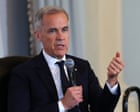
Mark Carney is not just a banker; he is a professional navigator of stormy seas. When the former head of the Bank of England and the Bank of Canada steps into the fray with a proposal for a "new US-Canada partnership," he isn't just making polite conversation at a summit. He is sounding an alarm about the fraying thread of North American competitiveness. His pitch to align Canadian economic policy with the "Make America Great Again" framework is a calculated, perhaps desperate, attempt to keep Canada from being crushed between a protectionist United States and a dominant China.
The strategy is simple but fraught with risk. Carney suggests that by integrating more deeply into the American supply chain—specifically in energy, critical minerals, and defense—Canada can transform itself from a target of U.S. tariffs into an indispensable partner in the push for American re-industrialization. It is a pivot away from globalism and toward a "Fortress North America" mentality.
The End of the Polite Neighbor Era
For decades, the economic relationship between Washington and Ottawa operated on a set of predictable, if sometimes strained, rules. Those rules are gone. The current American political climate has shifted toward a skepticism of free trade that spans both sides of the aisle. Whether it is a Republican or Democratic administration in the White House, the priority is now domestic manufacturing and securing supply lines against geopolitical rivals.
Canada finds itself in a precarious spot. If the U.S. moves toward a universal baseline tariff or doubles down on "Buy American" provisions, the Canadian economy, which sends over 75% of its exports south, faces an existential threat. Carney’s intervention is an acknowledgment that the old ways of lobbying Washington—appealing to shared history or "special relationship" rhetoric—no longer work.
Money talks. Influence follows. Carney is betting that the only way to secure Canada’s future is to prove that American greatness is physically impossible without Canadian inputs.
The Energy Pivot as a Bargaining Chip
At the heart of this proposed partnership is energy. While the political class in Ottawa has spent years focused on a green transition that often feels at odds with the resource-heavy reality of the Canadian economy, Carney is shifting the goalposts. He is framing Canadian oil, gas, and hydro power not just as commodities, but as the literal fuel for a U.S. manufacturing renaissance.
The logic is hard to argue with from a purely logistical standpoint. If the U.S. wants to repatriate factories from Asia, it needs vast amounts of reliable, affordable power. Canada has it. However, this creates a massive internal tension within Canada. To truly "make America great again" by providing cheap energy, Canada must accelerate its own resource development—a move that flies in the face of current federal environmental regulations and the slow-moving "Impact Assessment" processes that have stalled major projects for years.
The Critical Mineral Gap
Modern industry runs on more than just electricity. It runs on lithium, cobalt, nickel, and copper. Currently, China controls the vast majority of the processing and refining of these minerals. The U.S. has identified this as a major national security vulnerability.
Canada sits on some of the largest undeveloped deposits of these materials in the Western world. Carney knows that the U.S. is willing to pay a premium for "friend-shoring"—buying from allies to avoid dependence on adversaries. But there is a catch. Canada’s ability to actually get these minerals out of the ground and across the border is hampered by infrastructure deficits and complex Indigenous consultation requirements.
The "partnership" Carney envisions would require the U.S. to not just buy the minerals, but to actively invest in Canadian infrastructure to ensure they can be delivered. It is a request for the U.S. to treat Northern Ontario or the Yukon as if they were American soil for the purposes of industrial planning.
Why Washington Might Actually Listen
It is easy to dismiss a Canadian banker’s advice to the U.S. government as wishful thinking. Yet, Carney is uniquely positioned. He has spent years in the inner circles of global finance and climate policy. He understands that the American appetite for "economic sovereignty" is not a passing fad.
Washington is currently obsessed with the "De-risking" of its economy. By pitching a unified North American industrial base, Carney is offering a solution to the American problem of fragile supply chains. If the U.S. and Canada can synchronize their tax incentives and regulatory frameworks, they create a market that is too large for global competitors to ignore and too integrated for any single tariff to dismantle without causing self-inflicted pain on American soil.
The U.S. needs a "stable backyard." A weak or alienated Canada becomes a vacuum that other powers, namely China, would be happy to fill through investment in real estate, technology, or resources. By leaning into the MAGA rhetoric, Carney is speaking the language of the current American power structure to ensure that Canada remains inside the tent.
The Political Minefield at Home
This isn't just about cross-border trade. It is a domestic power play. Mark Carney is widely rumored to have aspirations for the leadership of the Liberal Party of Canada. By adopting a pragmatic, even "pro-MAGA" economic stance, he is distancing himself from the perceived failures of the current administration’s more ideological approach to trade and industry.
He is trying to build a bridge between the business community, which is terrified of American protectionism, and a political base that is traditionally wary of the U.S. Republican platform. It is a high-wire act. If he leans too far into the "America First" alignment, he risks being seen as a sell-out to Canadian sovereignty. If he doesn't go far enough, he risks presiding over a declining economy that loses its most important customer.
The Productivity Crisis
Canada has a math problem. For the last several years, labor productivity has been stagnant or falling. While American workers are producing more value per hour through tech adoption and capital investment, Canadian investment has lagged.
Carney’s proposal isn't just about trade; it’s about a forced upgrade. By hitching the Canadian wagon to the U.S. industrial engine, Canadian firms would be forced to compete or cooperate at an American level of intensity. This is the "hard-hitting" part of the truth that many in the Canadian elite don't want to hear: the current path of low-growth, high-regulation stability is a slow death.
$P = \frac{Y}{L}$
In this simple equation—where $P$ is productivity, $Y$ is total output, and $L$ is labor—Canada has focused too much on growing $L$ through massive immigration without enough investment to grow $Y$ at the same pace. Carney’s "partnership" is an attempt to inject the capital and demand necessary to fix the numerator.
The Counter-Argument: The Danger of Total Dependency
There is a dark side to this strategy. If Canada goes all-in on being the "resource and energy wing" of the American economy, it effectively abdicates its own industrial policy. It becomes a branch-plant economy once again.
Critics argue that this approach makes Canada a vassal state. If the U.S. changes its mind in four years—as it frequently does—Canada could find itself with billions in stranded assets, built specifically to serve an American market that no longer wants them. Relying on the political whims of a deeply divided neighbor is a gamble that requires more than just economic logic; it requires a crystal ball.
Moreover, there is the question of the "Green" vs "Brown" economy. Carney has been a vocal proponent of net-zero goals. How does he square that with a partnership that likely requires a massive expansion of oil and gas exports to satisfy U.S. energy security? The answer appears to be a quiet shift toward "decarbonized hydrocarbons"—using carbon capture and other technologies to make fossil fuels palatable in a net-zero framework. It is a compromise that will satisfy neither the hard-core environmentalists nor the traditional oil hawks.
Negotiating from a Position of Weakness
The most significant hurdle Carney faces is the reality of the power imbalance. In any negotiation, the party that can afford to walk away holds the cards. The U.S. can survive without Canada. It would be painful, expensive, and messy, but the U.S. is a continental superpower with its own internal resources. Canada cannot survive, in its current form, without the U.S.
This means that any "partnership" will be dictated largely on American terms. Canada may be asked to take sides in trade wars with the EU or China that don't necessarily serve its interests. It may be asked to harmonize its tax rates in a way that drains its ability to fund its social programs. This is the price of admission to Carney’s "Fortress North America."
The Defense Spending Requirement
One of the overlooked aspects of this partnership is the "defense" pillar. The U.S. has been increasingly vocal about Canada’s failure to meet the 2% NATO spending target. You cannot ask for a deep economic and industrial partnership while failing to contribute to the security of the continent.
Carney’s vision likely includes a massive increase in Canadian defense procurement—spending that would, coincidentally, go largely to American defense contractors or joint ventures. It is a "pay to play" model. Canada buys the jets and the submarines; the U.S. keeps the borders open for Canadian minerals and energy.
The Logistics of a New Accord
Moving from a speech to a policy is where most ideas go to die. For this partnership to work, several concrete things must happen:
- Regulatory Alignment: Canada must streamline its permitting process to match or beat American speeds. You cannot have a unified supply chain if a mine takes 15 years to open in Ontario but 5 years in Nevada.
- Infrastructure Corridors: The creation of pre-approved transit routes for energy and materials that bypass the usual provincial and state-level legal battles.
- Tax Reciprocity: Ensuring that "Buy American" tax credits for electric vehicles and other tech also apply to Canadian-made components without requiring a new treaty every time a new bill passes Congress.
None of this is easy. It requires a level of political courage and bureaucratic agility that has been absent from Ottawa for a long time.
A Choice Between Relevance and Decline
Mark Carney is offering a path that is uncomfortable, politically messy, and fraught with the risk of subservience. He is doing so because the alternative—continued drift into economic irrelevance—is worse. The "partnership" he describes is not a friendly handshake between equals. It is a strategic alignment of two very different powers against a common set of global threats.
Canada’s role in this new world order is being rewritten. The question is no longer whether Canada will be affected by the shift in American policy, but whether it will have any say in how it is integrated. Carney is making his move to ensure that Canada is an architect of the new North American reality, rather than just its warehouse.
Stop looking at the border as a fence and start looking at it as a seam. If that seam isn't reinforced, the whole garment will tear. Carney’s call for a new partnership is the first stitch in a very difficult repair job.