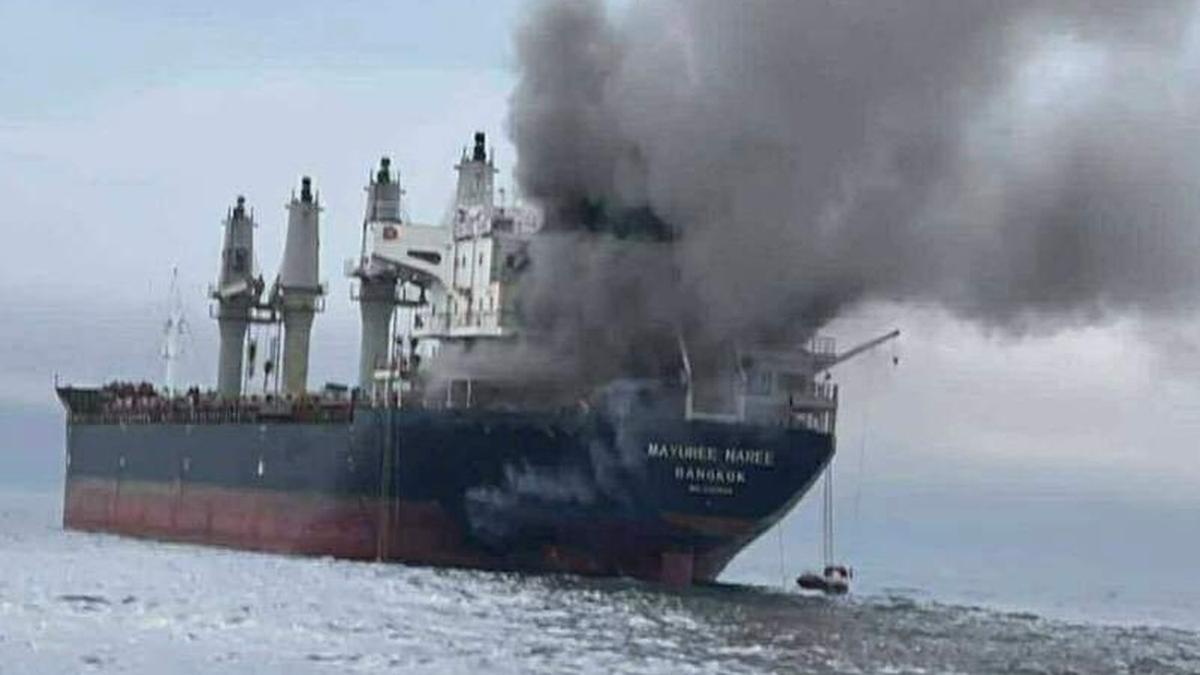
The confirmation of three Thai fatalities following a kinetic strike on a commercial vessel in the Strait of Hormuz shifts the risk profile of the world’s most vital energy artery from a theoretical bottleneck to an active zone of lethal attrition. This incident serves as a quantitative data point in a broader pattern of non-state and state-sponsored maritime interdiction that targets the logistical backbone of global energy security. For stakeholders in global shipping, insurance, and energy procurement, the event is not a tragedy in isolation; it is a signal that the operational cost of transit now includes a "fatality premium" that traditional risk models have failed to price accurately.
The Mechanics of Strait Instability
The Strait of Hormuz operates as a geographical choke point where 21% of global petroleum liquids consumption passes daily. Its strategic vulnerability is defined by three distinct variables: proximity, density, and depth. The shipping lanes are narrow, often forcing vessels into the territorial waters of states with high geopolitical volatility.
When a vessel is attacked, the immediate impact is measured in hull damage and loss of life, but the systemic impact is measured in the Insurance Risk Multiplier. Insurers typically utilize War Risk premiums that fluctuate based on the frequency and severity of kinetic incidents. The death of crew members, specifically from a labor-exporting nation like Thailand, introduces a layer of complexity regarding maritime labor laws, repatriation costs, and the increasing difficulty of manning vessels that traverse high-risk corridors.
Categorizing the Threat Vector
To analyze the threat properly, we must categorize maritime incidents into three functional tiers. The attack resulting in the Thai fatalities falls into the third, most severe category:
- Harassment and Intelligence Gathering: Non-kinetic maneuvers, drone surveillance, and radio interference designed to test response times.
- Property Damage and Interdiction: Limpet mines, boardings, or "soft" kinetic strikes intended to disable propulsion or seize cargo without high-level casualties.
- Lethal Kinetic Attrition: The use of Anti-Ship Cruise Missiles (ASCMs) or One-Way Attack (OWA) drones specifically targeted at the bridge or crew quarters, intended to cause maximum disruption through human loss.
The transition from Tier 2 to Tier 3 activity indicates a shift in the aggressor's objective function. They are no longer seeking to merely delay or tax the supply chain; they are seeking to decouple the supply chain by making it humanly untenable for crews to operate.
The Labor Economics of Maritime Risk
Thailand is a significant provider of specialized maritime labor. The death of three citizens creates a domestic political friction point that can lead to national restrictions on where their citizens are permitted to work. This creates a Labor Supply Bottleneck. If the Philippines, India, or Thailand—nations that provide a vast majority of the world's seafarers—decide that the Strait of Hormuz is a "no-go" zone for their nationals, the global shipping industry faces a catastrophic personnel shortage.
The cost of a maritime life is often quantified through P&I (Protection and Indemnity) clubs, but the structural cost is found in the Operational Risk Buffer. Shipping companies must now account for:
- Hazard Pay Escalation: Incremental salary increases required to incentivize crews to enter contested waters.
- Rerouting Logic: The calculation of whether the 10-14 day delay of sailing around the Cape of Good Hope is cheaper than the increased insurance and hazard pay of the Hormuz transit.
- Psychological Attrition: High turnover rates and decreased recruitment efficacy as the profession is perceived as increasingly high-risk.
Geometric Vulnerability and Vessel Profile
The vulnerability of a vessel is not uniform. It is a function of its Radar Cross-Section (RCS) and its Kinetic Maneuverability. Large tankers and bulk carriers have high RCS and low maneuverability, making them "soft targets" for even primitive drone technology.
When an attack occurs, the point of impact determines the severity of the outcome. Attacks on the engine room result in environmental and financial catastrophes (spills and salvage), while attacks on the superstructure (the bridge and crew quarters) result in the human fatalities seen in the recent Thailand-confirmed incident. The selection of the superstructure as a target suggests a deliberate intent to maximize the psychological and political impact of the strike.
The Failure of Current Deterrence Frameworks
The presence of international naval task forces has historically functioned as a deterrent against piracy, which is an economic crime. However, kinetic attacks in the Strait are often motivated by ideological or state-strategic goals where the "cost" of the attack (the loss of a drone or missile) is negligible compared to the "benefit" (the spike in global oil prices or the signaling of regional dominance).
The current security model relies on Passive Defense (monitoring and escorts) rather than Active Neutralization. This creates a "Defender’s Dilemma": the cost of an interceptor missile (e.g., an SM-2 or SM-6) is orders of magnitude higher than the cost of the attacking drone. This asymmetry ensures that the aggressor can sustain the conflict longer than the defender can afford to protect the entire commercial fleet.
Quantifying the Strategic Impact
The ripple effects of the three fatalities extend into the global commodity markets. The "Fear Premium" in Brent Crude pricing is directly correlated to the perceived safety of the Strait. A single lethal attack can trigger a $2 to $5 per barrel increase in the short term, not because of a physical shortage of oil, but because of the anticipated cost of disrupted logistics and increased overhead.
The Cost Function of Hormuz Transit
The total cost ($C$) of traversing the Strait can be modeled as:
$$C = O + I + H + (P \times L)$$
Where:
- $O$ = Standard Operating Costs (Fuel, Port Fees)
- $I$ = War Risk Insurance Premium
- $H$ = Hazard Pay and Crew Bonuses
- $P$ = Probability of a Kinetic Event
- $L$ = Total Financial Liability of a Loss (Vessel, Cargo, and Life)
As $P$ increases due to confirmed fatalities, the $(P \times L)$ component begins to dominate the equation, forcing a shift in global trade routes.
Structural Bottlenecks in Incident Reporting
A significant limitation in analyzing these events is the lag between the kinetic event and official state confirmation. In the case of the Thai sailors, the delay in confirmation allows for a period of information asymmetry where markets react to rumors. This lag is often due to the complexity of identifying remains in a maritime fire or the diplomatic protocols required between the shipping company (often a shell entity), the flag state (often a flag of convenience like Panama or Liberia), and the home nation of the crew.
This fragmentation of responsibility means that no single entity is fully accountable for the safety of the seafarers, which further complicates the implementation of standardized security protocols.
Strategic Realignment for Maritime Stakeholders
The confirmation of these deaths necessitates a move away from "business as usual" in the Persian Gulf. Shippers can no longer rely on the umbrella of international law to protect their assets and personnel.
The immediate requirement for firms operating in this theater is the implementation of Hardened Transit Protocols. This includes the installation of non-military grade counter-UAS (Unmanned Aircraft Systems) technology, the reinforcement of bridge glass with ballistic films, and the relocation of crew quarters to more protected, lower-deck areas during the transit of the "Hot Zone."
The focus must shift from surface-level safety to Integrated Kinetic Defense. If the state-sponsored actors in the region continue to see commercial crews as viable targets for political leverage, the Strait of Hormuz will cease to be a commercial waterway and instead become a purely military corridor, necessitating a total re-routing of the global energy supply chain to the East-West pipelines or the Cape of Good Hope. The era of low-cost, low-risk maritime transit through the Middle East has effectively concluded.