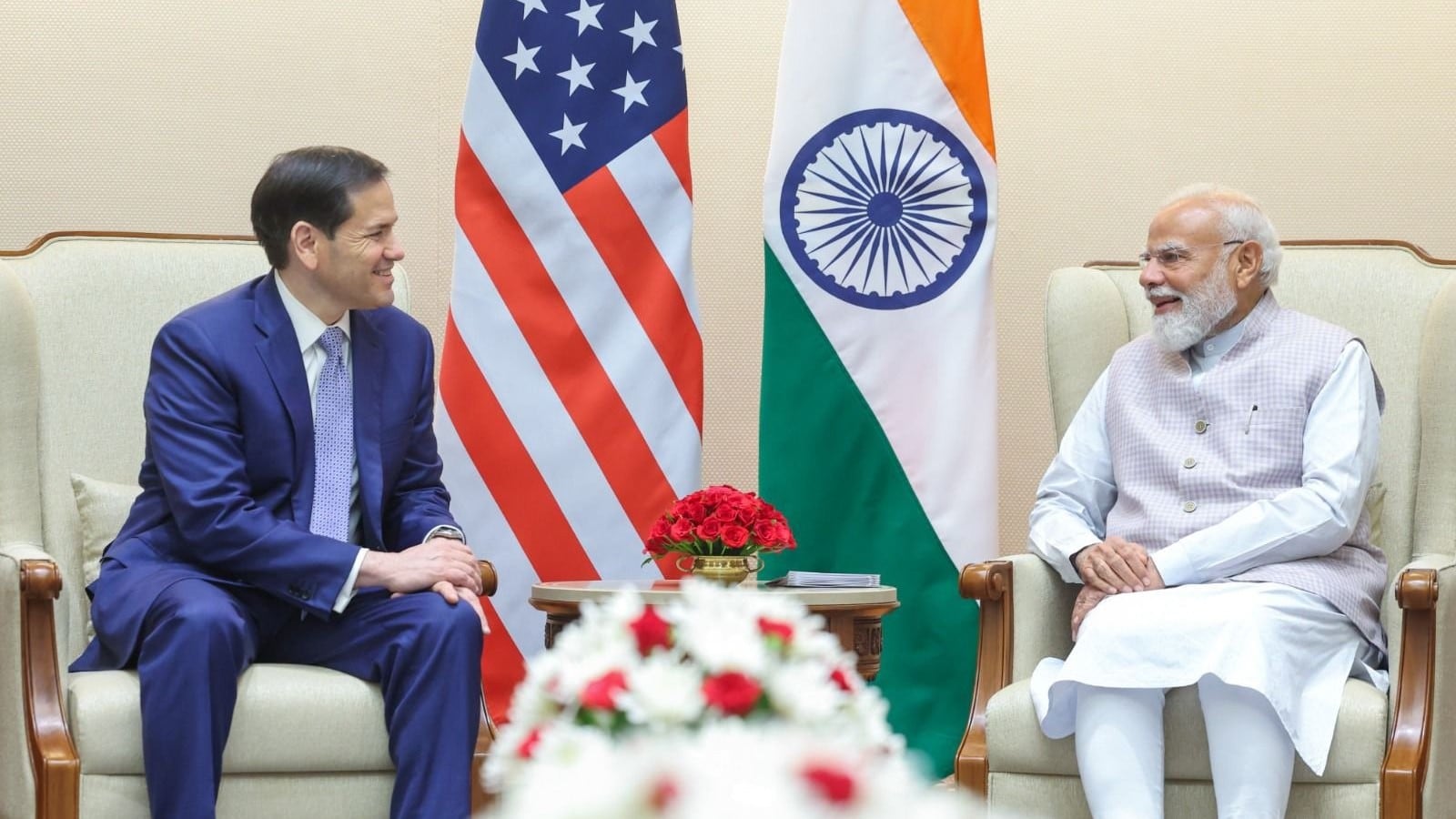
The foreign policy establishment is currently patting itself on the back. Newspaper columns are drowning in breathless analysis about US Secretary of State Marco Rubio’s four-day blitz across India. We are told the trip repaired a deep bilateral fracture. Mainstream commentators point to the grand imagery: Rubio lighting candles at the Missionaries of Charity in Kolkata, sweating at the Taj Mahal, and watching folk musicians on elephants in Jaipur. They swoon over the "Mission 500" framework and the Quad Foreign Ministers’ meeting as definitive proof that the United States and India are locked in an unbreakable strategic embrace.
It is a comforting narrative. It is also entirely wrong.
Strip away the carefully managed pageantry and the amplified speakerphone calls from Mar-a-Lago, and Rubio’s diplomatic mission reveals a starkly different reality. The trip was not a grand alignment of long-term vision; it was an aggressive, transactional exercise in American damage control and salesmanship. Washington is panicking over its own self-inflicted deindustrialization and energy vulnerabilities, and it is trying to use India as both an economic safety valve and a captive market.
The Myth of the Free and Open Indo-Pacific Alliance
Every establishment think tank piece repeats the same tired script: India is indispensable to the American Indo-Pacific strategy to counter China. The Quad is framed as the ultimate mechanism to achieve this.
This completely misreads New Delhi's calculus. Having analyzed trade and defense dependencies for over two decades, I have watched Western analysts repeatedly project their own treaty-bound desires onto a nation that prides itself on strategic autonomy.
India does not view the Quad as an alliance. It views it as a convenient, non-binding sandbox.
While Rubio was preparing to land in New Delhi to pitch a "free and open Indo-Pacific," India was busy chairing BRICS foreign ministers’ discussions. To a conventional Western diplomat, participating in both frameworks looks like a glaring contradiction. To New Delhi, it is a deliberate, calculated display of multi-alignment. India is actively refusing the binary choice Washington desperately wants to impose.
The underlying mechanics of this dynamic are clear:
- Asymmetric Commitment: The US wants a rigid geopolitical buffer against Beijing. India wants access to critical American technology and defense hardware without giving up its right to trade with Washington's adversaries.
- The Russia Disconnect: Despite intense Western pressure and sanctions, India remains deeply anchored to its relationship with Moscow. Minor concessions on Russian crude purchases are not a pivot; they are temporary tactical maneuvers.
- The Sovereignty Wall: India will never subordinate its foreign policy to a bloc controlled by the White House. The moment the Quad demands hard commitments that jeopardize India’s continental security, the illusion fades.
The Energy Sales Pitch Disguised as Security
The loudest applause during Rubio’s visit followed his declarations on energy security, specifically his line that "the United States will not let Iran hold the global energy market hostage." The mainstream press swallowed this as a joint stand against geopolitical disruptions in the Strait of Hormuz.
Let us look at the raw transactional truth beneath that rhetoric.
The US attack on Iran on February 28, and the subsequent regional conflict, severely shook global energy flows. This conflict was driven by Washington’s unilateral actions, which inadvertently triggered massive economic anxieties for New Delhi. Rubio’s visit was not about protecting India; it was an aggressive commercial push to sell American oil and gas to replace the very supplies disrupted by US policy.
"We want to sell them as much energy as they'll buy," Rubio openly told reporters.
This is not a grand strategy to blunt Chinese influence. It is a commercial extraction play. Washington crippled global energy stability with one hand and offered high-priced American exports with the other. The push under the "Mission 500" framework is less about shared democratic values and more about securing a massive, reliable market for American energy producers to help offset domestic economic vulnerabilities.
The Friction Trump's Vanity vs Modi's Pride
The lazy consensus asserts that because "President Trump loves India" and Rubio called External Affairs Minister S. Jaishankar "phenomenal," the underlying friction has vanished. This ignores the systemic trade wars defining the relationship.
The Trump administration’s aggressive tariff agenda, visa restrictions, and cutting of outsourcing channels are not accidental blips. They are structural components of an protectionist American trade policy designed to combat domestic deindustrialization. Rubio confirmed this himself, noting that the White House is explicitly rewriting global trade rules to claw back means of production that were outsourced.
This creates a fundamental clash of economic nationalist ideologies:
| American Position | Indian Counter-Position |
|---|---|
| Universal tariffs to rebuild the US industrial base. | "Make in India" manufacturing incentives requiring market access. |
| Demands for India to eliminate trade surpluses. | Aggressive defense of domestic markets and agricultural subsidies. |
| Weaponization of the US dollar and global financial sanctions. | Pushing for local currency settlements and dedollarization in BRICS. |
No amount of embassy birthday parties featuring the Village People can paper over this structural economic divergence. The relationship is transactional to its core. When an Indian journalist explicitly called out the administration's "mixed signals" on China and Pakistan, Rubio was forced into defensive damage control, brushing off anti-immigrant and anti-India rhetoric online as merely the work of "stupid people."
The Low-Key Reception at the Taj Mahal
If you want to know how a state truly feels about an alliance, look at the protocol, not the press releases.
While the media focused on the red-carpet greeting from Prime Minister Narendra Modi in Delhi, a telling incident occurred during Rubio’s tourist stop in Agra. The US Secretary of State was received at the Taj Mahal by just three mid-level Indian officials: an air force officer, a police officer, and a junior representative from the foreign ministry.
Social media commentators expressed shock at the sparse welcoming party, contrasting it with the massive receptions given to previous dignitaries. But this was a textbook display of Indian diplomatic signaling. New Delhi knows exactly how to play the game of asymmetric hospitality. They will give you the high-profile photo op in the capital to preserve the public facade, but they will withhold the deeper institutional reverence when unilateral American policies are actively hurting Indian economic interests.
India is acutely aware that Washington views it primarily as a hedge against China and a consumer of US liquefied natural gas. By maintaining a highly transactional, multi-aligned posture, New Delhi ensures it never becomes a client state.
Stop looking at the birthday cake and the choreographed smiles in New Delhi. The US-India relationship is not an unbreakable bond of shared democratic ideals; it is a volatile, high-stakes trade negotiation masquerading as a geopolitical alliance.