The human throat constricts at exactly thirty-four percent humidity when the air turns to static. In the limestone bellies of the Annamite Range, where Laos wrinkles into Vietnam, the air does not move. It sits on your chest like a wet wool blanket. It smells of ancient bat guano, crushed iron ore, and the cold, terrifying neutrality of stone that has not seen the sun since the Miocene epoch.
To understand what happened inside the Tham Khoun Xe cave system, you have to turn off your headlamp.
Do it. Let the blackness rush in. It is not the darkness of a bedroom at midnight. It is an absolute, heavy presence that presses against your eyeballs until your brain, desperate for input, begins to manufacture phantom lights. You lose your sense of up. You lose the rhythm of your own breath. Now, imagine the water rising around your shins.
Six men went into that dark. Only four came out.
The standard news reports dismissed the event with the sterile economy of modern journalism: a flash flood, an unexpected deluge during what should have been the dry shoulder season, a tragic miscalculation. They called the survivors "sources of information" and the missing men "the targets of a recovery operation." But facts are skeletal things. They lack the meat of human terror and the profound, aching debt that the living owe to the dead.
The real story isn't about a rescue plan drafted on a clipboard in a well-lit office in Vientiane. It is about the men who survived going back to the mouth of the beast, using the architecture of their own trauma to map the place where their friends stopped breathing.
The Weight of the Water
Every cave is a living lungs system. When it rains on the karst plateau above, the mountain doesn't shed the water; it absorbs it. The limestone acts like a massive sponge until it reaches critical mass. Then, the ceiling weeps.
Somsak—a pseudonym for a local guide who participated in the initial expedition—knew the rules of the Annamite caves. You watch the rivers. You watch the sky. But the sky in the tropics is a fickle liar. A storm fifty miles away can dump millions of gallons into an underground feeder system without a single drop falling on the jungle canopy directly above your head.
It began with a sound like a distant freight train.
In a subterranean chamber large enough to swallow a cathedral, sound behaves strangely. It bounces off flowstone and dissolves into mud banks. At first, the team thought it was the wind. The Tham Khoun Xe is famous for its massive chambers where atmospheric pressure shifts create sudden, phantom gales.
Then the river changed color. The clear, jade-green water of the subterranean river turned the color of milk coffee in less than ninety seconds. That is the warning. That is the moment your heart drops into your stomach because you realize the mountain is emptying its bladder, and you are in the toilet bowl.
Consider the physics of a cave flood. It is not like a rising tide on a beach. It is a hydraulic piston. As the water fills the lower tubes of the cave, it compresses the air trapped in the upper galleries. The pressure builds. Your ears pop. The water doesn't just rise; it rushes forward with the velocity of a broken dam, carrying logs, boulders, and the debris of the jungle above.
The team scrambled. Four men found a ledge, a narrow limestone lip twelve feet above the normal high-water mark. They clawed their way up, fingernails tearing against the sharp, crystalline rock. They reached down for the remaining two.
They missed.
The headlamps of the last two men flickered once, twice, as the brown foam swallowed them. In the dark, the survivors heard a single cry, cut short not by distance, but by the absolute density of water filling a throat. Then, there was only the roar.
The Geometry of Memory
For three days, the four survivors sat on that ledge in the dark. Their headlamp batteries died on twelve-hour cycles, one by one, until they were reduced to a single, dim yellow beam preserved for emergencies. They survived by licking the condensation off the limestone walls and listening to the roar of the water beneath their feet, wondering if it would rise those last three inches to claim them too.
When the water finally receded, leaving behind a thick, slick coat of grey silt, the rescue teams found them. They were alive, but changed. Their skin had turned the translucent white of cave crickets. Their eyes blinked painfully against the tropical sun.
In the standard narrative of disaster, this is where the survivors go home. They receive medical attention, they hug their families, and they relegate the horror to nightmares.
But heroism in the deep places of the world looks different.
The local authorities faced a logistical wall. The Tham Khoun Xe is a labyrinth of unmapped side-channels, blind sumps, and unstable rock falls. Sending divers into that environment without a blueprint is a form of state-sanctioned suicide. The water remained murky, visibility was zero, and the blueprints did not exist.
The survivors looked at each other. They looked at the families of the two men who had been left behind—families waiting at the cave entrance with small offerings of sticky rice and incense, praying to the spirits of the mountain for the return of the bodies.
They realized that the only map of that specific catastrophe existed inside their own heads.
Trauma has a way of sharpening certain memories while obliterating others. Somsak found that while he couldn't remember what he ate for breakfast the morning of the dive, he could remember the exact angle of the stalactite he grabbed to pull himself onto the ledge. He remembered how many seconds elapsed between the time his friend’s light vanished and the time the water hit the roof of the western passage.
The survivors became the cartographers of their own nightmare.
Drawing the Dark
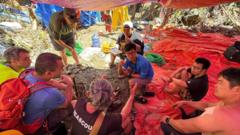
They sat in a makeshift command center—a wooden table under a blue tarp outside the cave entrance, swatting at mosquitoes and squinting at satellite images that were utterly useless for showing what lay five hundred feet beneath the jungle floor.
The process was grueling. It was an exercise in collective excavation.
"The water came from the north, but it didn't pool there," Somsak explained to the technical diving team, his finger tracing a blank space on a sheet of graph paper. "It swirled. There is a siphon there. A deep one."
To prove his point, he used an analogy that anyone who has ever cleaned a clogged sink can understand. When you fill a basin and pull the plug, the debris doesn't just sink; it rotates around the drain before being sucked down. He had watched the floating dry-bags of their gear spin in a tight, violent circle near the eastern wall before disappearing.
That circle was the key. It meant there was a vertical shaft below the waterline—a place where the current would naturally deposit anything it carried.
[Main Chamber] ---> [The Siphon (Somsak's Circle)]
                           |
                           v
              [Unmapped Vertical Shaft]  <-- Suspected location
                           |
                           v
              [Lower Drainage Level]
The survivors spent hours arguing over distances. In the dark, time dilates. Five minutes feels like an hour; ten feet feels like a mile. To correct for this psychological distortion, the dive specialists used a method of comparative memory.
They asked the survivors to compare the cave chambers to known structures. Was the room as large as the market in Thakhek? Was the ceiling as high as the temple wat? Slowly, the abstract terror was translated into meters, drafts, and flow rates.
This wasn't just data collection. It was an exorcism. Every time Somsak closed his eyes to estimate the width of the tunnel where the water caught his friends, he had to see their faces again. He had to hear that final, choked sound. Yet, he stayed at the table.
The Debt We Pay to the Mountain
There is a profound difference between a search operation and a recovery operation. A search is fueled by adrenaline and the wild, irrational hope of a miracle. A recovery is a somber, calculated duty. It is driven by the human refusal to leave our own behind in the dark.
In Laos, the belief in phi—the spirits of the earth, water, and trees—runs deep. To die in a cave is to have your soul trapped in the cold, wet stone, unable to find the path to rebirth. For the families waiting at the mouth of the Tham Khoun Xe, the recovery of the bodies was not about closure in the Western medical sense. It was a matter of cosmic urgency.
The survivors knew this. They weren't just helping the divers navigate the physical hazards of the cave; they were acting as guides for the souls of their friends.
The plan developed through this collaboration was surgical. Instead of a blind, dangerous sweep of the entire three-mile system, the divers would target three specific "hotspots" identified by the survivors’ collective memory—the siphon, a secondary boulder choke three hundred meters downstream, and a low-ceiling gallery where the air pocket might have held out the longest.
The divers prepared their gear: trimix gas blends to manage the depth, heavy-duty guide lines, and powerful underwater lights that could pierce at least a few inches of the liquid mud. They moved with the deliberate, slow grace of astronauts preparing for a spacewalk.
But as they submerged into the brown, churning mouth of the river, they carried something more important than high-tech equipment. They carried the mental map drawn by four men who had looked into the abyss, survived, and chosen to look back in.
The mountain does not give up its secrets easily, and it never gives them up for free. The work remains dangerous, unpredictable, and agonizingly slow. But the darkness is no longer absolute. It has been measured, noted, and understood by the very men it tried to destroy.
The map is finished. The divers are down. And in the silence of the Laotian jungle, the living wait for the dead to be brought home.