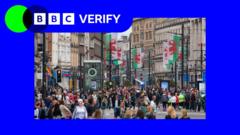
Walk into any chip shop in the Rhondda or a tech hub in Cardiff, and you are standing inside a living map. It is a map made of breath, history, and the quiet grit of people who traveled a thousand miles just to see the rain fall on Welsh slate.
We often treat immigration like a spreadsheet. We look at the Census data for Wales and see percentages: the 5.9% of people living here who were born outside the UK. We see the bars on a graph climb or dip. But graphs don't have cold hands. Graphs don't feel the sudden, sharp pang of missing a mother’s cooking while standing in the middle of a supermarket in Swansea.
To understand the movement of people into Wales, you have to stop looking at the "where" and start looking at the "why."
The Weight of a Suitcase
Consider a man we will call Elias. He arrived in Newport three years ago. In his mind, he carried the layout of a city that no longer exists in the way he remembers it. When we talk about "international migration" in the Welsh context, we are talking about Elias learning that a "cwtch" is more than a hug and that the wind in the Valleys has a specific, haunting whistle.
The data suggests that the number of non-UK born residents in Wales increased from roughly 168,000 in 2011 to over 186,000 by the last major count. That is not just a shift in demographics. It is 18,000 new stories. It is 18,000 more people contributing to the NHS, opening small businesses on high streets that were flagging, and sitting in classrooms from Wrexham to Llanelli.
Wales has a particular way of absorbing people. It is a small nation with a long memory of its own displacement. Perhaps that is why the integration looks different here than it does in the sprawling, anonymous metropolises of England. In Wales, there is nowhere to hide. You are part of the community, or you are a ghost. Most choose to be part of the community.
The Urban Magnet
If you zoom into the map, the colors darken in specific pockets. Cardiff, Newport, and Swansea remain the primary landing pads. It makes sense. Cities offer the comfort of the familiar—the scent of spices you recognize, the sound of a language that feels like home.
In Cardiff, more than 15% of the population was born outside the UK. Wander down City Road and you aren't just in the capital of Wales; you are in a global crossroads. You hear Arabic, Polish, and Urdu weaving through the local accent. This isn't a "takeover," as some fear-mongering corners of the internet might suggest. It is an infusion. These are the people who staff our hospitals during the night shifts and drive the taxis that get us home when the trains fail.
But the real story is in the places where the numbers are smaller. In Ceredigion or Powys, a single family moving into a village can change the texture of the local school. It brings a new perspective to the community council. It reminds a quiet town that the world is much larger than the mountains surrounding it.
The Myth of the Monolith
We fall into a trap when we talk about "immigrants" as a single block of people. The data tells a much more fractured, interesting story.
The largest group of non-UK born residents in Wales historically came from Poland. They arrived after 2004, filled gaps in the labor market, and stayed. They bought houses. Their children speak Welsh with the same melodic lilt as any kid born in Pontypridd. Then there are the newer arrivals—those from India, Romania, and the Philippines.
Each group arrives with a different set of invisible stakes. For the Filipino nurse in a North Wales hospital, the stake is the family back home relying on those remittances. For the Syrian refugee in Aberystwyth, the stake is the sheer, terrifying hope that this rainy town will be the place where their children finally stop flinching at loud noises.
The Census reveals that around 2.5% of people in Wales now identify with an ethnic group other than White. This sounds small until you realize it represents a doubling or tripling in certain areas over the last twenty years. The change is slow, like the tide coming in at Mumbles, but it is permanent.
The Economic Engine
There is a persistent, nagging anxiety that migration drains the system. The reality is far more pragmatic and, frankly, a bit more desperate. Wales has an aging population. Our villages are getting older, and our birth rates aren't keeping pace with the exit of the retired generation.
Without the influx of working-age people from overseas, the Welsh economy would look like a car running on fumes.
Migrants in Wales are disproportionately represented in "essential" roles. They are the backbone of social care. They are the researchers in our universities pushing for breakthroughs in green energy. When you look at the data for "economically active" migrants, you see a group of people who are not here to sit idly. They are here to build.
Consider the hypothetical case of a small tech startup in Swansea. Half the team might be local graduates, but the lead developer is from Lagos, and the data analyst is from Bucharest. This isn't just about filling seats. It's about a diversity of thought. Someone who has navigated the bureaucracy of two different continents thinks about problem-solving differently than someone who has never left their county. That friction creates fire.
The Invisible Language Barrier
One of the most beautiful, and occasionally difficult, aspects of the Welsh experience is the language. For a new arrival, the challenge is twofold. They must master English to navigate the UK, but in many parts of Wales, the heart of the community beats in Cymraeg.
There is a misconception that immigration threatens the Welsh language. In fact, the data and lived experience often show the opposite. Many immigrant families are some of the most enthusiastic supporters of Welsh-medium education. To them, Welsh isn't a political statement; it is a tool for belonging.
When a child from a Spanish-speaking household starts winning Eisteddfod competitions, the "us vs. them" narrative collapses. The language becomes a bridge, not a wall. It is a shared secret that says: We are both from here now.
The Hard Truths
It would be dishonest to pretend it is all harmony and fusion cooking. There are tensions. In areas where public services are stretched thin—where you have to wait three weeks for a GP appointment or the buses only run twice a day—the arrival of "outsiders" becomes an easy target for frustration.
People look at the data and see the population growing, then they look at their crumbling high street and draw a straight line between the two. But that line is a fallacy. The crumbling high street isn't the fault of the person who moved into the flat above the pharmacy. It is the result of decades of underinvestment and shifting global markets.
We blame the newcomer because the newcomer is visible. The systemic failures of governance are invisible.
The struggle is real for the migrants, too. Low-skilled workers often find themselves trapped in "tied" accommodation or exploitative shifts. The data doesn't show the loneliness of a Christmas spent on a video call to a time zone five hours away. It doesn't show the "qualification waste"—the doctors driving delivery vans because their certifications aren't recognized yet.
Beyond the Search Bar
Most people come to this topic looking for a number. They want to type their postcode into a search bar and see exactly how many foreign-born people live on their street. They want to know if the "character" of their neighborhood is changing.
But the character of a place is never static. Wales has always been a country of movement. From the Irish laborers who built the docks to the Italian families who gave us our cafe culture, we are a patchwork.
If you search for your area and see a high number, don't see it as a statistic. See it as a sign of life. A high migration number means your area is a place where people believe a future is possible. People do not move to dying places. They move to places with a pulse.
The data tells us that Wales is becoming more complex, more colorful, and more connected to the rest of the planet. It tells us that the person sitting next to you on the bus might have a map of the world tucked into their pocket, even if they are currently complaining about the weather in perfect, colloquial Welsh.
The map of Wales is being redrawn every day. Not with ink, but with footsteps.
It is a map where "home" is not a fixed point you are born into, but a place you choose to defend, to work for, and to love. We are no longer just a land of our fathers. We are becoming a land of our children, regardless of where their grandparents first closed their suitcases and decided that these green hills were enough.
The rain still falls on the slate, just as it always has. But now, there are more hands reaching out to catch it.