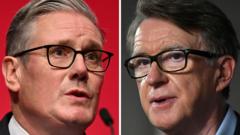
Keir Starmer entered Downing Street promising a government that would be "unflashy" and "service-driven." Yet, the persistent re-emergence of Peter Mandelson in the political periphery suggests that the ghost of New Labour is not just haunting the current administration—it is actively helping to design the floor plan. The central tension in British politics right now is the struggle between Starmer’s desire for a clean break from the past and an inescapable reliance on the strategic DNA of the 1990s. This is not merely a nostalgia trip. It is a calculated, high-stakes gamble on whether the old methods of triangulating power can survive in a fractured, high-speed economy.
The Architect in the Room
Peter Mandelson remains the most polarizing figure in the history of the modern Labour Party. To his detractors, he represents a brand of "dark arts" politics that prioritizes presentation over principle. To his disciples, he is the only man who truly understands how to hold the levers of power in a hostile media environment. Starmer’s dilemma is that while he needs the operational competence Mandelson provides, the mere mention of the Baron’s name triggers an immediate allergic reaction across the left wing of his party and large swaths of the electorate.
This is a structural problem. Starmer built his path to victory on a platform of stability. He was the "adult in the room" after the chaotic years of the Conservative collapse. However, stability often requires the kind of behind-the-scenes maneuvering that Mandelson mastered. When reports surface of Mandelson advising on key appointments or vetting diplomatic strategies, it undermines the image of the fresh start. It suggests that for all the talk of "change," the internal plumbing of the British state is being reconnected to the same old tanks.
Managing the City and the Unions
The real impact of this influence is felt in the Treasury and the Department for Business and Trade. Mandelson was always the bridge between Labour and the boardrooms of the FTSE 100. Today, Starmer and Chancellor Rachel Reeves are attempting a similar feat. They are trying to convince global investors that the UK is a "safe harbor" while simultaneously keeping the trade unions on a short leash.
The strategy is a carbon copy of the 1997 playbook. It involves making "difficult decisions" early to build market credibility, even if those decisions alienate the core base. The cut to the Winter Fuel Payment was a classic example of this. It was a signal to the markets that the government is willing to be unpopular in the pursuit of fiscal discipline. Mandelson’s finger-prints are all over this kind of "shock therapy" politics. It is designed to preemptively neuter the charge that Labour is fiscally irresponsible.
But the 2026 economic reality is vastly different from 1997. Back then, Blair and Brown inherited a growing economy and a world moving toward globalization. Starmer inherits a stagnant growth rate, a broken social care system, and a global trend toward protectionism. The old tricks of "pro-business" rhetoric might not be enough to stimulate the private investment required to fix public services. Investors are no longer looking for just stability; they are looking for a return on capital that a high-tax, low-growth UK struggles to provide.
The Diplomatic Vacuum and the US Question
Perhaps the most significant area where the Mandelson shadow looms is in international relations. As the UK attempts to navigate its post-Brexit identity, the question of who represents British interests in Washington and Brussels becomes vital. Mandelson’s name is frequently floated for the role of Ambassador to the United States. This isn't just because of his resume. It is because he understands the intersection of commerce and diplomacy better than almost anyone in the current cabinet.
The risk here is one of optics. If Starmer appoints a titan of the New Labour era to the most prestigious diplomatic post in the world, he signals that his talent pool is shallow. It suggests that the "new" Labour party lacks its own heavy hitters. Furthermore, in an era where "anti-establishment" sentiment is still a potent force, sending a peer of the realm to negotiate with a potentially populist US administration could backfire spectacularly. It reinforces the narrative that politics is a closed shop for the elite.
The Internal Friction of the Big Tent
Inside Number 10, the friction is palpable. There is a generational divide between the "Starmerites"—who are often more technocratic and focused on delivery—and the "Old Guard" who believe that optics are everything. Mandelson represents the latter. His philosophy is that a story not told is a story lost. He pushes for a more aggressive media strategy, a more defined "enemy" in the opposition, and a more ruthless approach to party management.
Starmer, by nature, is a proceduralist. He believes in the process. He believes that if the work is good, the results will follow. The "Mandelson nightmare" is essentially a clash of temperaments. The tension arises when the government tries to do both. You end up with a communications strategy that feels disjointed—one day focused on the gritty details of planning reform, the next day embroiled in a high-fashion "gifts" scandal that looks like a throwback to the "Cool Britannia" excesses of the late nineties.
The Cost of the Association
Every time Mandelson is seen entering the Cabinet Office, a certain segment of the British public is reminded of why they became disillusioned with politics in the first place. The era of "spin" left a deep scar on the national psyche. By allowing Mandelson to remain even an informal advisor, Starmer risks reviving the "liars" tag that plagued the party during the Iraq War era.
Trust is a finite resource. Starmer began his premiership with a modest amount of it, largely gained by not being a Conservative. He cannot afford to spend that trust on rehabilitating figures from the past. The public wants to see a government that is focused on their energy bills and the waiting lists at their local hospitals, not one that is obsessed with the internal power dynamics of a political dynasty.
The Myth of the Master Strategist
There is also the possibility that the "Mandelson magic" is a myth that has outlived its usefulness. The media landscape has changed. In 1997, a few key phone calls to the editors of the major broadsheets and tabloids could set the national agenda for a week. Today, the information ecosystem is decentralized and chaotic. You cannot "spin" a TikTok trend or a viral clip of a minister stumbling over a question about infrastructure.
The obsession with Mandelson reveals a deeper insecurity within the Starmer project. It suggests they fear they lack the native political instincts to survive without a chaperone. If Starmer wants to truly lead, he has to eventually kill the father figure. He has to demonstrate that his brand of politics—whatever that ultimately turns out to be—is strong enough to stand on its own two feet without the support of the architects of 1997.
The "nightmare" isn't that Mandelson is back. The nightmare is the possibility that without him, there is no plan at all. The coming months will reveal whether the government is capable of moving beyond the shadow of its predecessors or if it is destined to be a high-definition remake of a show we’ve all seen before. The British electorate rarely rewards sequels, especially when the original ending was so messy.
Success in this parliament won't be measured by how well the government manages the 24-hour news cycle. It will be measured by whether the average person feels more secure in their job and their home by the end of the decade. No amount of strategic maneuvering can substitute for that reality. The ghost of New Labour might be useful for a seance, but it cannot govern a country that has moved on.
Identify the three most critical infrastructure projects currently stalled by planning regulations and force them through within six months, regardless of the local political fallout.