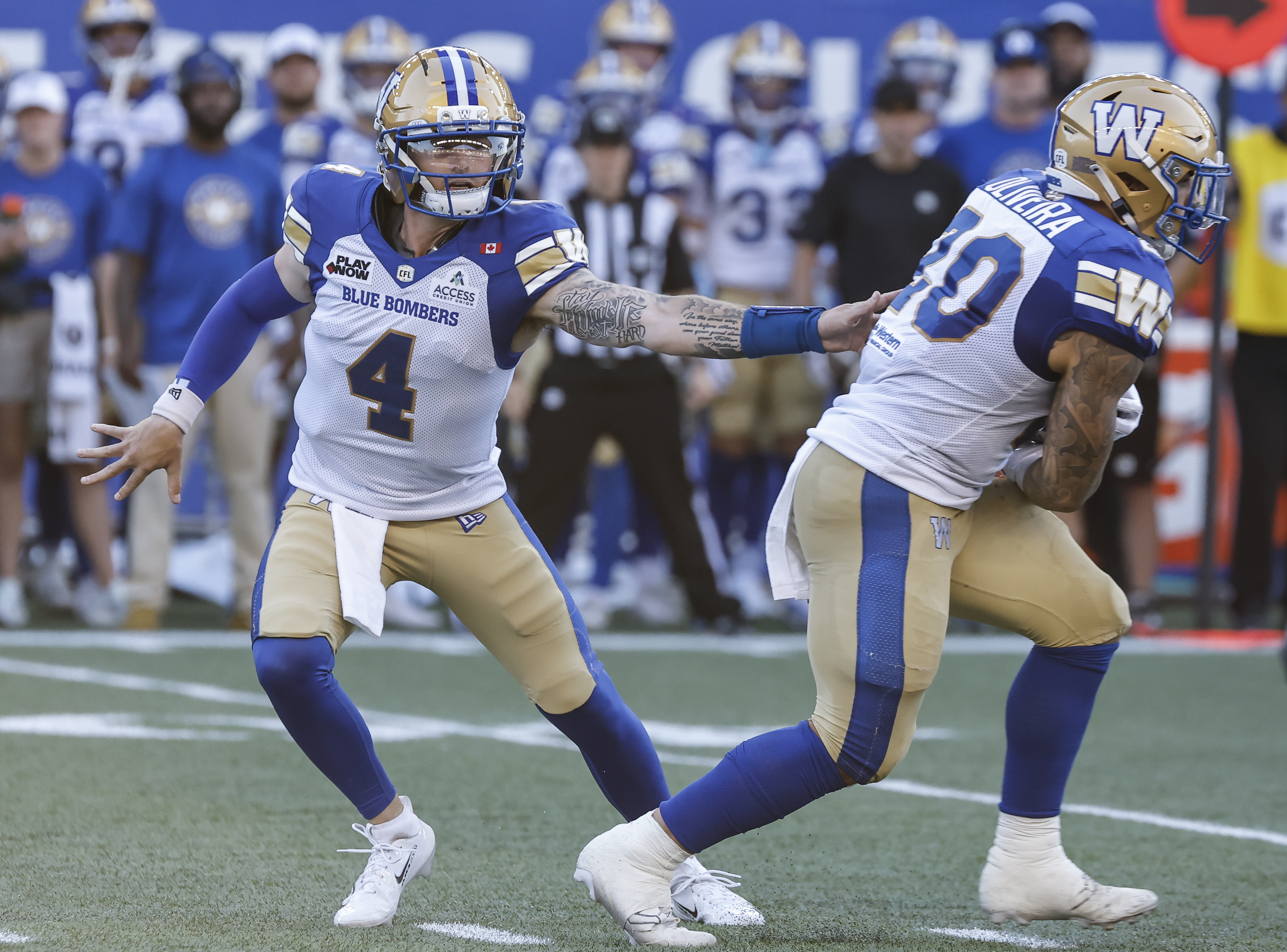
The backup quarterback lives in a state of professional paradox. You practice every day knowing that if you are doing your job on Friday night, something has gone terribly wrong. You wear the baseball cap. You hold the clipboard. You listen to the stadium roar for someone else, standing exactly two steps behind the head coach, trying to look engaged while secretly praying you do not have to untie your warm-up jacket.
For months, Dru Brown was that shadow. If you found value in this post, you might want to look at: this related article.
In Winnipeg, that shadow is cast by a massive figure. Zach Collaros isn't just the starting quarterback for the Blue Bombers; he is the sun around which the entire franchise orbits. He is a multi-time Most Outstanding Player, a grey-bearded champion, the guy whose face is plastered on billboards across Manitoba. When Collaros walks through the tunnel at Princess Auto Stadium, the concrete seems to vibrate.
Then came the hit. For another perspective on this event, see the recent update from Bleacher Report.
It never happens with a theatrical flare. It happens in a chaotic tangle of nylon and grass. A defensive lineman gets a half-step on a guard, an arm reaches out, and a star player stays down a second too long. The stadium, previously an arena of absolute noise, instantly drops twenty decibels. You can hear the plastic click of shoulder pads on the sideline. You can hear the coaches sucking air through their teeth.
And in that precise pocket of silence, the backup stops being a spectator.
The Heat of the Blue Lights
Every athlete says they stay prepared. They tell reporters they treat every meeting like they are the starter. It is a polite lie. Human nature does not allow you to maintain the same cortisol levels for a test you do not expect to take. When Brown had to step onto the field, his hands weren't just cold from the prairie air; they were processing the sudden, violent shift from the periphery to the exact center of a province’s anxiety.
The crowd doesn't cheer for the backup when he first walks out. They offer a polite, sympathetic golf clap that feels more like a collective sigh. It is the sound of a stadium managing its expectations.
Football looks fast on television. On the field, it feels like a highway pileup in slow motion. When you haven't taken live snaps in weeks, the defensive ends look wider, the cornerbacks look faster, and the playbook in your wristband feels like it is written in a language you only half-remember.
Brown's task wasn't just to run the offense. It was to prevent a panic.
The Bombers were supposed to be the juggernaut of the Canadian Football League, a machine built on continuity and veteran composure. Lose Collaros, the conventional wisdom said, and the machine loses its engine. The first win under Brown's direction had been treated by critics as a fluke, an emotional spike from a locker room rallying around an underdog. A desperate, scrambling survival act.
The second consecutive game, however, is where the narrative shifts. One win is a story. Two wins is a statement.
The Geometry of Trust
To understand how a newcomer leads a veteran locker room, you have to look at the huddle. The huddle is a sovereign state. Eleven men, soaking wet, lungs burning, staring at a kid who has spent the last year watching them from the bench. If they see a flicker of doubt in his eyes, the play is dead before the ball is even snapped.
Imagine standing in front of offensive linemen who have played a decade in the trenches. They are bruised, bleeding from the knuckles, and smelling of sweat and liniment. They do not want a speech. They want a cadence that sounds like certainty.
Brown didn't try to be Zach Collaros. That was his first victory. Young quarterbacks often destroy themselves trying to mimic the legend they are replacing. They try to make the impossible, cross-body throws that only veterans with ten thousand hours of muscle memory can pull off. Instead, Brown operated with a clinical, almost quiet efficiency.
He stayed in the pocket. When the pass rush closed in, the natural human instinct is to drop the eyes and look at the color of the jerseys coming at you. Brown kept his eyes downfield. He trusted the system.
Consider the mechanics of a simple slant route under that kind of pressure. The ball needs to leave the hand before the receiver even makes his break. You are throwing into an empty patch of grass, trusting that a three-hundred-pound defender won't intercept the trajectory. If the ball is six inches too far forward, it is a turnover. Six inches too far back, and your receiver gets his ribs broken by an oncoming safety.
During that second consecutive victory, Brown hit those windows repeatedly. Not with flash, but with the repetitive accuracy of a carpenter driving nails.
The Weight of the Clipboard
The hardest part of being the temporary savior is knowing the clock is ticking. Every good play Brown made was met with a dual reaction in the stands. There was joy for the touchdown, followed immediately by the radio commentators wondering aloud if this meant they could rest Collaros for another week to ensure he was healthy for the playoffs.
It is a strange way to live. You are the hero of the night, but you are still keeping the seat warm.
Yet, watching the sideline during the late stages of the fourth quarter, something changed. The veteran players weren't just giving Brown the customary slaps on the helmet. They were listening to him. The defensive starters, men who usually spend their offensive possessions sitting on coolers and drinking water, were standing at the numbers, watching the kid work.
The Blue Bombers didn't just survive those two weeks without their leader. They discovered they had a floor that was much higher than anyone outside their building believed.
When the final whistle blew on that second victory, securing a stretch of football that could have easily tanked Winnipeg's season, there was no wild celebration from the quarterback. Brown walked to the center of the field, shook hands with the opposing defense, and unbuckled his chin strap.
The stadium was singing. The noise was for him this time. But as he walked toward the locker room tunnel, he already looked like a man who knew that tomorrow, the star might be back, the baseball cap would be returned, and the shadow would lengthen once again. For two weeks, though, the shadow owned the light.