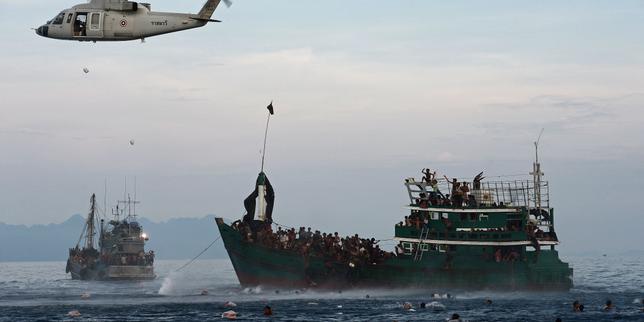
The capsizing of a vessel carrying approximately 250 Rohingya refugees departing from Bangladesh represents more than a humanitarian failure; it is a predictable outcome of a broken maritime logistics chain and a complete absence of safe passage protocols. When 250 individuals are reported missing following a maritime accident in these waters, the event functions as a terminal data point in a sequence of escalating risks. These risks are driven by three distinct structural failures: the degradation of vessel seaworthiness, the tactical exploitation by human smuggling syndicates, and the regional paralysis of Search and Rescue (SAR) coordination.
The Mechanical Failure of Unregulated Vessels
The vessels utilized for these crossings are almost exclusively modified fishing trawlers, which are fundamentally ill-equipped for the deep-sea navigation required to reach Indonesia or Malaysia. The physics of these accidents often traces back to a specific set of mechanical and structural vulnerabilities.
- Center of Gravity Displacement: These boats are designed for a crew of 10 to 15. Loading 250 passengers elevates the center of gravity significantly. In the turbulent conditions of the Bay of Bengal, the vessel's "metacentric height"—the measure of its initial static stability—is reduced to a critical level. Any sudden shift in passenger weight or a side-on wave creates a capsizing moment that the hull cannot counteract.
- Structural Fatigue: These hulls are often timber-based and lack the internal reinforcement to manage the stress of 250 bodies and the necessary fuel/water supplies. Water ingress is not a possibility but a mathematical certainty.
- Engine Reliability: Most of these boats utilize single-cylinder diesel engines repurposed from agricultural machinery. Without redundancy, an engine failure in open water leaves the vessel "dead in the water," making it susceptible to broaching—turning broadside to the waves—which is the primary cause of capsizing in high seas.
The Smuggling Syndicate Business Model
The human smuggling networks operating in the camps of Cox’s Bazar treat human lives as perishable cargo. Their operational logic focuses on maximizing "yield per hull" while minimizing capital expenditure on the vessel itself. Because the boat is intended to be abandoned or scuttled upon arrival, there is zero incentive for the operators to invest in safety equipment like life vests, flares, or communication gear.
The second layer of this logic is the timing of departures. Syndicates often wait for specific atmospheric windows that theoretically offer calmer seas but also coincide with reduced maritime patrolling. When these windows close unexpectedly due to localized squalls or the onset of monsoon conditions, the lack of onboard navigation technology prevents the crew from making necessary course corrections. The result is a high-probability intercept with lethal weather patterns.
The Regional SAR Policy Vacuum
The loss of 250 people is exacerbated by the "push-back" policies and the lack of a unified regional SAR framework. The Bay of Bengal is a complex theater of overlapping maritime jurisdictions, yet there is no central authority coordinating refugee-related emergencies.
The first breakdown occurs at the detection phase. Because these vessels operate in the "dark"—without Automatic Identification Systems (AIS)—they are invisible to standard maritime monitoring. Detection usually happens only when a vessel is already in distress and a passenger manages to make a desperate mobile call or when a commercial ship happens upon the debris.
The second breakdown is the "Non-Refoulement" conflict. Coastal states often delay response times, hoping the vessel will drift into a neighboring Search and Rescue Region (SRR). This jurisdictional hand-off creates a "lethal lag" between the initial distress signal and the arrival of assets. In a capsizing event, the survival window in these waters is measured in hours, not days. A six-hour delay in dispatching a coast guard vessel is effectively a decision to conduct a recovery mission rather than a rescue.
The Economic Drivers of Continued Transit
The migration is not a random movement but a response to the total economic stagnation within the camps in Bangladesh. With no legal right to work and diminishing international food aid, the "push factor" is a calculated risk assessment by the refugees. For many, the statistical probability of drowning—which has risen sharply as routes become more dangerous—is outweighed by the certainty of slow starvation and lack of agency in the camps.
The "pull factor" remains the informal labor markets in Southeast Asia. As long as these markets exist and legal pathways remain closed, the smuggling syndicates will find a steady supply of "customers" willing to pay exorbitant fees for a seat on a substandard vessel. This creates a feedback loop: higher demand leads to more frequent, more crowded, and more dangerous departures.
The Geopolitical Bottleneck
The resolution of these maritime disasters is stalled by the refusal of regional powers to treat the Rohingya crisis as a collective security issue rather than a bilateral dispute between Bangladesh and Myanmar. The Association of Southeast Asian Nations (ASEAN) operates on a principle of non-interference that effectively prevents the implementation of a binding maritime safety protocol for refugees.
The absence of a "Regional Disembarkation Mechanism" means that even when a ship is rescued, no country wants to allow the passengers to land. This creates the "floating coffin" scenario where ships are towed back and forth between maritime borders until they eventually sink or are forced onto a beach.
Operational Shift to Deep Sea Routes
As coastal patrols increase near the Bangladesh-Myanmar border, smugglers are forced to take longer, more circuitous routes further into the Indian Ocean. These routes require the vessels to spend more time in high-sea conditions for which they are not rated.
- Fuel to Payload Ratio: Longer routes require more fuel. On a crowded boat, fuel containers take up space and add weight. To maintain the 250-person capacity and the necessary fuel, food and water are the first items to be sacrificed.
- Dehydration and Exposure: Even before a boat capsizes, the mortality rate increases due to the lack of basic supplies. A weakened passenger population has a much lower "self-rescue" capability when the vessel eventually takes on water.
The loss of 250 people in a single event is the largest single-event casualty count in recent years, signaling that the "risk-to-vessel" ratio has reached a breaking point. This is no longer a series of isolated accidents; it is a systemic collapse of maritime safety in the region.
The primary strategic move for regional actors is the immediate establishment of a "Neutral Maritime Coordination Center" (NMCC) specifically tasked with monitoring and responding to non-industrial vessels in the Bay of Bengal. This center must operate independently of immigration status, focusing purely on the IMO (International Maritime Organization) "Duty to Render Assistance" at sea. Until the legal and physical risk of disembarkation is decoupled from the act of rescue, coastal states will continue to ignore distress signals, and the death toll will continue to climb. The NMCC must integrate satellite thermal imaging to track small craft and mandate that commercial shipping lines in the region maintain active watches for distressed vessels, backed by a regional fund to compensate these ships for the time and fuel lost during rescue operations. Failing to professionalize the rescue response ensures that the next departure of 250 people will meet an identical fate.