The humidity in the Ecuadorian Amazon at midnight feels less like weather and more like a physical weight pressing against your chest. Every breath is thick. Your flashlight beam cuts through a dense, vibrating darkness, catching the glint of a million eyes. For a field researcher, this is where the world becomes hyper-detailed. You look closely at everything because missing a detail can mean missing history.
Alexander Bentley, a conservationist leading a night hike through the Llanganates-Sangay Corridor, stopped his flashlight on the underside of a broad leaf. Hanging there was a grim, familiar sight. It was a tiny, pale mass sprouted with yellow and white stalks. To anyone who knows the rainforest, this looks like a crime scene. It looked exactly like a spider that had been hijacked, hollowed out, and digested from the inside by a parasitic fungus.
In the natural world, few things inspire more quiet horror than the family of fungi that includes cordyceps and Gibellula. These are the real-life zombie pathogens. They infect a host, manipulate its mind, drive it to an exposed underside of a leaf to shield the fungus from heavy rain, and then burst out of the host's corpse in a flurry of spore-bearing tendrils.
Bentley reached out. He poked the fuzzy, yellowing corpse with his finger.
The corpse moved.
It did not just twitch. It held its ground. The dead thing was entirely, impossibly alive.
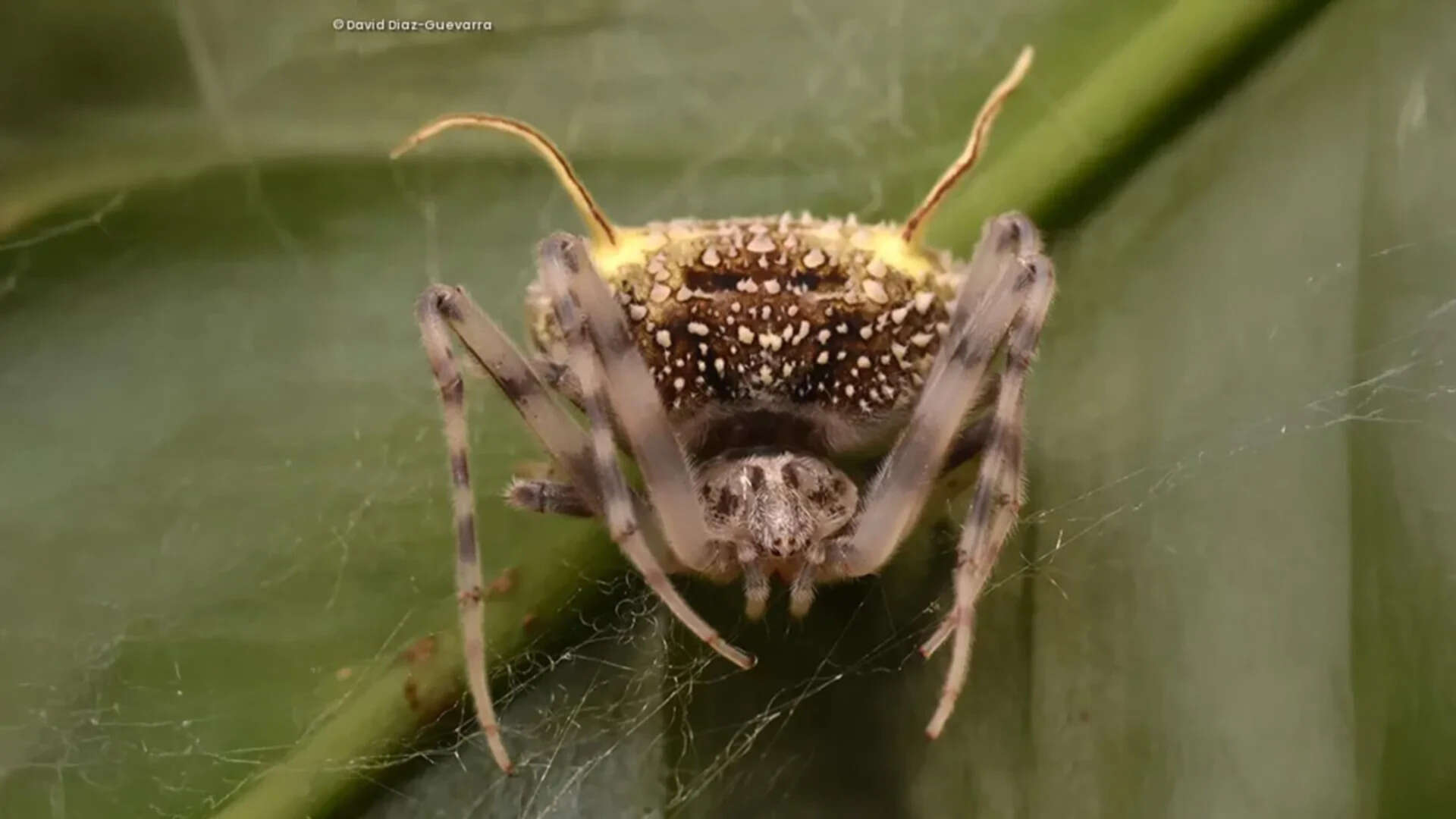
What Bentley actually stumbled upon was not a victim of a horrific parasite, but a master of an entirely new psychological game. This creature, later formally described by biologist David Ricardo Díaz-Guevara and arachnologist Nadine Dupérré as Taczanowskia waska, is a newly discovered species of spider. It is the first spider known to science that actively mimics the exact organism that brutally hunts its own kind.
Evolutionary biology teaches us that animals usually hide by blending into background noise. They look like twigs, bird droppings, or dead leaves. But Taczanowskia waska chose a different strategy. It evolved to look like a nightmare.
The strategy is a brilliant piece of behavioral misdirection. Consider the world from the perspective of a wandering predator, like a bird or a larger wasp, hunting through the foliage. You see a plump, juicy spider, and you eat it. But if you see a carcass covered in a flesh-eating, parasitic fungus, you avoid it entirely. The fungus is toxic, empty of nutrients, and dangerous. By carrying two fleshy, elongated growths called tubercles on its back that perfectly resemble fungal stalks, the spider creates an evolutionary forcefield. It transforms itself into something repulsive.
But the disguise is not just defensive. It is a trap.
Most spiders are architects. They build intricate silk webs, waiting for the vibration of a trapped insect to signal dinner. Taczanowskia waska does away with all of that. It does not weave webs. Instead, it relies entirely on patience and the absolute certainty of its camouflage.
Imagine an unsuspecting fly buzzing through the dense undercanopy. It sees a spot under a leaf that appears to hold nothing but a dead, fungus-covered spider. There is no web to avoid. There is no active predator in sight. The fly drops its guard and lands nearby.
The spider waits in total immobility, mimicking the stillness of death. Then, when the prey steps within striking distance, the illusion shatters. The spider uses two greatly enlarged claws on its front legs to snatch the insect directly out of the air. It is a lethal ambush executed by an animal playing the role of a decaying corpse.
Discovering this creature required a breakdown of traditional scientific barriers. After Bentley took photos of the strange animal, he did not immediately hide them away in an academic journal. He uploaded them to iNaturalist, a citizen-science platform where amateur naturalists, hobbyists, and global experts congregate.
Online communities parsed the images. They noticed the subtle alignment of the legs, the distinct shape of the eyes, and realized that this was not a fungus-ridden corpse but an undocumented arachnid. The discovery bypassed the traditional, slow-moving channels of isolated fieldwork, jumping straight into a global, collaborative effort.
The Amazon is shrinking, and with it, the quiet, bizarre histories written over millions of years of evolution are disappearing before we even know they exist. We often look at nature as a struggle of strength against strength, or speed against speed. But under a single leaf in Ecuador, a tiny creature proves that sometimes the ultimate survival strategy is simply becoming the thing everyone is afraid to touch.