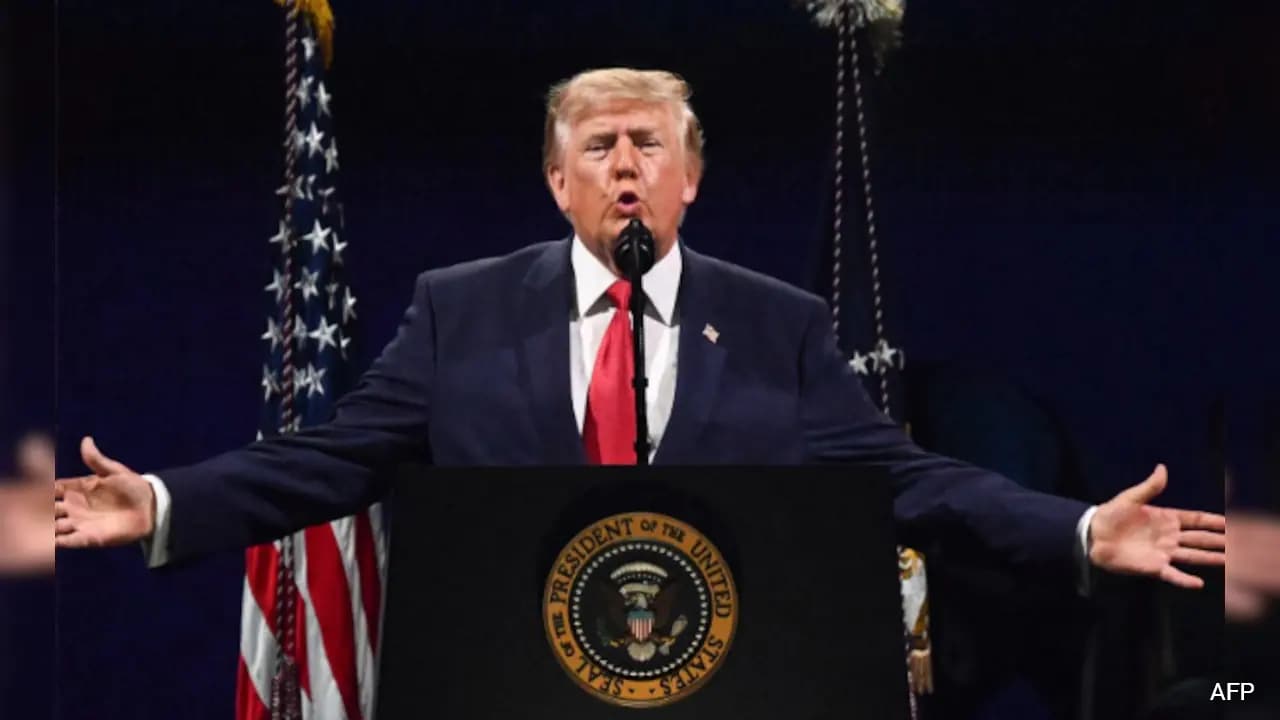
A detailed analysis by blockchain intelligence firm Nansen confirms that 988,905 retail buyers of the $TRUMP memecoin have lost a collective $3.81 billion. Concurrently, President Donald Trump’s official financial disclosures reveal he personally extracted $636 million from the exact same token over the course of 2025. This historic asymmetry represents a fundamental transformation in modern political finance. While nearly one million individual accounts watched their portfolios plummet by 97% from the token's peak, a sophisticated network of corporate shells guaranteed that the sitting president profited on every single transaction, regardless of market direction.
The mechanism was completely legal. By embedding royalty agreements directly into the underlying smart contracts and routing trading volumes through entities he controls, Trump established a financial structure that decoupled his personal gains from the actual performance of the asset. This was not a standard speculative market bubble. It was an engineered yield engine powered by political loyalty and a calculated regulatory void.
The Financial Architecture of the Royalties
To understand how a token can lose nearly all its value while its figurehead walks away with over half a billion dollars, one must dissect the transactional mechanics. The $TRUMP token launched on the Solana blockchain on January 17, 2025, precisely three days before the second inauguration. Within hours, intense buying pressure drove the price from pennies to a peak of $75.35, pushing the fully diluted market capitalization beyond $75 billion.
Most retail buyers assumed their financial interests aligned with the creator. They did not.
Every time an investor purchased or sold the token on a decentralized exchange, a built-in transaction fee was triggered. A percentage of the total transaction volume automatically routed back to the issuer. According to the June 30 financial disclosures filed with the U.S. Office of Government Ethics, this single stream brought in $636 million for Trump throughout 2025.
He did not need the token price to stay high. He only needed people to trade it.
[Retail Trade Triggered] ──> [Smart Contract Executes] ──> [Automated Royalty Skimmed] ──> [CIC Digital LLC]
                                      │
                                      └──> [Remaining Value Declines for Retail Buyer]
The volume was sustained through aggressive promotion on Truth Social and X. Direct calls to action urged supporters to acquire the coin immediately. This constant stream of promotional material generated the necessary liquidity for early institutional allocators to exit their positions, leaving retail buyers holding the depreciating asset. By the middle of 2026, the coin had collapsed to $1.76. A $10,000 investment made on inauguration day was reduced to roughly $364, yet every panic-sale that contributed to this decline generated further royalty fees for the Trump family.
Inside the Corporate Shells and Vesting Pipelines
The capital did not flow directly into a personal bank account. It moved through a sophisticated corporate network designed to shield the operation from conventional political scrutiny. Two primary entities handle the token supply and revenue distribution: CIC Digital LLC and Fight Fight Fight LLC.
Of the one billion total tokens minted at genesis, these two entities retained a staggering 80% of the entire supply. Only 20% was made available to the public during the initial offering. This extreme concentration of supply gave the internal entities absolute control over the market dynamics.
To prevent an immediate, catastrophic market crash that would destroy trading volume, the entities implemented a three-year unlock schedule. This release pipeline injects approximately 900,000 new tokens into the circulating market every single day.
The math is brutal for the average holder. This constant, artificial dilution creates unrelenting downward pressure on the token price. Even if organic demand remained steady, the daily influx of programmatic supply systematically devalues existing holdings. For the corporate entities, however, these daily unlocks represent a steady liquidation pipeline, turning digital code into hard cash on a rhythmic, daily basis.
A separate study by Chainalysis highlighted the stark divide inside this ecosystem. It discovered that just 58 early traders managed to secure profits exceeding $10 million each by executing precise exits during the initial hype phase. These entities were not mom-and-pop retail investors. They were highly sophisticated, quantitative trading desks capable of identifying the liquidity peaks and dumping millions of tokens onto the market before the retail base realized the top was in.
A Targeted Regulatory Vacuum
The timing of this multi-billion-dollar extraction coincided with a sweeping transformation of federal financial oversight. As the token was actively draining capital from retail portfolios, the administration was systematically pulling back the regulatory apparatus that traditionally governs speculative financial products.
Since early 2025, the Securities and Exchange Commission has dropped or paused approximately 60% of its active crypto enforcement actions. Major, multi-year litigation against dominant industry platforms like Binance, Coinbase, and Kraken suddenly slowed or entered indefinite administrative stasis. This policy pivot effectively removed the threat of federal intervention for localized token issuance.
The legislative strategy further insulated the project. In July 2025, the administration signed the GENIUS Act into law. The statute was widely praised by institutional market participants for establishing a clear, federal framework for stablecoins and tokenized bank deposits. It provided the legal certainty Wall Street required to move billions into digital assets.
Yet, the law contained a glaring, intentional omission. It lacked any provisions or consumer protections addressing memecoins, highly volatile speculative assets, or digital tokens issued directly by elected officials.
This legislative omission created an asymmetrical regulatory environment. Across the Atlantic, the European Union’s Markets in Crypto-Assets regulation enforced strict disclosure mandates, capital reserves, and consumer protection laws on any entity marketing digital tokens to the general public. The American market, by contrast, left retail buyers entirely exposed to the structural mechanisms of the $TRUMP smart contracts.
Capital and Personal Access at the Virginia Gala
The financial boundaries blurred completely on May 22, 2025. Trump hosted a private, black-tie gala at his Trump National Golf Club in Sterling, Virginia. The entry requirement was simple but incredibly expensive: attendees had to be among the top 220 holders of the $TRUMP token.
To secure an invitation, these individuals had spent a combined $148 million acquiring the coin. The event effectively turned financial speculation into a direct conduit for elite political access. Outside the gates, protest groups gathered to voice opposition to the unprecedented blending of executive power and private token promotion. Inside, high-net-worth individuals mingled directly with the sitting president.
A deep forensic wallet analysis conducted by Bloomberg revealed that 19 of the top 25 wallets associated with the coin were controlled by entities based outside the United States. Among the prominent guests was Chinese-born crypto executive Justin Sun, the coin’s single largest external holder. At the exact time of the dinner, Sun was facing complex fraud charges brought by the SEC. Within weeks of the event, the agency’s case against his affiliates was quietly paused.
This correlation raises profound legal and ethical dilemmas that traditional campaign finance laws are unequipped to handle. Foreign nationals are strictly prohibited from contributing to American political campaigns. However, no such framework prevents a foreign billionaire from buying hundreds of millions of dollars worth of a memecoin on a decentralized network, pushing up trading volumes, generating massive transaction fees for the president’s private company, and securing an exclusive seat at a private presidential gala.
The Broader Billion Dollar Crypto Portfolio
The memecoin was only one component of a much larger, highly coordinated financial enterprise. The 2025 Office of Government Ethics filing reveals that the Trump family’s aggregate crypto-related revenue exceeded $1.435 billion for the year.
The second major pillar of this operation was World Liberty Financial, a decentralized finance startup established by Trump, his sons, and a network of close business partners in late 2024. The venture commercialized its own token, $WLFI.
The internal corporate architecture of World Liberty Financial was even more favorable to the insiders than the memecoin project. The underlying corporate charters mandate that Trump-owned entities receive 75% of all token sales revenue after basic operational expenses are deducted. The asset followed an identical trajectory to its memecoin predecessor. Following a brief period of intense public promotion from the family's personal media accounts, the price crashed, leaving 85% of traceable retail buyers with significant capital losses.
Simultaneously, Melania Trump launched her own independent token asset, $MELANIA, on January 19, 2025. Her asset brought in an additional $6 million in revenue through integrated digital collectibles and high-percentage royalty structures.
When confronted by reporters regarding the ethics of extracting over a billion dollars from retail supporters via unbacked digital tokens, the executive response was dismissive. Trump asserted that external funds manage his money and pointed out that he possessed immense wealth long before entering public office. White House Deputy Press Secretary Anna Kelly supported this position, stating that the administration's actions are designed to transform the nation into the undisputed crypto capital of the world.
Legislative Pushback and Future Civil Vulnerabilities
The scale of the retail devastation has triggered intense political friction in Washington. Senator Kirsten Gillibrand has launched a legislative campaign to introduce comprehensive ethics reforms specifically targeting the digital asset space. The proposed framework seeks to establish an absolute federal ban prohibiting all sitting elected officials, along with their spouses, from issuing, sponsoring, or directly profiting from private digital assets or memecoins.
The legislative battle faces immense resistance from a heavily unified congressional crypto caucus. Critics of the proposed ban argue that it unfairly limits the economic freedom of public servants and stifles domestic financial technology experimentation. Gillibrand and her co-sponsors counter that without explicit statutory guardrails, the basic integrity of public office collapses into an unchecked vehicle for systemic self-dealing.
While criminal prosecution remains a legal impossibility due to broad executive immunities and the deliberate rollback of SEC enforcement parameters, the post-presidential outlook contains significant legal liabilities.
A coalition of corporate litigation firms is already aggregating transactional data from the nearly one million underwater wallets. Legal scholars specialize in consumer protection law note that while the regulatory environment remains highly permissive, the explicit use of personal media channels to repeatedly urge retail followers to buy a highly diluted asset could form the foundation for historic class-action fraud and misrepresentation lawsuits once the shield of executive office is removed. The underlying blockchain ledgers provide an immutable, unalterable map of every transaction, every fee extracted, and every dollar lost.
The money has already moved. The $3.81 billion lost by retail buyers cannot be easily recovered through legislative debates or delayed civil filings. It sits securely inside private corporate accounts, a stark testament to a political era where influence is no longer just leveraged for votes, but programmatically monetized through the blockchain.