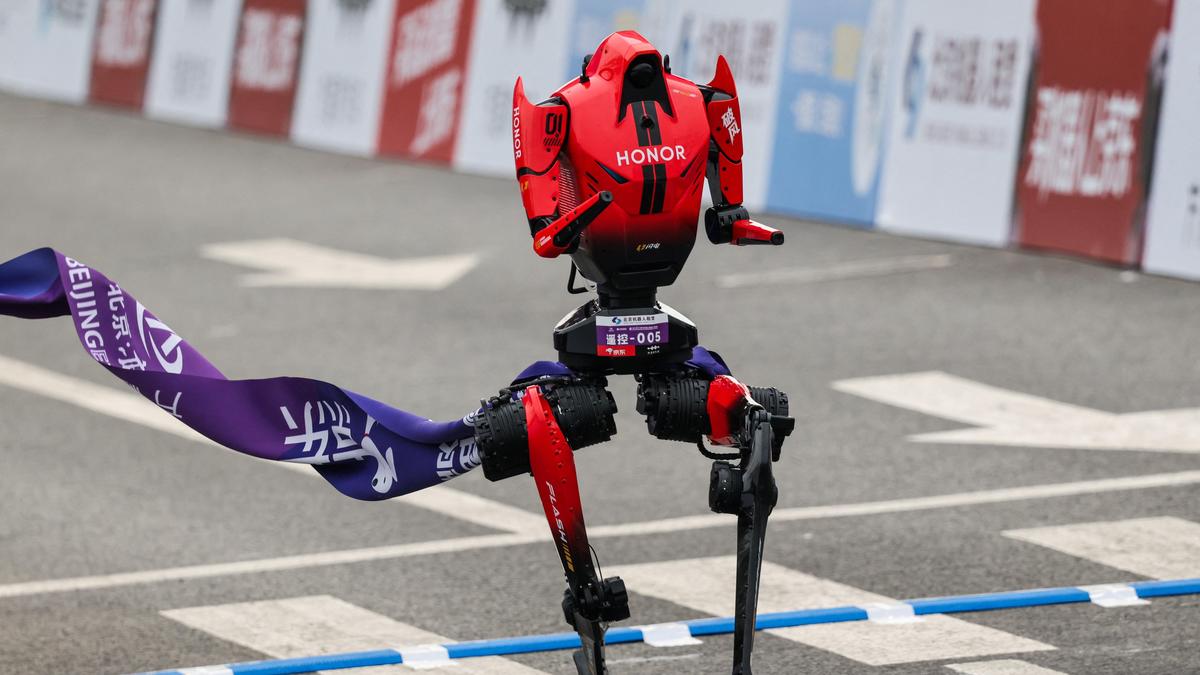
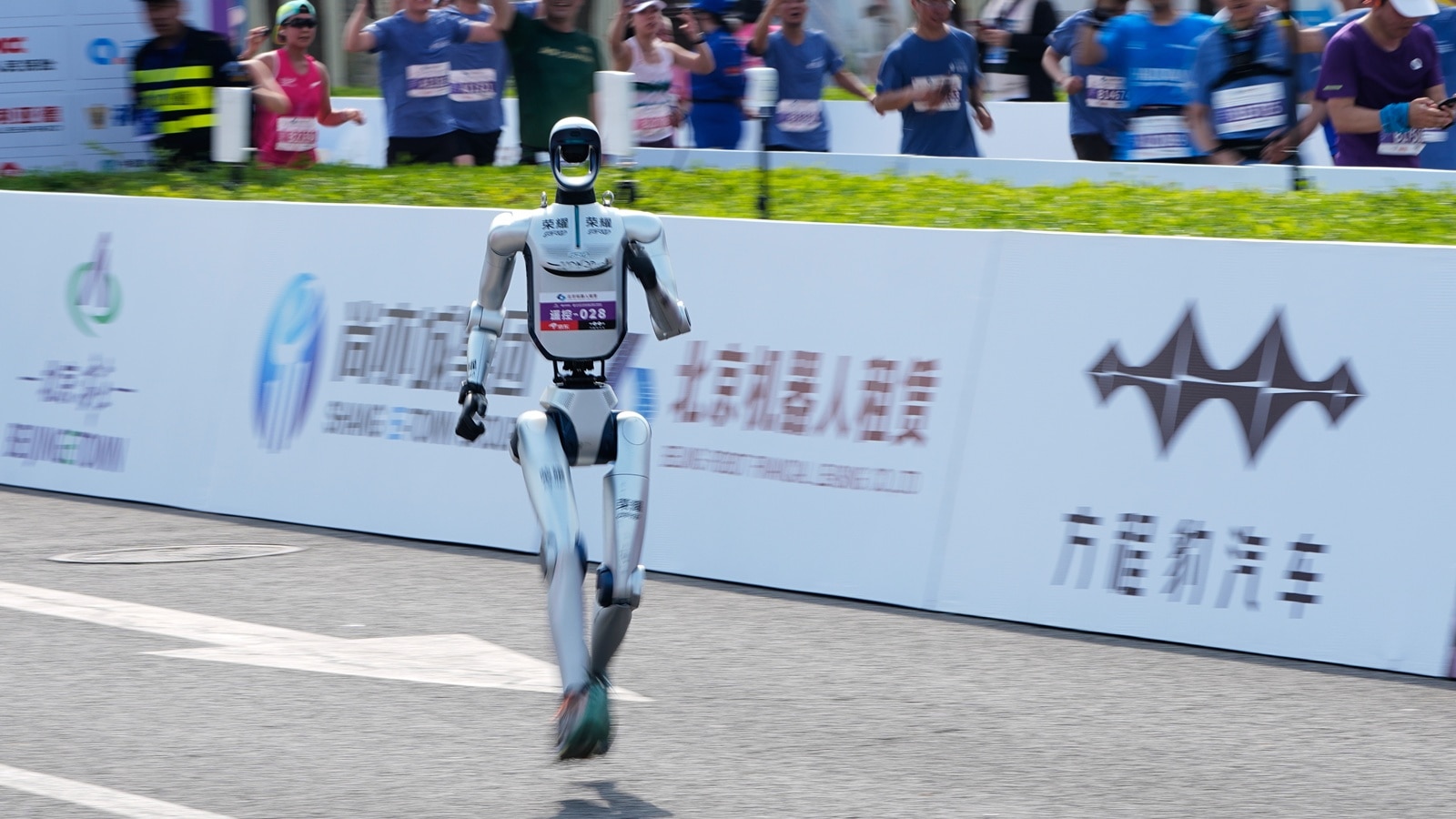
The recent completion of a half-marathon distance by a humanoid robot in Beijing, allegedly surpassing the human world record time, marks a shift from experimental robotics to the era of operational kinetic parity. While public discourse focuses on the spectacle of the "race," a rigorous analysis reveals that this achievement is not a victory of "effort" but a successful optimization of energy density and structural endurance. The human world record of 57:31 for a half-marathon, held by Jacob Kiplimo, represents a biological peak governed by oxygen transport, thermoregulation, and metabolic waste clearance. The robotic equivalent represents a engineering peak governed by torque-to-weight ratios and the mitigation of mechanical hysteresis.
The Triad of Bipedal Performance Optimization
To understand how a machine displaces a human athlete at this distance, we must analyze the three distinct layers of bipedal efficiency: the mechanical advantage of the chassis, the power-to-mass ratio of the energy system, and the algorithmic control of the gait cycle.
1. Mechanical Structural Integrity and Compliance
Humans are limited by the fatigue life of biological tissues. In a 21.1 km run, a human athlete experiences approximately 15,000 ground impact cycles. Each impact sends a shockwave through the musculoskeletal system, requiring muscular contraction to stabilize joints. This results in eccentric muscle loading, leading to micro-tears and glycogen depletion.
The Beijing humanoid utilizes high-torque density actuators and carbon-fiber structural components. Unlike human bone and tendon, these materials do not suffer from acute inflammatory responses. The "compliance" in a robot—how it absorbs impact—is a programmable variable. By utilizing regenerative braking logic in the actuators during the swing phase, the robot can recover energy that a human dissipates as heat.
2. The Thermal Dissipation Bottleneck
The primary constraint on human endurance is not the legs, but the radiator. Human muscles are roughly 20-25% efficient; the remaining 75-80% of energy is converted into heat. At elite speeds, the body's ability to shed this heat through evaporation (sweating) becomes the hard ceiling on performance. If the core temperature rises too high, the central nervous system throttles power output to prevent organ failure.
Robotic systems decouple power from thermal management. Using active liquid cooling or high-surface-area heat sinks, a humanoid can maintain peak power output indefinitely. The robot does not "hit the wall" because it lacks the biological feedback loops that prioritize survival over speed.
3. Algorithmic Gait Precision
Elite runners strive for a "metabolic cost of transport" ($CoT$), defined as the energy required to move a unit of mass over a unit of distance. Human $CoT$ varies based on fatigue; as a runner tires, their form degrades, vertical oscillation increases, and efficiency drops.
$$CoT = \frac{E}{m \cdot d}$$
Where $E$ is energy, $m$ is mass, and $d$ is distance. A humanoid robot maintains a mathematically optimized gait for the duration of the event. By keeping the center of mass trajectory almost perfectly linear, the machine eliminates the "leaking" of kinetic energy common in human biomechanics.
Quantifying the Advantage: Silicon vs. Sarcoplasm
A comparison of the operational variables between an elite human and the Beijing humanoid reveals why the "world record" was an inevitable milestone rather than a surprise.
- Sustained Power Output: An elite marathoner maintains roughly 4-5 Watts per kilogram (W/kg). Current high-performance electric actuators can exceed this for short durations, but the challenge has always been the battery. The Beijing breakthrough suggests a leap in battery discharge consistency and motor efficiency.
- Actuation Latency: The human neural conduction velocity is approximately 100 meters per second. A robot’s control loop operates at the kilohertz level (1,000+ cycles per second). This allows the robot to adjust its balance and foot placement 10 to 50 times faster than a human, reducing the energy wasted on minor stumbles or surface irregularities.
- Mass Distribution: Humans carry significant "dead weight" in the upper body (organs, arms, head) that does not contribute directly to propulsion. Modern humanoid designs concentrate mass in the pelvis and torso, with low-inertia limbs. This reduces the energy required to swing the legs forward, a major component of the total energy cost of running.
The Cost Function of Legged Robotics
Despite the headline-grabbing speed, the Beijing humanoid faces a "Cost Function" that humans have solved over millions of years of evolution. The trade-off between stability and speed is the primary friction point in robotics.
The "Zero Moment Point" (ZMP) theory remains the foundational framework for this stability. To keep the robot from falling, the point where the total inertia force equals the ground reaction force must stay within the "support polygon" (the area of the foot on the ground). Running is essentially a series of controlled falls where the support polygon disappears during the flight phase.
The achievement in Beijing proves that the Control Distribution algorithms have matured. The robot is no longer just reacting to the ground; it is predicting the optimal landing vector to maximize forward thrust while maintaining a dynamic equilibrium. This requires massive onboard compute power, which itself consumes energy, creating a feedback loop: more compute requires more battery, which adds mass, which increases the energy required to run.
Strategic Implications for Non-Human Kinetic Assets
The successful "beating" of a human record in a high-impact, high-endurance environment like a half-marathon signals that bipedal robots have exited the "uncanny valley" of mobility. The implications extend far beyond the sports track.
Logistics and Last-Mile Delivery
The half-marathon test proves that a bipedal chassis can navigate 21 kilometers of varying terrain without mechanical failure. This validates the humanoid form factor for environments designed for humans—stairs, curbs, and narrow hallways—where wheeled robots fail.
Industrial Endurance
Humans are "shift-based" assets. A robot capable of a sub-hour half-marathon possesses the mechanical stamina to operate for 20+ hours daily in a warehouse or factory setting. The "record" is merely a stress test for the durability of the joints and the reliability of the software stack.
Defense and Search-and-Rescue
The ability to sustain high speeds over long distances allows for rapid deployment in areas inaccessible to vehicles. If a robot can run at 20 km/h for an hour, it can cover terrain that would take a human search team four hours to traverse, specifically in high-altitude or toxic environments where human biology is a liability.
The Reality of the Record: A Categorical Error
It is critical to distinguish between a "human record" and a "robotic benchmark." While the media frames this as a competition, it is actually a comparison of two different physics engines.
Human records are a measure of biological willpower and genetic lottery. Robotic records are a measure of iterative engineering and power density. The Beijing robot didn't "beat" Kiplimo; it rendered the comparison obsolete. We are moving toward a bifurcated view of performance where "natural" records will be protected for cultural value, while "synthetic" records will be used to measure the rate of technological acceleration.
The next barrier is not speed, but versatility. The robot that ran the half-marathon was likely optimized for a flat, paved surface. The true "masterclass" in robotics will be a machine that can run a sub-hour half-marathon and then immediately navigate a complex construction site or climb a ladder.
The strategic priority for developers is now the "Universal Locomotion Controller"—a single neural network capable of handling all terrains and speeds without manual tuning. Once the software can generalize movement as effectively as the hardware can execute it, the gap between human and machine capability will not just be wide; it will be unbridgeable. Organizations should stop viewing humanoids as "experimental" and start integrating them into long-range infrastructure planning. The hardware is no longer the bottleneck; the deployment logic is.