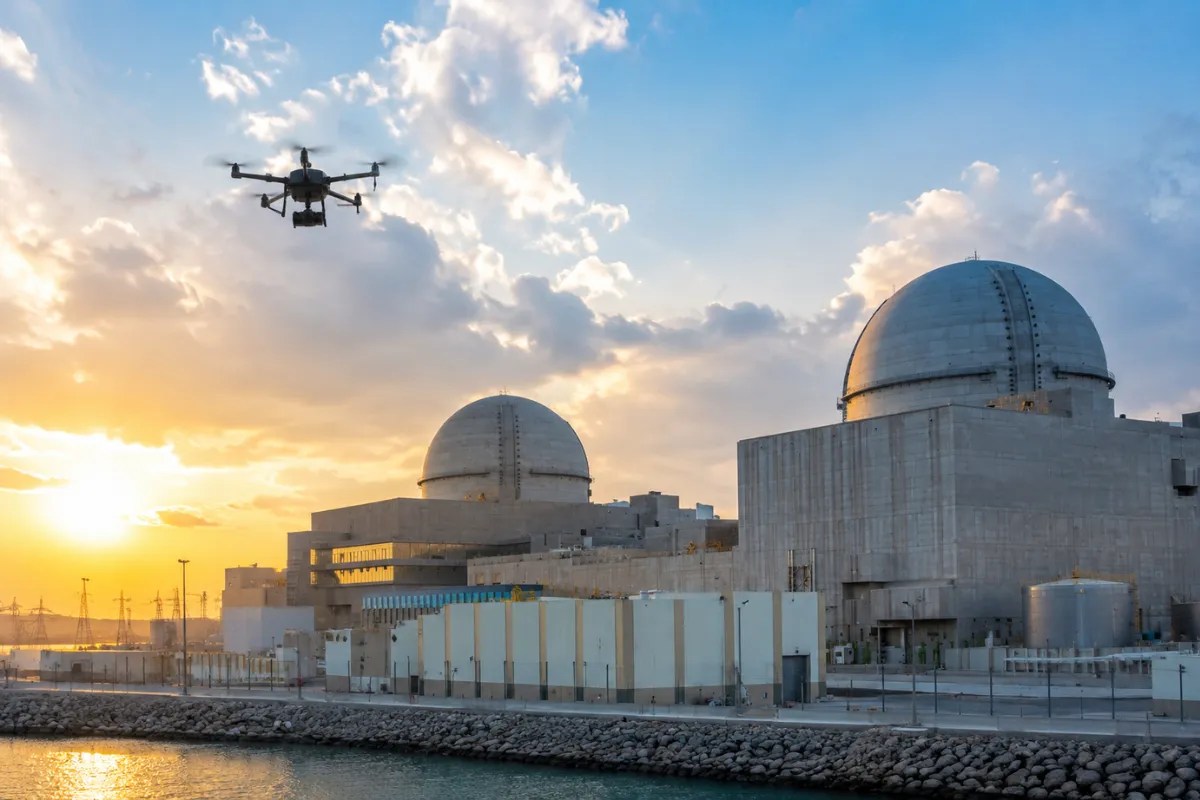
The desert wind near Al Ruwais usually carries nothing but the scent of salt from the Persian Gulf and the fine, abrasive dust of the Empty Quarter. It is a place of engineered silence. Here, the Barakah Nuclear Power Plant stands as a monument to human ambition, its four massive containment domes rising like white ribcages against the hazy horizon. Inside those domes, atoms split in a controlled, rhythmic dance, generating enough electricity to power millions of homes without a single puff of carbon smoke.
But silence in the modern age is often an illusion.
High above the shimmering heat haze, something small, plastic, and profoundly indifferent was humming. It wasn't a bird. It wasn't a commercial airliner. It was a drone—a collection of off-the-shelf electronics and high-grade explosives—navigating via satellite toward the heart of the United Arab Emirates’ energy future. In that moment, the gap between a peaceful morning and a regional catastrophe was measured in a few hundred meters of airspace.
The Fragility of the Fortress
We like to believe that billion-dollar infrastructure is invincible. We surround these sites with concrete walls thick enough to withstand a direct hit from a Boeing 747. We staff them with elite security forces and monitor them with the most advanced sensors money can buy. Yet, the arrival of the drone changed the math of warfare forever. It democratized destruction.
Consider the perspective of a technician on a standard morning shift. Let’s call him Omar. He isn't thinking about geopolitics or the long-standing tensions between regional powers. He is looking at a cooling system gauge, ensuring that the water flowing through the secondary loop remains within a fraction of a degree of its target. To Omar, the plant is a living thing that needs to be breathed for.
Then the alarms triggered. Not the slow, methodical siren of a pressure deviation, but the sharp, frantic staccato of a perimeter breach.
The drones used in these types of incursions are often no larger than a kitchen appliance. They are difficult to track on traditional radar designed to spot fighter jets. They move low. They move slow. By the time the UAE’s defense systems identified the threat, the stakes had shifted from a hypothetical security concern to an existential crisis. If a drone hits a containment building, the concrete likely holds. But if it hits a transformer, a cooling pump, or the spent fuel pools outside the main dome?
The result isn't just a power outage. It’s a psychological scar on a nation.
A Sovereignty Built on Stability
The United Arab Emirates has spent decades cultivating a specific image: the safe harbor. In a region often defined by volatility, the UAE marketed itself as the place where the world comes to trade, vacation, and build. This reputation is its most valuable currency. When an explosive-laden drone enters the airspace of a nuclear facility, it isn't just targeting turbines and reactors. It is targeting the very idea of Emirati stability.
Abu Dhabi’s response was swift and lacked the usual diplomatic fluff. They called it a "vile attack" on their sovereignty. They promised a "crushing response."
Why the intensity? Because the UAE knows that the era of "gray zone" warfare has arrived. This isn't a declared war with tanks crossing a border. It is a war of shadows, where non-state actors or proxy militias use cheap technology to harass a wealthy state. It is a mosquito trying to kill an elephant by finding the one spot where the hide is thin.
The drone didn't succeed in causing a meltdown. The defenses held, and the reactor remained untouched. But the message was delivered with surgical precision: We can touch you anywhere.
The Physics of the Threat
To understand why this is so terrifying, we have to look at the geometry of a nuclear site. A plant like Barakah is a masterpiece of redundancy. It has backups for its backups. But those systems rely on a stable external environment. When you introduce an unpredictable aerial threat that can bypass a five-meter-tall fence as if it weren't there, you force the security apparatus to rethink everything.
Traditional air defense is like trying to catch a fly with a sledgehammer. Launching a million-dollar interceptor missile at a drone that costs five thousand dollars is a losing game of attrition.
The UAE has been investing heavily in "soft-kill" technologies—electronic jamming systems that sever the link between the drone and its pilot, or high-energy lasers that can cook a circuit board in mid-air. But technology is an arms race that never ends. For every new jammer, there is a new autonomous flight path that doesn't require a remote signal.
The invisible stakes here aren't just about radiation. They are about the global energy transition. If nuclear plants—the backbone of many countries' plans to reach "Net Zero"—become seen as liabilities or "soft targets" for terrorists, the political will to build them will evaporate. One lucky drone strike in the desert could effectively end the nuclear renaissance in the West.
The Human Cost of the "Almost"
We often gloss over the "near miss." We see a headline that says "missile intercepted" or "attack thwarted" and we move on to the next notification. We shouldn't.
Every time a drone is intercepted over a facility like Barakah, a thousand tiny fractures appear in the public’s sense of safety. The people living in the gleaming towers of Abu Dhabi or the villas of Al Ruwais look at the horizon differently. They wonder if the lights will stay on. They wonder if the air they breathe will remain clean.
The UAE’s vow to give a "fitting response" isn't just about revenge. It is about re-establishing the deterrent. In the cold logic of international relations, if you don't hit back, you invite the next strike. The drones represent a test of resolve. If the response is seen as weak, the drones will return, perhaps in greater numbers, perhaps with more sophisticated payloads.
The Silence Returns
Eventually, the sirens at Barakah stopped. The smoke from the intercepted debris cleared, and the desert sun continued its relentless bake of the Arabian Peninsula. The reactors continued to hum. Omar went back to his gauges.
But the silence is different now. It is heavier.
The attack on the Abu Dhabi nuclear plant serves as a preview of the 21st century’s primary conflict: the struggle between high-tech civilization and the low-tech disruptors who wish to dismantle it. We are living in a time where a teenager with a joystick and a few grams of plastic explosive can threaten the energy security of a superpower.
As the UAE reinforces its skies and its borders, the world watches. We are all searching for the same thing: a way to protect our brightest achievements from the small, buzzing shadows that refuse to go away. The desert is quiet for now, but in the distance, just beyond the range of human hearing, the hum remains.