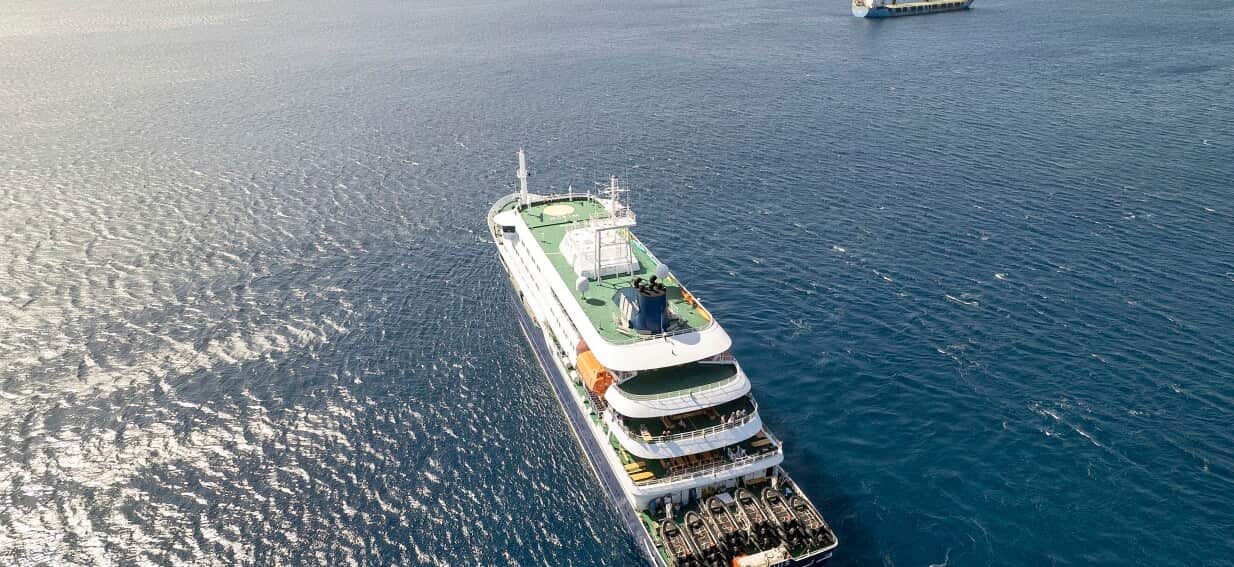
The air conditioning hummed with a clinical, rhythmic vibration that usually promised comfort. For the three thousand souls aboard the Grand Horizon, it was the sound of luxury. It meant the Caribbean heat stayed on the other side of the glass. But for a family in Cabin 402, the air began to feel heavy. It wasn't the humidity. It was the dawning realization that something—something small, silent, and ancient—had come aboard without a ticket.
When news broke that three passengers had died on a high-end cruise liner, the headlines scrambled for a culprit. Was it the buffet? A freak wave? The truth was far more unsettling. The enemy wasn't a shark or a storm. It was a virus named for a river in Korea, carried by creatures that haunt the dark corners of rural outbuildings and dusty sheds.
Hantavirus.
To understand why this matters, you have to look past the sterile laboratory reports and see the human cost. Imagine a man named Elias. He is healthy, active, and sixty. He spent his retirement traveling. He didn't die of a heart attack or a fall. He died because his lungs filled with fluid, a biological betrayal that turned his own immune system into an aggressor.
The Ghost in the Dust
We often think of viruses as urban monsters. We fear the subway sneeze or the crowded office elevator. Hantavirus flips that script. It is a virus of the wilderness, of the quiet spaces where humans and rodents overlap. It doesn't travel through the air because someone coughed; it travels because a deer mouse scurried across a shelf in a long-closed cabin.
The virus lives in the saliva, urine, and droppings of specific rodent species. When those waste products dry out, they become a fine, invisible dust. If you sweep that dust, or if a ventilation system kicks it into the air, you breathe it in.
On a cruise ship, the "wilderness" feels a world away. Yet, logistics are a complex web. Supplies are moved from rural warehouses. Crates are stored in shadowed docks. Somewhere in the chain, the boundary between the wild and the refined collapsed. A single contaminated pallet or a stowaway rodent in a dry-storage locker is all it takes to turn a vacation into a tragedy.
A Slow Burn and a Sudden Storm
The cruelty of Hantavirus Pulmonary Syndrome (HPS) lies in its timing. It is a master of disguise. For the first few days, it looks like nothing more than a stubborn flu. You feel tired. Your muscles ache, particularly those large groups in the thighs, hips, and back. You might have a headache or a chill.
If Elias were sitting across from you, he would tell you he thought he just needed a nap. He’d tell you the motion of the ship was making him a bit queasy. But then, the window of opportunity slams shut.
Four to ten days after the initial symptoms, the second phase begins. This is the "leakage" phase. The virus attacks the tiny capillaries in the lungs, causing them to weep fluid directly into the air sacs. Suddenly, the patient is gasping. It feels like drowning on dry land. There is no cough that can clear it. There is no deep breath deep enough to satisfy the hunger for oxygen.
In the case of the three passengers who perished, the progression was likely relentless. Medical staff on ships are skilled, but they are equipped for broken bones, norovirus, and heart episodes. HPS requires the kind of intensive, high-pressure ventilation usually found only in major urban trauma centers. When you are a hundred miles from the nearest coast, the stakes become infinite.
The Math of Survival
Let’s be blunt about the numbers, because the numbers are terrifying. Hantavirus is not the common cold. It is not even COVID-19. While the latter has a high transmission rate but a lower case-fatality rate, Hantavirus is its opposite. It is hard to catch, but if you do, the odds are grim.
The mortality rate for Hantavirus Pulmonary Syndrome hovers around 38%.
Think about that. Nearly four out of every ten people who contract the respiratory form of the virus do not survive. It is one of the most lethal pathogens currently circulating in the Western Hemisphere. The reason we don't live in a state of constant panic is that it does not spread from person to person. If you are sitting next to someone with Hantavirus, you are safe. You cannot catch it from their breath or their touch.
You only catch it from the ghost in the dust.
The Misconception of Safety
There is a recurring myth that Hantavirus is a "poor person’s disease" or something restricted to the Southwestern United States. The deaths on the cruise ship shattered that illusion. While the Sin Nombre strain—the most famous version—was first identified in the Four Corners region of the US, various strains exist globally.
In South America, some strains have even shown rare evidence of person-to-person transmission, though the cases on the cruise ship were linked to the more common environmental exposure. The ship itself becomes a closed ecosystem. If the virus enters the HVAC system or is concentrated in a specific cargo hold, the luxury of the environment provides no shield.
The ship’s crew likely worked frantically behind the scenes once the connection was made. They would have been looking for the source: a nest in the lifeboats? A shipment of grain for the kitchens that had sat too long in a port-side granary? The investigation is a forensic hunt for a needle in a haystack of steel and velvet.
Protection in the Quiet Moments
So, how do we live in a world where a mouse in a shed can end a life on a cruise ship? We change how we interact with the "quiet spaces."
If you are cleaning a space that has been closed for a long time—a summer cottage, a storage unit, or even a deep-set pantry—the instinct is to grab a broom. Stop. Brooms create dust clouds. Vacuuming does the same, often venting the virus back out through the exhaust.
The professional approach is wet. You soak the area with a mixture of bleach and water. You let it sit, pinning the virus to the floor, drowning it in disinfectant before it ever has a chance to reach your lungs. You wear gloves. You wear a mask. You respect the dust.
For the travel industry, the lesson is one of rigorous, unglamorous vigilance. It’s about pest management in the supply chain that goes beyond "seeing a bug." It’s about recognizing that the most dangerous cargo isn't what's on the manifest.
The Weight of the Air
The Grand Horizon eventually docked. The remaining passengers shuffled down the gangway, their faces a mixture of relief and haunted confusion. They had paid for an escape from reality, only to find that nature’s most primitive elements can penetrate even the most sophisticated bubbles of human engineering.
The three empty chairs in the dining hall served as a silent testament. They weren't just victims of a virus; they were reminders of our fragility. We have mapped the stars and built floating cities, yet we remain subject to a biological lottery governed by the path of a rodent in the dark.
When we talk about "public health," we often speak in abstractions. We talk about policy and infrastructure. But at its heart, public health is the simple, desperate desire for the air we breathe to be life-giving rather than life-taking.
The ocean remains vast and beautiful. The ships will continue to sail. But for those who know the story of the three who didn't come home, the sound of a ventilation fan will always carry a faint, shivering note of caution. We are never as alone as we think, and the smallest creatures often carry the heaviest consequences.
The dust eventually settles, but it never truly disappears.


00128-7/asset/c466084c-91d2-4e7e-b9c9-54c0be1ccc1c/main.assets/gr1_lrg.jpg)